Maths › Area and perimeter
Area and perimeter: round the edge, then fill the middle
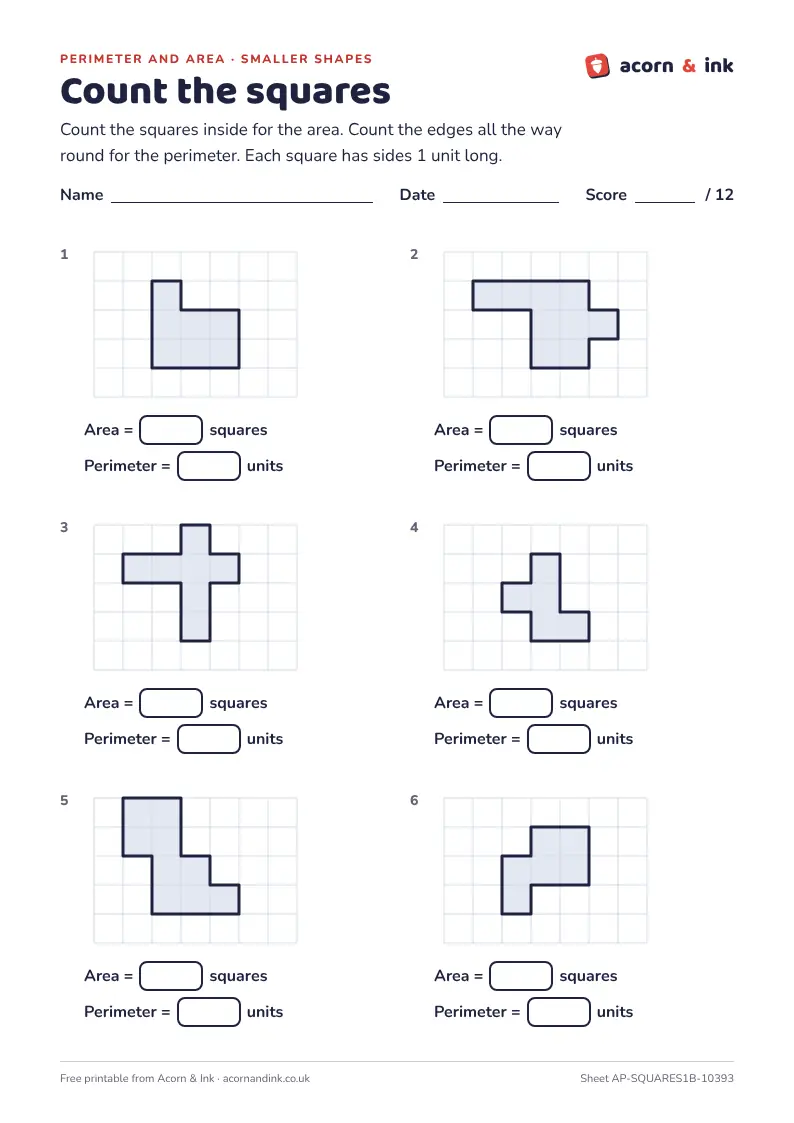
Free printable worksheets for counting squares on a grid, working out the perimeter and area of rectangles and compound shapes, comparing shapes with the same area, and finding the area of triangles and parallelograms. Every sheet comes with an answer page that shows the working in red.
Perimeter: the distance all the way round
The perimeter of a shape is the total length of its edges. Picture putting a fence round a garden: the perimeter is how much fencing you need. To find it, add up the lengths of all the sides, going all the way round and back to where you started.
Perimeter is a length, so it is measured in centimetres (cm), metres (m) and other units of length.
Area: the space inside
The area of a shape is how much flat space it covers. Picture a carpet that fits a floor exactly: the area is the size of the carpet. We measure area by counting how many squares it takes to cover the shape, with no gaps and no overlaps.
Why area units are squared
A square that is 1 cm long and 1 cm wide has an area of 1 square centimetre, written 1 cm². The small 2 is there because area always comes from two lengths, a length and a width, multiplied together. Centimetres measure how long something is. Square centimetres count how many of those little squares fit inside. Bigger spaces, such as a room or a garden, are measured in square metres (m²): squares 1 m long and 1 m wide.
Length × width for rectangles
Counting every square takes a long time. In a rectangle the squares sit in neat rows, so you can multiply instead: the number of squares in one row (the length) times the number of rows (the width).
Compound shapes: split them up
A compound shape (also called a composite shape) is made by joining simpler shapes together. An L-shape is two rectangles. To find its area, split it into rectangles, find the area of each one and add them up. There is often more than one way to split it, and every way gives the same answer.
Sometimes a side has no length marked. Look at the sides that run the same way. In the L-shape below, the bottom edge (8 cm) is as long as the two top edges together, 5 cm + 3 cm. The left edge (6 cm) matches the two right edges, 4 cm + 2 cm.
Triangles: half a rectangle
Draw a rectangle round a triangle, with the same base and the same height. The height is measured straight up from the base, at a right angle to it: this is the perpendicular height, shown as a dashed line. The dashed line splits the rectangle into two smaller rectangles, and the triangle fills exactly half of each one. So the triangle is half of the big rectangle.
Area of a triangle = ½ × base × height.
Make a sheet
Choose the kind of sheet, what to find and how hard it is, then roll for a fresh one.
Tips for parents
- Measure real things. Use a ruler or tape measure to find the perimeter of a book, a table top or a room, then work out the area. A room is a good way to meet square metres.
- Use squared paper. Draw shapes on squared paper and count the squares inside and the edges round the outside. The squared paper maker prints sheets in different sizes.
- Build shapes with square tiles or sticky notes. Make a shape from 12 tiles, then rearrange the same 12 into a different shape. The area stays the same, but the perimeter changes.
- Walk the perimeter. Run a finger, or walk, all the way round the edge of a shape. Perimeter is a journey round the outside; area is the space you would need to paint.
- Say the units out loud. “Twelve centimetres” for a perimeter, “twelve square centimetres” for an area. It helps children keep the two ideas apart.
What the National Curriculum for England says about area and perimeter:
- Year 3: measure the perimeter of simple 2-D shapes.
- Year 4: measure and calculate the perimeter of a rectilinear figure (including squares) in centimetres and metres, and find the area of rectilinear shapes by counting squares.
- Year 5: measure and calculate the perimeter of composite rectilinear shapes in centimetres and metres; work out and compare the area of rectangles (including squares) in square centimetres (cm²) and square metres (m²); and estimate the area of irregular shapes.
- Year 6: recognise that shapes with the same area can have different perimeters, and the other way round; calculate the area of parallelograms and triangles; and know when a formula for area can be used.
- Key Stage 3: work out and use formulae to calculate the perimeter and area of triangles, parallelograms and trapezia, and solve problems with them.
Source: National Curriculum in England: mathematics programmes of study (Department for Education). Crown copyright, Open Government Licence v3.0.
Questions parents ask
- What is the difference between area and perimeter?
- Perimeter is the distance all the way round the edge of a shape, like the length of a fence round a garden. Area is the space inside the shape, like the carpet that covers a floor. Perimeter is a length, measured in cm or m. Area is measured in square units, such as cm² or m².
- Why is area written in cm² and not cm?
- Area counts squares, and each square is 1 cm long and 1 cm wide. Finding an area always multiplies two lengths together, so the unit is centimetres × centimetres, written cm² and read as “square centimetres”.
- Which year groups are these worksheets for?
- They suit children aged about 7 to 12. In the National Curriculum for England, perimeter starts in Year 3, counting squares for area in Year 4, the area of rectangles and compound shapes in Year 5, and triangles, parallelograms and shapes with the same area in Year 6. The Key Stage 3 triangle sheets are good for revision and stretch.
- Why do the sheets say the diagrams are not drawn to scale?
- The shapes are drawn smaller than the lengths on their labels, so measuring them with a ruler won’t work. Children should use the numbers on the labels. The compound shapes, triangles and parallelograms keep the right proportions, so a longer side does look longer.
- Are the answers included?
- Yes. Each sheet can print with an answer page after it. It shows the answers and the working in red: the edges counted round each shape on a grid, the sums for each rectangle, the split into rectangles for compound shapes, and the area formula for each triangle and parallelogram. Choose Sheet only or Answers only under Print if you want just one of them.