English › Story dice
Story dice: roll a story, then write it
Free printable story dice and story prompts for ages 5 to 11. Cut out and fold dice for characters, settings and problems, or print a sheet that has already rolled them for you, with a story planner and prompt cards. Choose an age and a theme, and every roll gives a new story to tell.
How to play
Story dice give you the start of a story. One die rolls a character, one rolls a setting and one rolls a problem. You can add a fourth die for an object. Your job is to tell a story that uses everything you rolled.
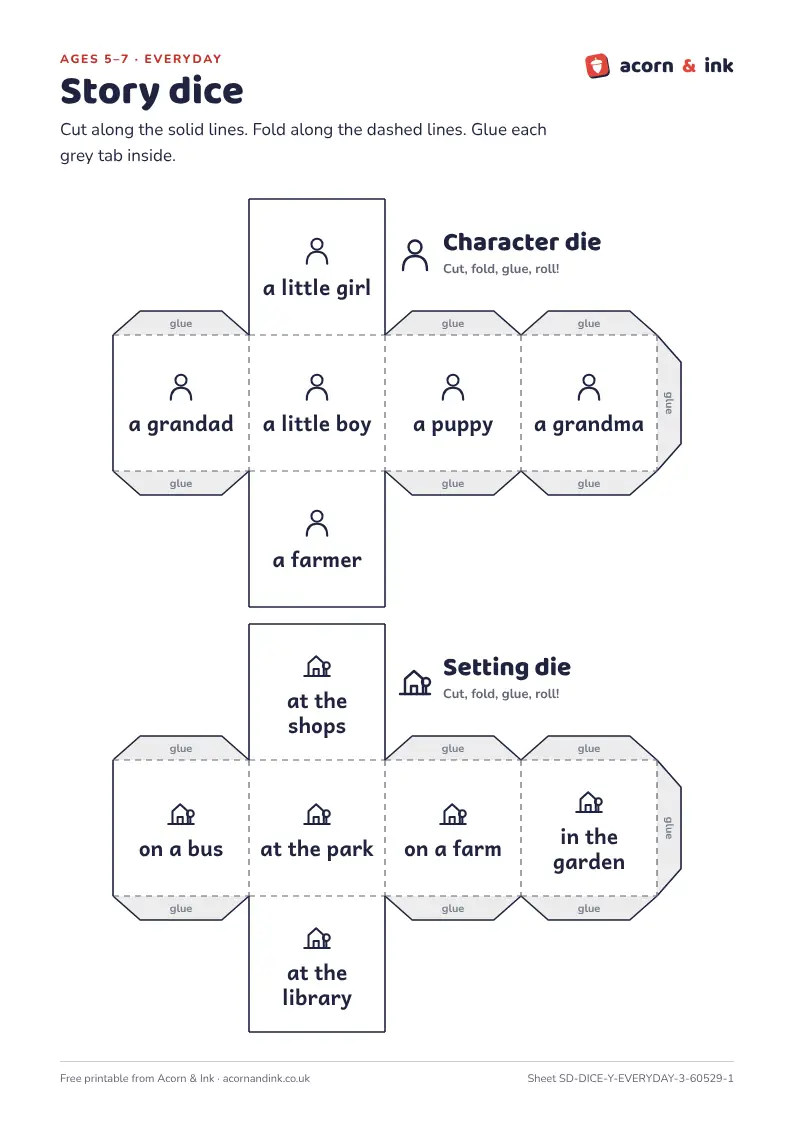
1Make the dicePrint the dice sheets, on card if you can. Cut along the solid lines, fold along the dashed lines and glue each grey tab inside.
2Roll them allRoll the dice together and read out the words on top. That’s who, where and what goes wrong.
3Tell the storySay the story out loud first. It needs a beginning, a middle where the problem happens, and an end where it gets sorted out.
Other ways to play
- Take turns. Roll the dice, then go round the table adding one sentence each until the story has an ending.
- Swap one. Halfway through, roll just one die again and change the story to fit the new word.
- Plan, then write. Roll, then fill in a story planner before writing the story out in full.
- No dice? Print a “Roll your story” sheet or a story planner, which have already rolled for you, or cut out the prompt cards and pick one of each from a pile.
Ways to use it at different ages
Ages 5–7
- Tell the story together out loud before any writing.
- Draw the beginning, middle and end, then write one sentence for each.
- Use the simpler words and the 3-box planner.
Ages 7–11
- Use the 5-part story mountain to plan before writing.
- Describe the setting so a reader can picture it.
- Show how the character feels about the problem, and how they change.
Make a sheet
Choose the kind of sheet, an age and a theme, then roll for a fresh set of story prompts.
Tips for parents
- Say it before writing it. Telling the story out loud first means the hard thinking is done before the pencil comes out.
- Let them re-roll. If a word really doesn’t spark anything, roll that one die again. The point is to get started.
- Write for them sometimes. For younger children, you can write down the story as they tell it, so the ideas aren’t held back by handwriting.
- Keep it short. A story with a clear beginning, middle and end in five sentences is a real achievement. Length can come later.
- Ask questions, don’t give answers. “How does the character feel?” or “What could the object be used for?” helps more than suggesting what happens next.
- Read it back together. Afterwards, read the story aloud and pick one sentence to make even better.
In the National Curriculum for England, writing composition includes planning from Year 1. In Year 1, pupils say out loud what they are going to write about and put sentences in order to make short narratives. In Year 2, they plan or say out loud what they are going to write about, and write stories about real and imagined experiences. In Years 3 and 4, they plan by discussing and recording ideas, and when writing narratives they create settings, characters and plot. In Years 5 and 6, they think about how authors develop characters and settings when planning their own narratives. Source: National Curriculum in England: English programmes of study (Department for Education), summarised in our own words. Crown copyright, Open Government Licence v3.0.
Questions parents ask
- What are story dice?
- Story dice are dice with words or pictures on the faces instead of spots. You roll them and use whatever lands face up, such as a character, a setting and a problem, to make up a story.
- How do I make the dice?
- Print the dice sheets at actual size, on thin card if you have it. Cut along the solid lines, fold along every dashed line, then glue each grey tab inside the cube. Each face is 36 mm square.
- What age are the story dice for?
- Ages 5 to 11 (Year 1 to Year 6). The ages 5–7 setting uses simpler words and a 3-box planner. The ages 7–11 setting has richer settings and problems and a 5-part story mountain.
- Do I need to make the dice?
- No. The “Roll your story” sheet and the story planner have already rolled a character, a setting, a problem and an object for you, and the prompt cards can be cut out and picked from a pile.
- Is it free?
- Yes. The story dice and story sheets are free to make and print, and every roll gives a new set of prompts.