Maths › Missing number sums
Missing number sums: find the hidden number
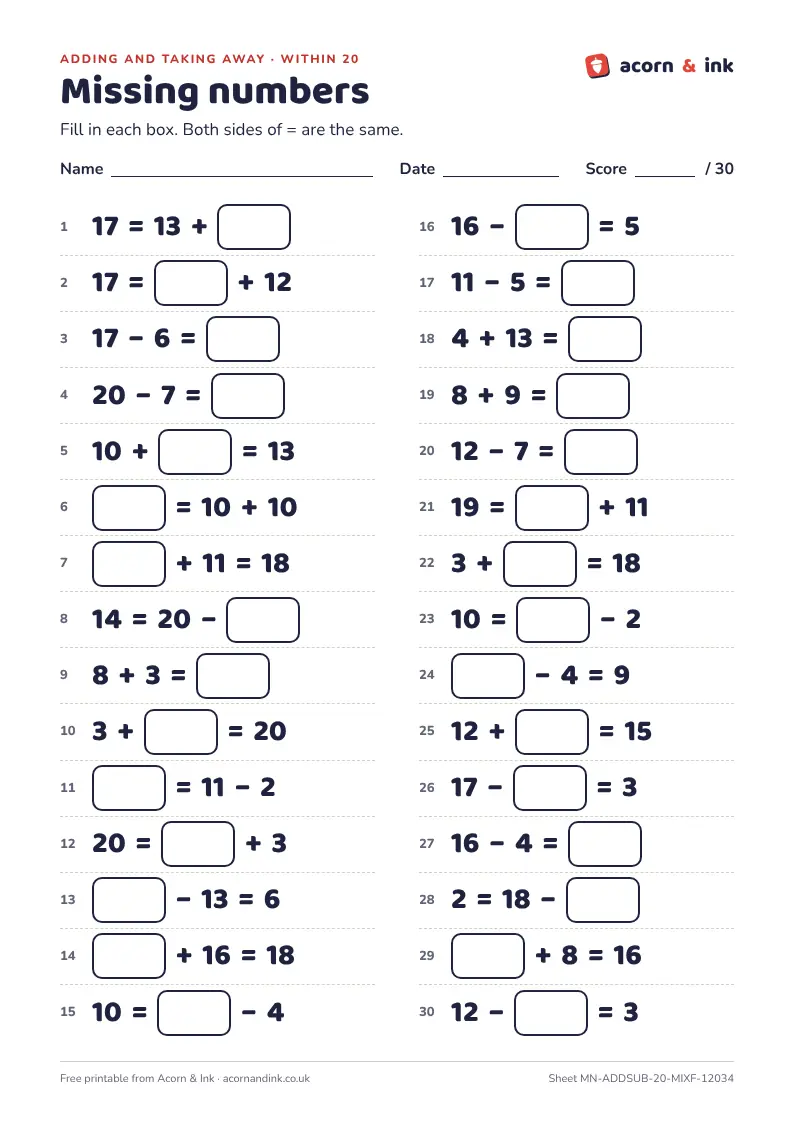
Free printable missing number worksheets for Years 1 to 4. One number in each sum is hidden in a box, and children work out what it is: in adding, taking away, times and divide sums, including ones written the other way round, like 7 = ☐ − 9. Choose the numbers and where the box goes. Every sheet comes with an answer page.
What is a missing number sum?
It is a number sentence with one number hidden in a box. The box might be where the answer usually goes, as in 6 + 3 = , or it might be one of the numbers in the sum, as in + 3 = 9. The equals sign can be on either side, so 9 = 6 + is a missing number sum too.
How to find the missing number
1Say it in wordsRead + 4 = 9 as “what add 4 makes 9?” Saying it out loud often shows what to do.
2Count on or backThink “what goes with 4 to make 9?” Count on from 4 to 9: that is 5 jumps. For taking away, count back.
3Use the inverseAdding undoes taking away, and times undoes divide. So if − 9 = 7, then 7 + 9 = .
Worked examples
7 = 16 − 9
5 × 4 = 20
15 = 8 + 7
30 ÷ 5 = 6
The equals sign means “is the same as”. It doesn’t mean “the answer comes next”. Whatever is on one side must be worth the same as what is on the other, like a pair of scales that balance. 15 = 8 + 7 is just as true as 8 + 7 = 15.
Sums like 7 = − 9 are a good test of this. If a child reads them as “7, then work it out”, they look back to front. Reading them as “7 is the same as something take away 9” makes them make sense.
Make a sheet
Choose the sums, the numbers and where the box goes, then roll for a fresh sheet.
Tips for parents
- Start with the box at the answer. When those feel easy, move the box into the sum, then try the sheets with the equals sign on the left.
- Hide some counters. Put 9 counters on the table, cover some with a cup and leave 4 showing. How many are under the cup? That is + 4 = 9 with real things.
- Read the sum aloud with “is the same as”. “Fifteen is the same as eight add something” helps with sums like 15 = 8 + ☐.
- Put the answer back in. Once the box is filled, read the whole sum again to check both sides match.
- For times and divide, use the tables they know. × 4 = 20 is “how many fours make 20?”, and the check row turns it into 20 ÷ 4.
In the National Curriculum for England, Year 1 children solve one-step adding and taking away problems using objects and pictures, and missing number problems such as 7 = ? − 9. In Year 2 they recognise and use the inverse relationship between addition and subtraction, both to check calculations and to solve missing number problems. In Year 3 they solve problems, including missing number problems, using number facts and place value, and solve missing number problems with multiplication and division. Source: National Curriculum in England: mathematics programmes of study (Department for Education). Crown copyright, Open Government Licence v3.0.
Questions parents ask
- What is a missing number sum?
- It is a sum with one number hidden in a box, such as ☐ + 4 = 9 or 7 = ☐ − 9. Children work out which number makes both sides of the equals sign the same.
- What age are these missing number worksheets for?
- They are for children aged about 5 to 9, in Years 1 to 4. Adding and taking away within 10 and 20 suits Years 1 and 2, two-digit numbers within 100 suit Years 2 and 3, and the times and divide sheets use the 2, 5 and 10 tables, the 3, 4 and 8 tables, or all the tables to 12 × 12.
- Why is the equals sign sometimes on the left?
- The equals sign means “is the same as”, so 15 = 8 + 7 is as true as 8 + 7 = 15. The National Curriculum’s own Year 1 example of a missing number problem, 7 = ? − 9, is written this way round. Untick Equals sign on the left sometimes if you only want the usual way round.
- What does the National Curriculum say about missing number problems?
- In the National Curriculum for England, Year 1 children solve missing number problems such as 7 = ? − 9, Year 2 children use the inverse relationship between addition and subtraction to check calculations and solve missing number problems, and Year 3 children solve missing number problems using number facts and place value, and with multiplication and division.
- Are the answers included?
- Yes. Each sheet can print with an answer page after it, with every missing number written in red. Choose Sheet only or Answers only under Print if you want just one of them.