Maths › 100 square
100 square: every number from 1 to 100
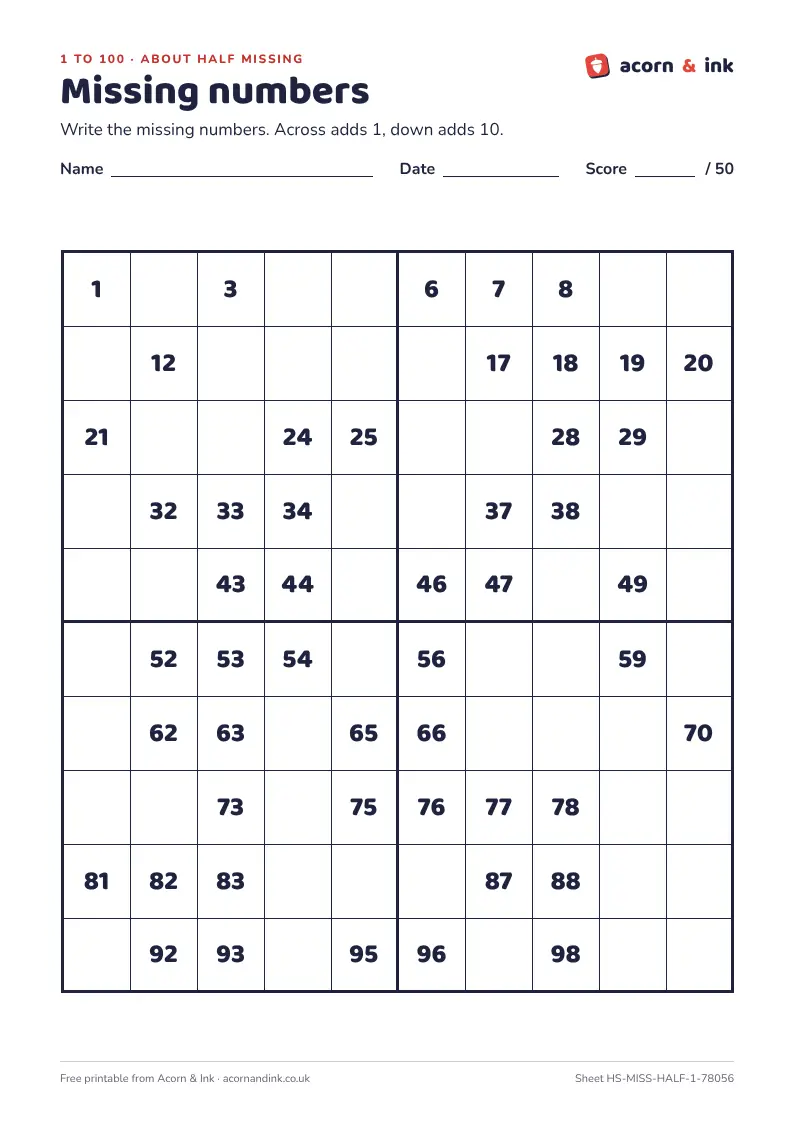
Free printable 100 square worksheets. Print a full hundred square to keep on the table, a blank one to fill in, a square with missing numbers, a counting pattern to colour, or 100 square puzzle pieces. Every sheet you fill in comes with an answer page.
How a 100 square works
A 100 square shows the numbers 1 to 100 in ten rows of ten. Each row starts where the row above stopped, so you read it like a book: left to right, then down to the next row.
Because every row holds ten numbers, the square has two simple rules. Moving one square across adds 1, and moving one square down adds 10. Going back the other way takes them away again: one square left is 1 less, one square up is 10 less. Each number in a column ends in the same digit, and only the tens digit changes as you go down.
1Across adds 134, 35, 36: one step right is one more.
2Down adds 1034, 44, 54: one step down is ten more. The ones digit stays the same.
3Look for patternsColour the numbers you say when you count in 2s, 5s or 10s and shapes appear.
- Counting in 10s from 10 goes straight down the last column: every number ends in 0.
- Counting in 2s colours every other column. These are the even numbers, which end in 0, 2, 4, 6 or 8. The ones left white are the odd numbers.
- Counting in 3s makes slanting lines that run down to the left: 3, 12, 21, then 6, 15, 24, 33.
- Counting in 4s gives a pattern that repeats every two rows, because 20 is five 4s.
Make a sheet
Choose a full or blank square, missing numbers, a pattern to colour or puzzle pieces, then roll for a fresh one.
Tips for parents
- Keep a full square nearby. Print one to keep on the table or the wall, so it’s there to check an answer or to count on from.
- Count out loud, forwards and back. Point to each number as you say it. Start from different numbers, not always 1, and count back as well as on.
- Jump with a counter. Put a button on 23 and ask for 10 more. Moving it one square down lands on 33. Ten less is one square up.
- Find the row first. For a missing number or a puzzle piece, look at the numbers around the gap. The number above is 10 less and the one to the left is 1 less.
- Make it reusable. Slip a sheet into a plastic wallet and use a whiteboard pen, so the same square can be filled in again and again.
- Talk about the patterns. After colouring, ask what your child notices. Which column is coloured? Which digit stays the same?
In England, the early learning goals at the end of Reception (from the EYFS statutory framework) include counting aloud beyond 20 and recognising the pattern of the counting system. In Year 1 of the National Curriculum, children count to and across 100, forwards and backwards, starting from 0 or 1 or from any number; count, read and write numbers to 100 in numerals; and count in multiples of twos, fives and tens. In Year 2 they count in steps of 2, 3 and 5 from 0 and in tens from any number, forwards and backwards, and recognise the place value of each digit in a two-digit number. In Year 3 they count from 0 in multiples of 4, 8, 50 and 100. Sources: Early years foundation stage (EYFS) statutory framework and National Curriculum in England: mathematics programmes of study (Department for Education). Crown copyright, Open Government Licence v3.0.
Questions parents ask
- What is a 100 square?
- A 100 square is a grid of ten rows of ten that shows the numbers 1 to 100 in order. Moving one square across adds 1 and moving one square down adds 10, which makes it useful for counting and spotting number patterns.
- Should a 100 square start at 0 or 1?
- Both are used. A 1 to 100 square ends at 100. A 0 to 99 square puts all the numbers with the same tens digit in the same row, so 20 to 29 sit together. The National Curriculum asks Year 1 children to count from 0 or 1, so this page makes both.
- Which year groups use a 100 square?
- In Year 1 of the National Curriculum for England, children count to and across 100 and count in twos, fives and tens. In Year 2 they count in steps of 2, 3 and 5 from 0 and in tens from any number, and learn the place value of each digit in a two-digit number. A 100 square helps with all of these.
- What are 100 square puzzle pieces?
- They are small shapes cut from a 100 square, with one or two numbers filled in. Children use the rules of the square, 1 more across and 10 more down, to fill in the rest of each piece.
- Are the answers included?
- Yes. The blank square, missing numbers, colouring and puzzle sheets all come with an answer page, with answers in red or the pattern coloured in. The full 100 square is a single page to keep and use.