Maths › Number bonds
Number bonds: two parts make a whole
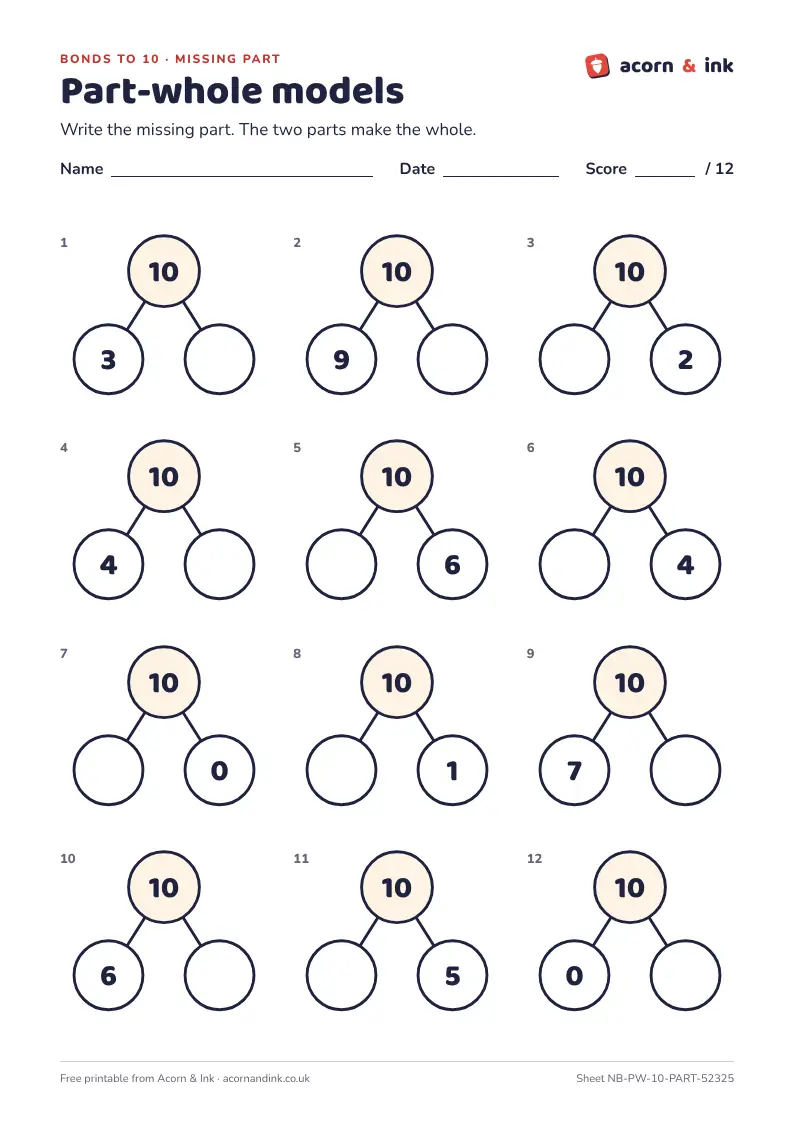
Free printable number bonds worksheets for Reception to Year 2. Make part-whole models, bar models, missing number sentences and fact families for bonds to 5, 10, 20 and 100. Every sheet comes with an answer page.
What is a number bond?
A number bond is a pair of numbers that make another number. 3 and 7 make 10, so 3 + 7 = 10 is a number bond to 10. The two smaller numbers are the parts and the number they make is the whole.
Knowing the parts and the whole gives you four facts at once: 3 + 7 = 10, 7 + 3 = 10, 10 − 3 = 7 and 10 − 7 = 3. If you know any two of the numbers, you can find the third.
1Find the wholeThe biggest number goes in the top circle, or the long bar.
2Split it into two partsThe two parts go below. Together they make the whole.
3Find what’s missingA missing part: take away. A missing whole: add the parts.
- Use objects first. Take 5 buttons or toy cars and split them into two groups in every way you can: 5 and 0, 4 and 1, 3 and 2.
- Try a ten frame. Put 7 counters in a 2 × 5 grid. The 3 empty spaces show the number that makes 10.
- Use fingers. Hold up 10 fingers and fold some down. The fingers still up and the fingers folded down make 10 together.
- Look for the pattern. 1 + 9, 2 + 8, 3 + 7, 4 + 6, 5 + 5: as one part goes up by 1, the other goes down by 1.
- Turn them round. 3 + 7 and 7 + 3 make the same whole, so every bond you learn gives you another one free.
- Use small bonds for big ones. 3 + 7 = 10, so 30 + 70 = 100 and 13 + 7 = 20.
Make a sheet
Choose the kind of sheet, the number the bonds make and which number is missing, then roll for a fresh one.
Tips for parents
- Keep counters nearby. If a missing part is tricky, make the whole with counters, then move the part you know to one side and count what’s left.
- Start with part-whole models. When the circles are easy, move to bar models, then to number sentences with no picture at all.
- Say the facts out loud. “Three and seven make ten. Ten take away three is seven.” Hearing the whole family helps it stick.
- Check by adding. When a part is missing, add the two parts at the end. They should make the whole.
- Go from 10 to 100. Once bonds to 10 are quick, try “100 in tens”: 3 + 7 = 10 becomes 30 + 70 = 100.
In England, the early learning goal for number at the end of Reception (from the EYFS statutory framework) includes recalling number bonds up to 5, with the matching taking-away facts, and some number bonds to 10, without needing to count. In Year 1 of the National Curriculum, children show and use number bonds and the related subtraction facts within 20. In Year 2 they recall and use adding and taking-away facts to 20 fluently, and work out and use related facts up to 100. Sources: Early years foundation stage (EYFS) statutory framework and National Curriculum in England: mathematics programmes of study (Department for Education). Crown copyright, Open Government Licence v3.0.
Questions parents ask
- What is a number bond?
- A number bond is a pair of numbers that make another number, like 3 and 7, which make 10. The two numbers are the parts and the number they make is the whole.
- Which year group learns number bonds?
- Children start in Reception: the early learning goal for number includes recalling number bonds up to 5 and some to 10. In Year 1 of the National Curriculum for England they use number bonds and related subtraction facts within 20, and in Year 2 they recall facts to 20 fluently and use related facts up to 100.
- What is the difference between a part-whole model and a bar model?
- Both show a whole split into two parts. A part-whole model uses circles, with the whole at the top joined to the two parts below. A bar model uses bars, with the whole as one long bar and the two parts as shorter bars underneath.
- Are the answers included?
- Yes. Every sheet comes with an answer page, with the answers in red. Choose Sheet only or Answers only to print just one of them.
- Is it free?
- Yes. The number bonds worksheets are free to make and print, and every roll makes a new sheet.