English › Homophones
Homophones: there, their or they’re?
Free printable homophones worksheets for Years 2 to 6. Choose the right word in a sentence, match each word to its meaning, spot the mistakes or write your own sentences, using the homophones from the National Curriculum spelling lists. Every sheet comes with an answer page.
What are homophones?
Homophones are words that sound the same but have different meanings and different spellings, like see and sea, or there, their and they’re. Near-homophones sound almost the same, like quite and quiet, or accept and except, so they are easy to mix up too.
You can’t hear which spelling is meant, so the rest of the sentence has to tell you. That’s why homophones are best learnt in sentences, not as a list of single words.
therein or at that place: “Put it over there.”
theirbelonging to them: “They hung up their coats.”
they’reshort for “they are”: “They’re going out.”
Ways to remember them
- Here and there are both about places. And “there” has “here” inside it.
- You hear with your ear. “Hear” has “ear” in it.
- An apostrophe shows missing letters. They’re is “they are”, who’s is “who is” and he’ll is “he will”. If you can say the long version, use the apostrophe.
- Two, twice and twins all start with “tw” and are all about two.
- A piece of pie. “Piece” starts with “pie”.
- Stationery with an e is for envelopes; stationary with an a means at a standstill.
- c for the naming word, s for the doing word. Advice, practice and licence are things; advise, practise and license are actions. You can hear the difference in advice and advise, so use that pair as your guide.
Make a sheet
Choose the kind of sheet and the year group list, or pick just the word groups you want to practise, then roll for a fresh one.
Tips for parents
- Always say it in a sentence. When you read out a homophone for a spelling test, put it in a sentence so your child knows which word you mean: “there, as in over there”.
- Talk about the meaning first. Before your child picks a spelling, ask what the word means in that sentence. “Belonging to them” points to their.
- Work on a few at a time. Use Choose word groups to make a sheet from just one or two tricky sets, such as there, their and they’re.
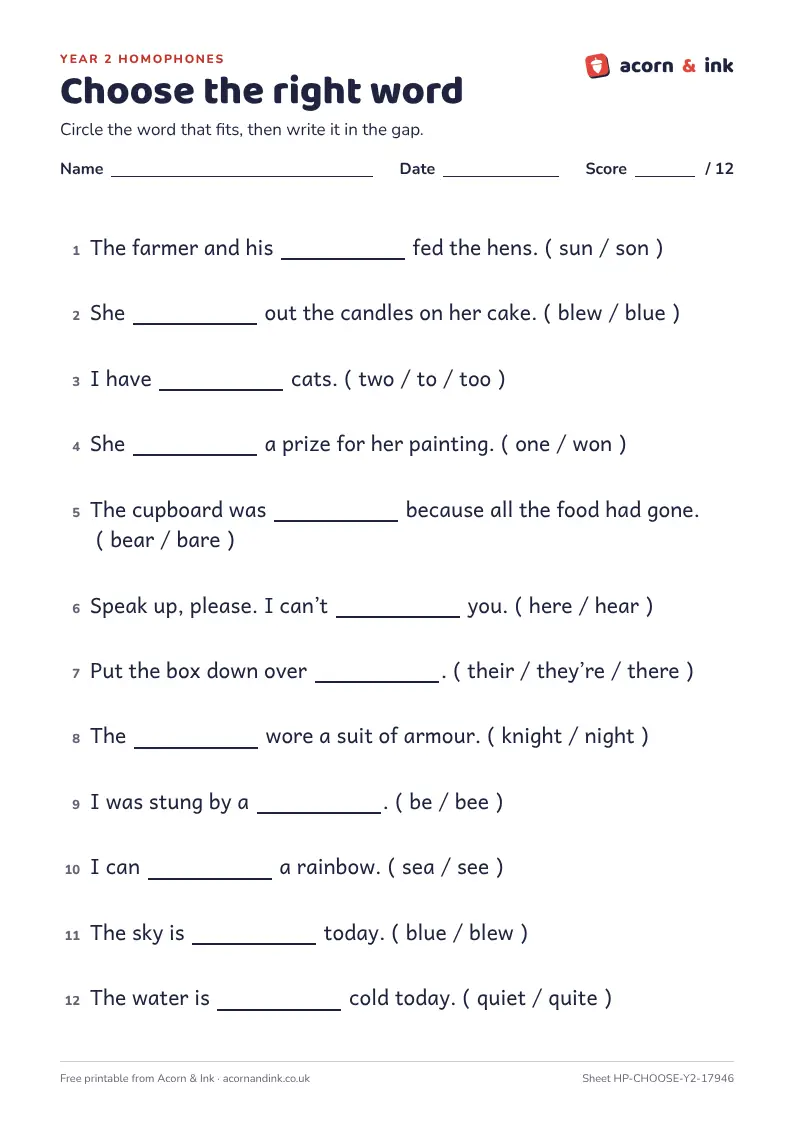
- Build up the steps. Start with Choose the right word, then Spot the mistake, and finish with Write your own sentence, where your child has to use each word without a clue.
- Mark it together. Let your child check their sheet against the answer page, then talk about any mix-ups.
- Look for them everywhere. Point out homophones in books, signs and your child’s own writing, and ask which spelling fits.
Homophones and near-homophones are part of the spelling appendix (English Appendix 1) of the National Curriculum for England, with a list for Year 2, a list for Years 3 and 4, and a list for Years 5 and 6. In Year 2, children learn to spell common homophones and near-homophones and to tell them apart. In Years 3 and 4 they learn to spell further homophones, and in Years 5 and 6 they keep learning to tell apart homophones and other words that are often confused. The groups on this page are the ones the appendix lists for each stage. Source: National Curriculum in England: English programmes of study, English Appendix 1: Spelling (Department for Education). © Crown copyright 2013, Open Government Licence v3.0. Summarised in our own words.
The homophone lists, by year group
Every word the sheets use, in the groups English Appendix 1 gives for each stage, with a short meaning for each word. The meanings are our own, written for children. Affect and effect, and whose and who’s, are on both the Years 3 and 4 list and the Years 5 and 6 list.
Year 2 homophones
Homophones and near-homophones.
- there: in or at that place; their: belonging to them; they’re: short for “they are”
- here: in or at this place; hear: to take in sounds with your ears
- quite: fairly, or completely; quiet: making little or no noise
- see: to look at something with your eyes; sea: the salt water that covers much of the Earth
- bare: not covered; with nothing on; bear: a large, furry wild animal
- one: the number 1; won: came first in a game or race
- sun: the star that gives us light and heat; son: a boy, as someone’s child
- to: towards; also used before a doing word, as in “to swim”; too: also, or more than is wanted; two: the number 2
- be: a doing word, as in “be kind”; bee: a buzzing insect that visits flowers
- blue: the colour of a clear sky; blew: past of blow
- night: the dark time between evening and morning; knight: a soldier in armour long ago, often on horseback
Years 3 and 4 homophones
Further homophones.
- accept: to take something that is offered, or to agree to it; except: apart from; not including
- affect: to change something or make a difference to it (a doing word); effect: a result or change caused by something (a naming word)
- ball: a round object used in games; bawl: to cry or shout loudly
- berry: a small, juicy fruit; bury: to put something in the ground and cover it
- brake: the part that slows or stops a bike, car or train; break: to smash or damage; also a short rest
- fair: right and equal for everyone; also a funfair; fare: the money you pay for a journey
- grate: to rub food into small shreds; great: very good, or very big
- groan: a long, low sound of pain or unhappiness; grown: got bigger; past of grow
- here: in or at this place; hear: to take in sounds with your ears
- heel: the back part of your foot; heal: to get better, or to make better; he’ll: short for “he will”
- knot: a tie made in string or rope; not: a word that means no, as in “not now”
- mail: letters and parcels sent by post; male: a boy or a man, or an animal such as a bull or a stallion
- main: the most important or the biggest; mane: the long hair on the neck of a horse or lion
- meat: food that comes from animals; meet: to come together with someone
- medal: a metal disc given as a prize; meddle: to interfere in something that is not your business
- missed: did not hit, catch or get to; past of miss; mist: a thin cloud near the ground
- peace: calm and quiet; a time with no fighting; piece: a part of something
- plain: simple, with no pattern or extras; plane: short for aeroplane
- rain: water falling from clouds; rein: a strap used to guide a horse; reign: the time when a king or queen rules
- scene: a part of a play or film; a view; seen: looked at; as in “I have seen it”
- weather: what it is like outside: sunny, rainy, windy and so on; whether: if; used when there is a choice
- whose: belonging to which person; who’s: short for “who is” or “who has”
Years 5 and 6 homophones
Homophones and other words that are often confused. In the first five pairs, the word ending in -ce is the naming word (noun) and the word ending in -se is the doing word (verb).
- advice: a suggestion about what to do (a naming word); advise: to suggest what someone should do (a doing word)
- device: a tool or machine made for a job (a naming word); devise: to plan or invent (a doing word)
- licence: a document that gives permission (a naming word); license: to give official permission (a doing word)
- practice: training, or the act of practising (a naming word); practise: to do something again and again to get better (a doing word)
- prophecy: a saying about what will happen in the future (a naming word); prophesy: to say what will happen in the future (a doing word)
- farther: more far; at a greater distance; father: a male parent
- guessed: gave an answer without being sure; past of guess; guest: a visitor who has been invited
- heard: past of hear; herd: a large group of animals, such as cows
- led: past of lead (to show the way); lead: a soft, heavy grey metal
- morning: the early part of the day; mourning: deep sadness after someone has died
- past: the time before now; also beyond, as in “walk past”; passed: went by, handed over or succeeded; past of pass
- precede: to come before; proceed: to go on, or carry on
- principal: most important; also the head of a college; principle: a rule or belief that guides what you do
- profit: the money left over after costs are paid; prophet: a person believed to speak for God or to see the future
- stationary: not moving; stationery: paper, pens, envelopes and other writing things
- steal: to take something that is not yours; steel: a strong metal made mostly from iron
- wary: careful, because of possible danger; weary: very tired
- whose: belonging to which person; who’s: short for “who is” or “who has”
- aisle: a passage between rows of seats or shelves; isle: an island
- aloud: out loud, so others can hear; allowed: permitted; let someone do something
- affect: to change something or make a difference to it (a doing word); effect: a result or change caused by something (a naming word)
- altar: a holy table in a church or temple; alter: to change
- ascent: a climb, or the way up; assent: agreement or permission
- bridal: to do with a bride or a wedding; bridle: the straps on a horse’s head, used to guide it
- cereal: a grain such as wheat or oats; a breakfast food made from grain; serial: a story told in parts; also in a series, as in “serial number”
- compliment: something kind said to praise someone; complement: something that completes or goes well with something else
- descent: the way down, or going down; dissent: disagreement
- desert: a very dry area of land; dessert: the sweet course after a main meal
- draft: a first try at a piece of writing; draught: a current of cold air in a room
Word groups from National Curriculum in England: English Appendix 1, Spelling. © Crown copyright 2013. Contains public sector information licensed under the Open Government Licence v3.0. Meanings and example sentences are written by us.
Questions parents ask
- What is a homophone?
- A homophone is a word that sounds the same as another word but has a different meaning and spelling, like see and sea, or there, their and they’re.
- What is the difference between a homophone and a near-homophone?
- Homophones sound exactly the same. Near-homophones sound almost the same, like quite and quiet, or accept and except. Both are easy to mix up when spelling, so the National Curriculum lists them together.
- Which homophones should my child know in each year?
- English Appendix 1 of the National Curriculum for England gives a list for Year 2 (such as there, their and they’re, and to, too and two), a list for Years 3 and 4 (such as brake and break, and whose and who’s) and a list for Years 5 and 6 (such as stationary and stationery, and practice and practise). All three lists are on this page.
- Can I make a sheet for just there, their and they’re?
- Yes. Open Choose word groups and tick only the groups you want. The sheet then uses just those words. With only one or two groups the sheet is shorter, so that no sentence is repeated.
- Are the answers included?
- Yes. Every sheet comes with an answer page, with the answers in red. For Write your own sentence, the answer page gives an example sentence for each word. Choose Sheet only or Answers only to print just one of them.