Maths › Place value and rounding
Place value and rounding: what every digit is worth
Free printable place value worksheets: split numbers into hundreds, tens and ones, find what a digit is worth, compare and order numbers with <, > and =, and round to the nearest 10, 100, 1,000 or more. Numbers go from up to 100 for Year 1 to up to 10,000,000 for Year 6, and every sheet comes with an answer page.
What each digit is worth
A digit’s value depends on its place in the number. In 365, the 3 is in the hundreds place, so it is worth 300. The 6 is worth 6 tens, or 60, and the 5 is worth 5 ones. Each place is worth ten times the place to its right.
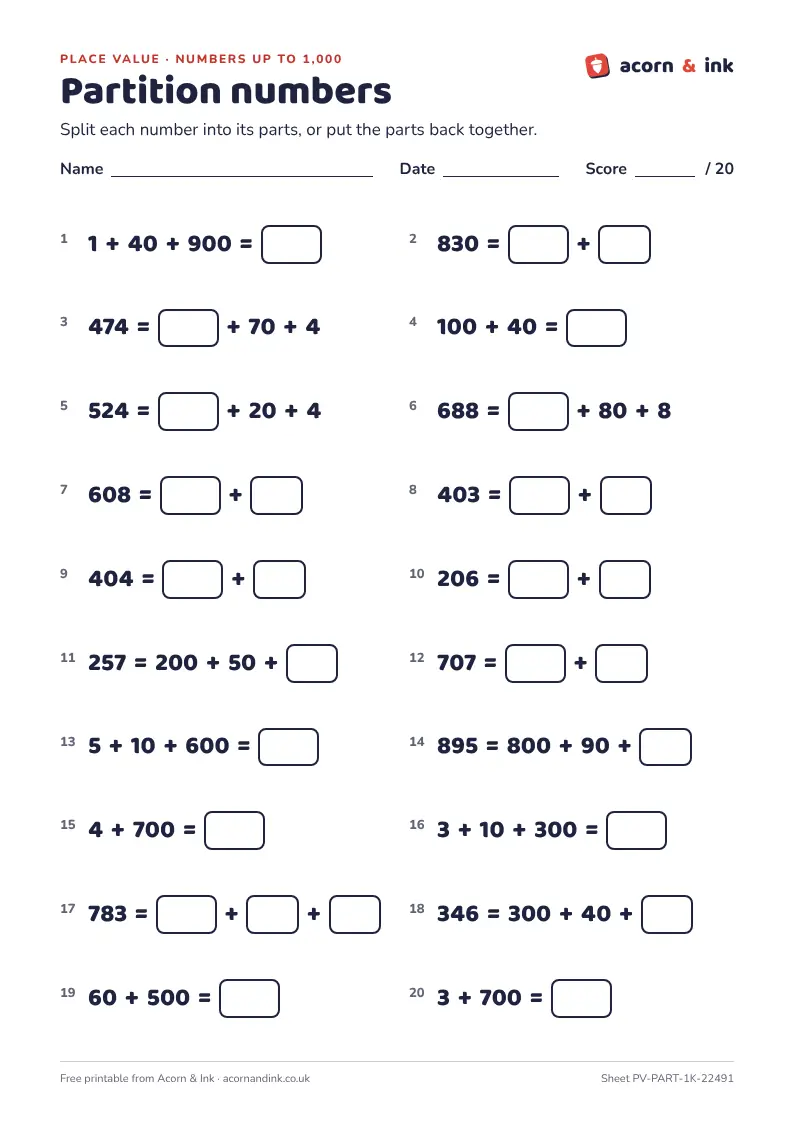
Splitting a number up like this is called partitioning: 365 = 300 + 60 + 5. A place value grid, with a column for each place, makes it easy to see.
Zero holds a place
In 305 there are no tens, but we still write a 0 in the tens place. Without it, 305 would turn into 35. The zero is a placeholder: it keeps the 3 in the hundreds place, so 305 = 300 + 5.
Bigger numbers
The places carry on to the left: thousands, ten thousands, hundred thousands, then millions. Commas split big numbers into groups of three digits from the right, so 2,437,105 is easy to read: 2 million, 437 thousand, 105. In 2,437,105 the 4 is worth 400,000.
Another way to partition. 365 can also be split as 300 + 50 + 15, or 200 + 160 + 5. The total is the same. This is what happens when you exchange a ten for ten ones in column subtraction.
Comparing and ordering: start on the left
With whole numbers, a number with more digits is bigger: 1,203 is bigger than 987. When two numbers have the same number of digits, compare them from the left, one place at a time. The first place where the digits are different decides it.
The sign’s open side faces the bigger number: 352 > 325 says “352 is greater than 325”, and 325 < 352 says “325 is less than 352”.
Rounding with a number line
Rounding gives a simpler number that is close. To round 3,460 to the nearest 100, find the hundreds on either side of it: 3,400 and 3,500. Halfway between them is 3,450. 3,460 is past halfway, so it rounds up to 3,500.
Without a number line, look at the digit just to the right of the place you are rounding to. If it is 5 or more, round up. If it is 4 or less, round down. For 3,460 to the nearest 100, that digit is the 6 tens, so round up.
A number exactly halfway, like 3,450 to the nearest 100 or 45 to the nearest 10, rounds up too: 3,450 becomes 3,500 and 45 becomes 50. That is the rule taught in schools.
Make a sheet
Choose an activity and how big the numbers are, then roll for a fresh sheet.
Tips for parents
- Use money as hundreds, tens and ones. £1 coins are hundreds of pennies, 10p coins are tens and 1p coins are ones. Make £3.65 with three £1 coins, six 10p coins and five 1p coins, and you have 365p = 300p + 60p + 5p.
- Read big numbers out loud. The commas tell you where to say “million” and “thousand”: 2,437,105 is “two million, four hundred and thirty-seven thousand, one hundred and five”. Take turns reading numbers from a newspaper, a car mileage or a price list.
- Round when you estimate. In the shop, round each price to the nearest pound to guess the total before you pay. On a journey, round the distance to the nearest 10 miles. Ask whether the guess was close.
- Bundle things in tens. Straws, lolly sticks or pasta in bundles of ten with a band round each show tens and ones before the blocks on the sheets.
In the National Curriculum for England, Year 1 children count to and across 100, and read and write numbers to 100 in numerals. In Year 2 they recognise the place value of each digit in a two-digit number (tens and ones), and compare and order numbers from 0 up to 100 using the <, > and = signs. In Year 3 they recognise the place value of each digit in a three-digit number, and compare and order numbers up to 1,000. In Year 4 they recognise the place value of each digit in a four-digit number, order and compare numbers beyond 1,000, and round any number to the nearest 10, 100 or 1,000. In Year 5 they read, write, order and compare numbers to at least 1,000,000, work out the value of each digit, and round any number up to 1,000,000 to the nearest 10, 100, 1,000, 10,000 and 100,000. In Year 6 they read, write, order and compare numbers up to 10,000,000, work out the value of each digit, and round any whole number to a required degree of accuracy. Source: National Curriculum in England: mathematics programmes of study (Department for Education). Crown copyright, Open Government Licence v3.0.
Questions parents ask
- What is place value?
- Place value means that a digit is worth a different amount depending on where it sits in a number. The 4 in 47 is worth 40, but the 4 in 2,437 is worth 400. Knowing this is what makes adding, taking away, comparing and rounding big numbers work.
- Should my child write “400” or “4 hundreds”?
- Both are right. The Value of a digit answer pages give the value as a number, like 400, with the words “4 hundreds” beside it. Saying it both ways helps children connect the digit with its place.
- Why do numbers ending in 5 round up?
- A number exactly halfway, like 45 to the nearest 10, is as close to 40 as to 50, so there has to be an agreed rule. The rule taught in schools is “5 or more, round up”, so 45 rounds to 50 and 3,450 rounds to 3,500 to the nearest 100. The sheets include halfway numbers so children practise the rule.
- Which number size should we start with?
- Follow the year groups on the buttons: up to 100 for Years 1 and 2, up to 1,000 for Year 3, up to 10,000 for Year 4, up to 1,000,000 for Year 5 and up to 10,000,000 for Year 6. If a sheet feels hard, drop down one size, or use the place value grid or blocks.
- Are the answers included?
- Yes. Every sheet can print with an answer page after it, with the answers in red. Choose Sheet only or Answers only under Print if you want just one of them.