Maths › Short and long division
Short and long division: one digit at a time
Free printable worksheets for the bus stop method of short division and for long division, with no remainders or with remainders written as whole numbers, fractions or decimals. Every sheet comes with an answer page that shows all the working in red.
What dividing means
Dividing can mean two things, and both give the same answer. Sharing: 12 sweets shared equally between 3 people gives 4 each. Grouping: 12 sweets put into bags of 3 fills 4 bags. Either way, 12 ÷ 3 = 4.
The written methods below work for big numbers by dividing one digit at a time, starting on the left.
Short division: the bus stop method
1Set it upThe number you are dividing goes under the bar. The number you divide by goes outside, on the left.
2Divide the first digitHow many times does the divisor go into it? Write that on top.
3Carry the remainderWrite anything left over as a small digit in front of the next digit.
4RepeatMove one digit to the right each time until you reach the end.
What the remainder means
The remainder is what is left over when the groups are as full as they can be. If 157 eggs are packed into boxes of 6, that fills 26 boxes with 1 egg left over. The question decides the answer: 26 boxes are full, but 27 boxes are needed to hold every egg.
A remainder can also be written as a fraction of the divisor: 1 left over out of 6 is 1/6, so 157 ÷ 6 = 26 1/6. Or, by carrying on past the decimal point, as a decimal:
Long division
Long division is the same idea, but every step is written down. It helps when you divide by a two-digit number, because the remainders are too big to keep in your head. Each step has four parts.
1DivideHow many times does the divisor go in? Write it on top.
2MultiplyMultiply that digit by the divisor and write the answer underneath.
3SubtractTake it away to find what’s left. It must be smaller than the divisor.
4Bring downBring the next digit down next to what’s left, and start again.
- 73 ÷ 15 = 4. 4 × 15 = 60, and 73 − 60 = 13. Bring down the 6 to make 136.
- 136 ÷ 15 = 9. 9 × 15 = 135, and 136 − 135 = 1. Bring down the 5 to make 15.
- 15 ÷ 15 = 1. 1 × 15 = 15, and 15 − 15 = 0. No remainder.
It helps to write out the first few multiples of the divisor before you start. For 15 that is 15, 30, 45, 60, 75, 90, 105, 120 and 135.
Check with multiplication
Multiplying undoes dividing. Multiply the answer by the divisor and add the remainder: you should get back to the number you started with. For 157 ÷ 6 = 26 r 1: 26 × 6 = 156, and 156 + 1 = 157. For 7,365 ÷ 15 = 491: 491 × 15 = 7,365.
Make a sheet
Choose short or long division, how big the numbers are and what to do with remainders, then roll for a fresh sheet.
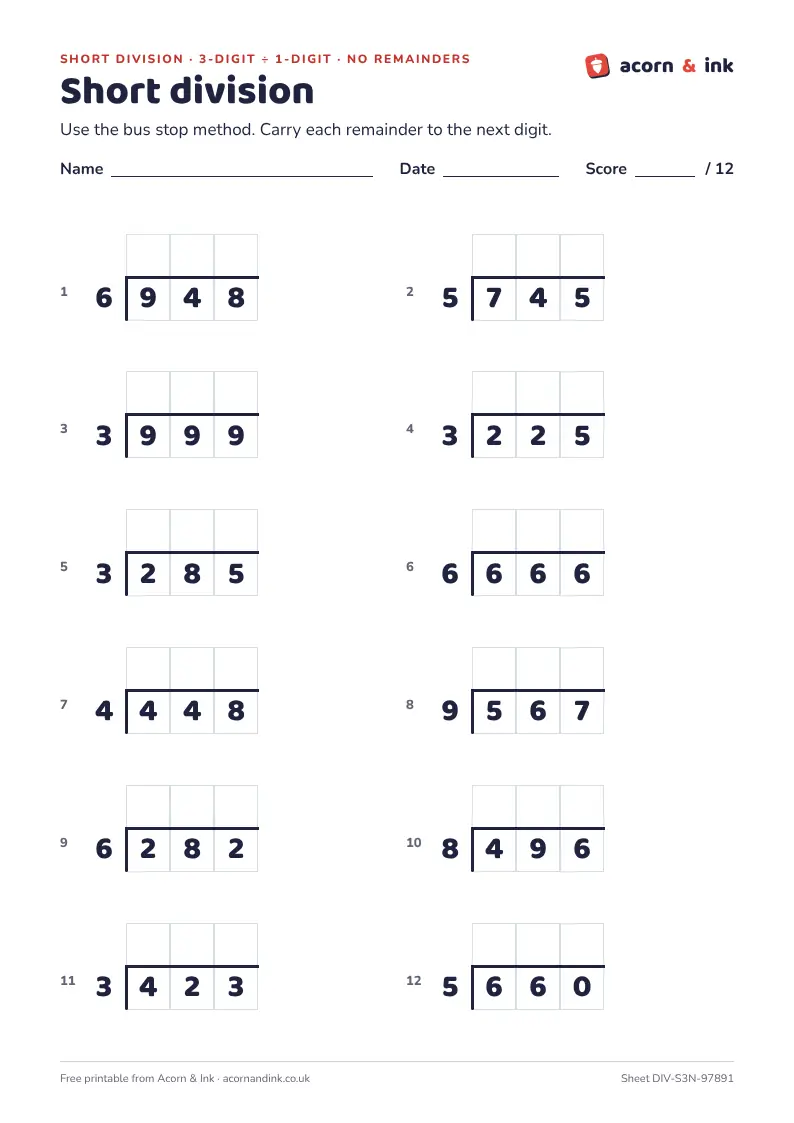
Tips for parents
- Make sure the times tables are secure. Short division leans on knowing facts like 7 × 6 = 42 quickly. The times table sheets are good practice alongside these.
- Start with real things. Share counters, coins or dried pasta into equal groups, and talk about what is left over. That makes the remainder mean something before it is written down.
- Estimate first. 745 ÷ 5 must be between 700 ÷ 5 = 140 and 750 ÷ 5 = 150, so an answer of 1,490 or 14 is clearly wrong.
- Use squared paper. One digit in each square keeps the columns lined up, which matters most in long division. The sheets are drawn on squares for this reason.
- List the multiples for long division. Writing out 1 × to 9 × the divisor first turns each step into a lookup, so the focus stays on the method.
- Turn remainders into stories. “23 children, 4 to a table: how many tables?” needs a different answer from “23 cakes shared by 4: how much each?” Ask which makes sense.
In the National Curriculum for England, Year 5 children divide numbers up to 4 digits by a one-digit number using the formal written method of short division, and interpret remainders in a way that suits the context. In Year 6 they divide numbers up to 4 digits by a two-digit whole number using the formal written method of long division, and interpret remainders as whole number remainders, as fractions, or by rounding, depending on the context. Year 6 children also divide numbers up to 4 digits by a two-digit number using short division where it is appropriate. Source: National Curriculum in England: mathematics programmes of study (Department for Education). Crown copyright, Open Government Licence v3.0.
Questions parents ask
- Why is short division called the bus stop method?
- “Bus stop” is a common nickname rather than an official name: the bar and the line beside it are often said to look like a bus shelter, with the divisor waiting outside. The National Curriculum calls it the formal written method of short division.
- What is the difference between short and long division?
- They use the same layout and divide one digit at a time. In short division the remainders are carried as small digits and the multiplying and subtracting happen in your head. In long division each multiply, subtract and bring down step is written out underneath, which makes dividing by a two-digit number easier to follow.
- Which year groups are these division worksheets for?
- They suit children aged about 8 to 12. In the National Curriculum for England, short division by a one-digit number is taught in Year 5 and long division by a two-digit number in Year 6. The two-digit short division sheets make a gentle start, and all of them are useful revision in Key Stage 3.
- How should my child write a remainder?
- It depends on the question. Choose Whole number for answers like 26 r 1, As a fraction for answers like 26 1/6 (always in its simplest form), or As a decimal for answers like 39.25. The decimal questions are chosen so that they finish within two decimal places.
- Are the answers included?
- Yes. Each sheet can print with an answer page after it, showing the answer and all the working in red: the carried remainders for short division, and every multiply, subtract and bring down step for long division. Choose Sheet only or Answers only under Print if you want just one of them.