Maths › Picture subtraction
Picture subtraction worksheets for Reception and Year 1
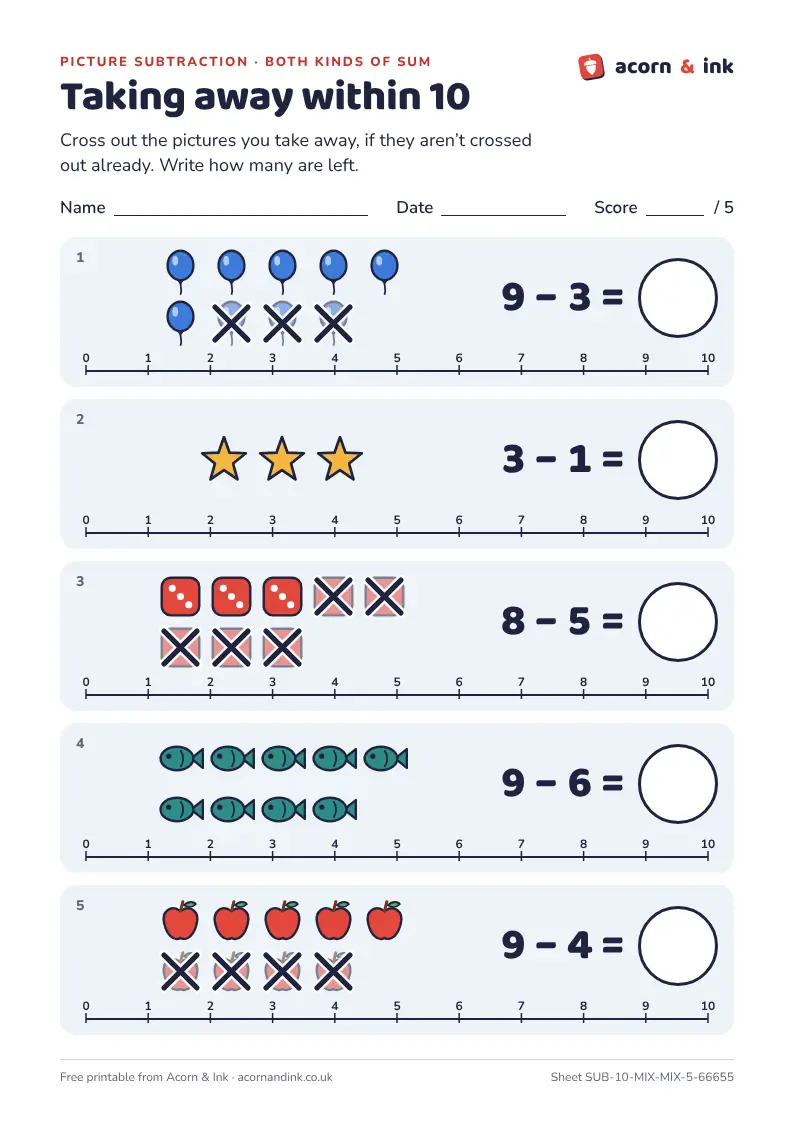
Free printable picture subtraction worksheets: children count a group of pictures, cross out the ones taken away and write how many are left, within 10 or within 20. On some sums the pictures are already crossed out; on others children cross them out themselves. Choose apples, stars, balloons, fish, dice, ladybirds or a mix, with a number line under each sum if you want one. For ages 4 to 7 (Reception and Year 1), free with no sign-up, and each sheet can print with an answer page.
How to take away with pictures
Taking away means some of a group go away, and you find out how many are left. In 8 − 3, there are 8 to start with and 3 go away. Pictures make this easy to see: cross out the ones that go, then count the ones that stay.
1Count them allTouch each picture once as you count. That is the first number in the sum.
2Cross out the ones that goCross out as many as the second number, one at a time, counting as you go.
3Count what’s leftCount the pictures that aren’t crossed out. Write that number in the circle.
8 − 3 = 5
- Two kinds of sum. On Crossed out for you sums, the pictures that go are already crossed out, so children count what’s left. On Cross them out yourself sums, every picture is shown and children cross out the number being taken away.
- Cross out from the end. Crossing out the last pictures in the group keeps the ones that are left together, so they are easier to count.
- Count back on the number line. Start on the first number and jump back one for each picture taken away: for 8 − 3, jump from 8 to 7, 6, 5. Where you land is the answer. There is more of this on subtraction on a number line.
- Rows of five. The pictures are drawn in rows of up to five, and in tens when there are more than ten, so children can start to see five and ten without counting each one.
- Within 10 or within 20. Within 10 starts with groups of up to 10 pictures; within 20 starts with 10 to 20 pictures.
Make a picture subtraction sheet
Choose how far to take away from, the kind of sum, the pictures and how many sums, then roll for a fresh one.
Tips for parents
- Start with real things. Put out a few toys, buttons or pieces of fruit, count them, then move some away and count what’s left, before moving to pictures.
- Tell the sum as a story. “Seven ducks on the pond, two swim away. How many ducks are left?” turns the picture into a number sentence.
- Cross out one at a time. Say “one, two, three” as each picture is crossed out, so the right number goes.
- Say the number sentence. After writing the answer, read it aloud: “eight take away three equals five”.
- Check by adding back. The pictures left and the pictures crossed out should make the number you started with: 5 + 3 = 8.
- Within 10 first. When taking away within 10 feels easy, try within 20, and untick the number line when it’s no longer needed.
In England, the early learning goal for number at the end of Reception (from the EYFS statutory framework) includes recalling number bonds up to 5, including the taking-away facts, without needing to count. In Year 1 of the National Curriculum, children read, write and understand number sentences with +, − and = signs, show and use number bonds and the related subtraction facts within 20, add and subtract one-digit and two-digit numbers to 20 (including zero), and solve one-step problems using objects and pictures. Sources: Early years foundation stage (EYFS) statutory framework and National Curriculum in England: mathematics programmes of study (Department for Education). Crown copyright, Open Government Licence v3.0.
Questions parents ask
- What age are these picture subtraction worksheets for?
- They are for children aged about 4 to 7, in Reception and Year 1, who are learning to take away by crossing out pictures and counting how many are left.
- What is the difference between the two kinds of sum?
- On Crossed out for you sums, the pictures being taken away are already crossed out, so children count the ones left. On Cross them out yourself sums, all the pictures are shown and children cross out the number being taken away before counting what’s left. Choose Both to mix the two on one sheet.
- Are the answers included?
- Yes. Every sheet comes with an answer page, with each answer in red in its circle. On Cross them out yourself sums, the pictures to cross out are also crossed out in red. Choose Sheet only or Answers only to print just one of them.
- What does the curriculum say about taking away in Reception and Year 1?
- In England, the early learning goal for number at the end of Reception includes recalling number bonds up to 5, including the taking-away facts. In Year 1 of the National Curriculum, children use subtraction facts within 20, subtract one-digit and two-digit numbers to 20, and solve one-step problems using objects and pictures.
- Are the worksheets free?
- Yes. Every sheet is free to make, print or save as a PDF, there is no sign-up, and every roll makes a new sheet.