Maths › Short and long multiplication
Short and long multiplication: one digit at a time
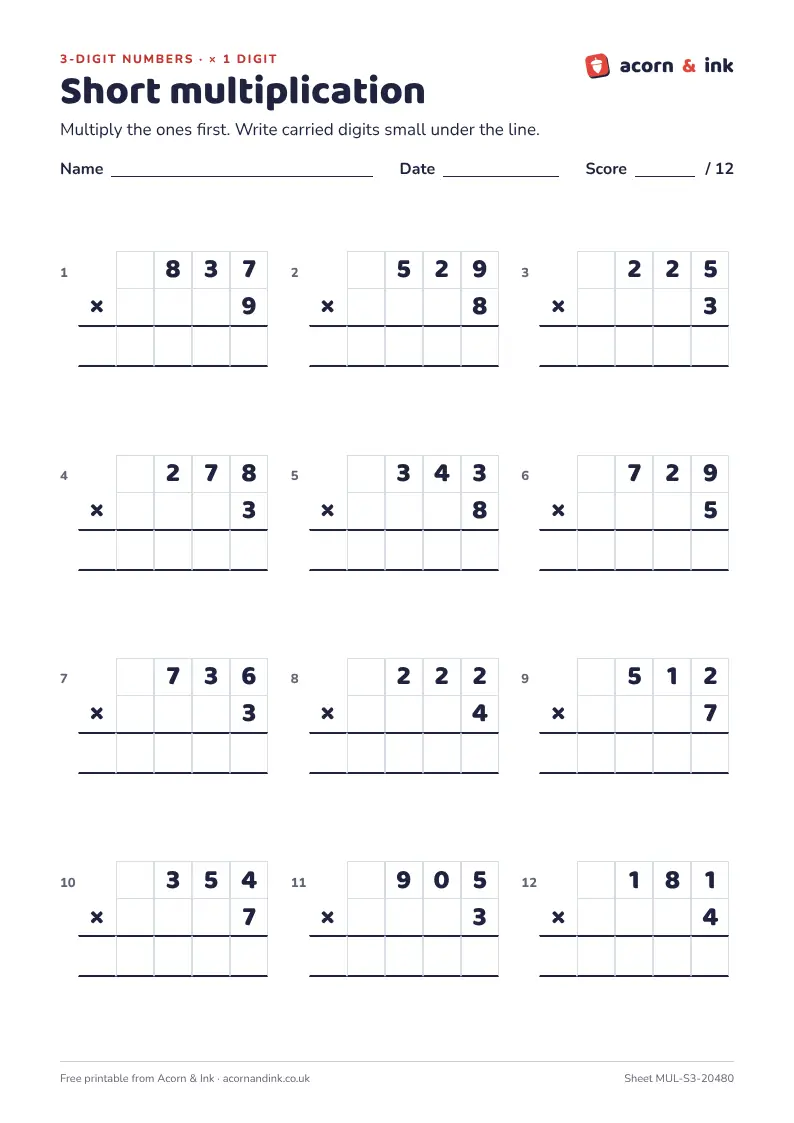
Free printable short and long multiplication worksheets for Years 4 to 6. Multiply 2, 3 and 4-digit numbers by a one-digit or two-digit number in the formal written layout, on squared paper so the digits stay lined up. Every sheet comes with an answer page that shows each step: the carries, each row of the long multiplication, the placeholder zero and the total.
How written multiplication works
Both methods break a big multiplication into small steps you already know from the times tables. The squared paper keeps each digit in its own column, so ones stay under ones and tens under tens.
1Line up by place valueWrite the bigger number on top and the multiplier underneath, with the ones digits in the same column on the right.
2Start with the onesMultiply each digit of the top number in turn, working from right to left.
3Carry the tensIf a step makes 10 or more, write the ones digit and carry the tens small into the next column, ready to add on.
Short multiplication: times a one-digit number
- Ones: 7 × 6 = 42. Write the 2 and carry 4 small under the tens.
- Tens: 4 × 6 = 24, add the carried 4 to make 28. Write the 8 and carry 2.
- Hundreds: 3 × 6 = 18, add the carried 2 to make 20. There is nothing left to multiply, so write 20 in full.
Long multiplication: times a two-digit number
Long multiplication does two short multiplications and then adds them. For 243 × 36, multiply by the 6 ones, then by the 3 tens (which is 30), then add the two rows.
- Multiply by 6: 243 × 6 = 1,458. The carries are written small under the row.
- Multiply by 30: write a 0 in the ones column first, as a placeholder, because you are multiplying by tens. Then 243 × 3 = 729 goes in front of it: 7,290.
- Add the two rows: 1,458 + 7,290 = 8,748.
- Estimate first. 243 is about 250 and 36 is about 40, and 250 × 40 = 10,000. Both numbers were rounded up, so the answer should be a bit under 10,000. If you get 87,480 or 874, something has slipped a column.
- Where the carries go. On these sheets, carried digits are written small under the line, in the column they are carried into, as on our column addition sheets. When there is nothing left to multiply, the last carry goes straight into the answer.
- The placeholder zero matters. In the second row you are multiplying by tens, so every digit belongs one column further left. The 0 holds the ones column empty.
A stepping stone: the grid method
Before the column layout, some children find the grid method helpful. Split the number into hundreds, tens and ones, multiply each part, then add the parts together. For 243 × 6:
| × | 200 | 40 | 3 |
|---|---|---|---|
| 6 | 1,200 | 240 | 18 |
1,200 + 240 + 18 = 1,458, the same as the first row of the long multiplication above. Short multiplication does the same steps, just written more compactly.
Make a sheet
Choose short or long multiplication and how big the first number is, then roll for a fresh sheet.
Tips for parents
- Check the times tables first. Every step is a times table fact plus a carry. If a child is unsure of 7 × 8, practise the tables alongside these sheets.
- Say what each digit is worth. In 243 × 36, the 3 in 36 is three tens, so “times 3” is really “times 30”. Saying it this way makes the placeholder zero make sense.
- Go one step at a time. Start with short multiplication and 2-digit numbers, then 3 and 4 digits. For long multiplication, the Multiples of 10 sheets practise the second row on its own.
- Estimate before and check after. Round both numbers, multiply in your head, and compare. A calculator is fine for checking once the working is done.
- Mark the working, not just the answer. The answer page shows every carry and row, so you can see exactly which step went wrong.
In the National Curriculum for England, Year 4 children multiply two-digit and three-digit numbers by a one-digit number using the formal written layout. In Year 5 they multiply numbers with up to 4 digits by a one-digit or two-digit number using a formal written method, including long multiplication for two-digit numbers. In Year 6 they multiply numbers with up to 4 digits by a two-digit whole number using the formal written method of long multiplication. Source: National Curriculum in England: mathematics programmes of study (Department for Education). Crown copyright, Open Government Licence v3.0.
Questions parents ask
- What is the difference between short and long multiplication?
- Short multiplication multiplies a number by a one-digit number in a single row, with the carries written small. Long multiplication multiplies by a two-digit number: one row for the ones, one row for the tens with a placeholder zero, and then the two rows are added together.
- Which year groups are these multiplication worksheets for?
- They suit Years 4 to 6, about ages 8 to 12, and older children who want practice. In the National Curriculum for England, Year 4 children multiply two-digit and three-digit numbers by a one-digit number using the formal written layout, and Years 5 and 6 bring in long multiplication by a two-digit number for numbers with up to 4 digits.
- Why is there a zero in the second row of long multiplication?
- The second row multiplies by the tens digit, so it is really multiplying by a multiple of 10. The 0 in the ones column is a placeholder that moves every digit of that row one place to the left. For 243 × 36, the second row is 243 × 30 = 7,290.
- Where do the carried digits go?
- On these sheets the carried digits are written small under the line, in the column they are carried into, the same as on our column addition sheets. In long multiplication each row has its own carries, and the adding at the end has its own too.
- Are the answers included?
- Yes. Each sheet can print with an answer page after it, showing every carry, each row of the long multiplication, the placeholder zero and the total in red. Choose Sheet only or Answers only under Print if you want just one of them.