English › Phonics
Phonics worksheets: sounds, blending and tricky words
Free printable phonics worksheets for Reception to Year 2. Match sounds to pictures, add sound buttons, read and draw, sort real words from alien words, and practise the Year 1 tricky words. Choose which sets of sounds to use, and every word on the sheet uses only those sounds. Most sheets print with an answer page.
What phonics is
Phonics teaches reading and spelling through the sounds in words. Children learn which letter, or group of letters, stands for each sound. Then they learn to blend the sounds together to read a word, and to split a word into its sounds to spell it.
Sounds, not letter names
When you practise phonics, use the sound a letter makes, not its name. The letter s says sss, not “ess”. Letter names are useful later, for spelling words out loud, but for reading the sounds come first.
Pure sounds
Say each sound as cleanly as you can, without an extra “uh” on the end: mmm, not “muh”, and sss, not “suh”. Short sounds like t, p and d can’t be stretched, so keep them crisp and quiet. Pure sounds make blending much easier: mmm-a-t runs together into mat, but “muh-a-tuh” doesn’t.
Blending to read
1Say each soundTouch each sound button as you say its sound: s, a, t.
2Say them again, fasterRun along the sounds without stopping between them.
3Push them togetherThe sounds join up into the word: sat.
Segmenting to spell
Spelling works the other way round. Say the word, split it into its sounds, then write the letter or letters for each sound. Counting the sounds on fingers helps: ship has three sounds, sh-i-p, so it needs three spellings, even though it has four letters.
Digraphs and trigraphs
A digraph is two letters that make one sound, like sh in ship or ai in rain. A trigraph is three letters that make one sound, like igh in night. A split digraph is two letters that work together with another letter in between, like a‑e in cake.
On sound buttons, a dot goes under each sound made by one letter and a line goes under each sound made by two or three letters. A split digraph gets a curved line joining its two letters.
Tricky words
Some common words have a part that doesn’t follow the sounds a child knows yet, like said, the and was. These are often called tricky words; the National Curriculum calls them common exception words. Children learn them by heart, and it helps to point out the tricky part: in said, the ai says “e”.
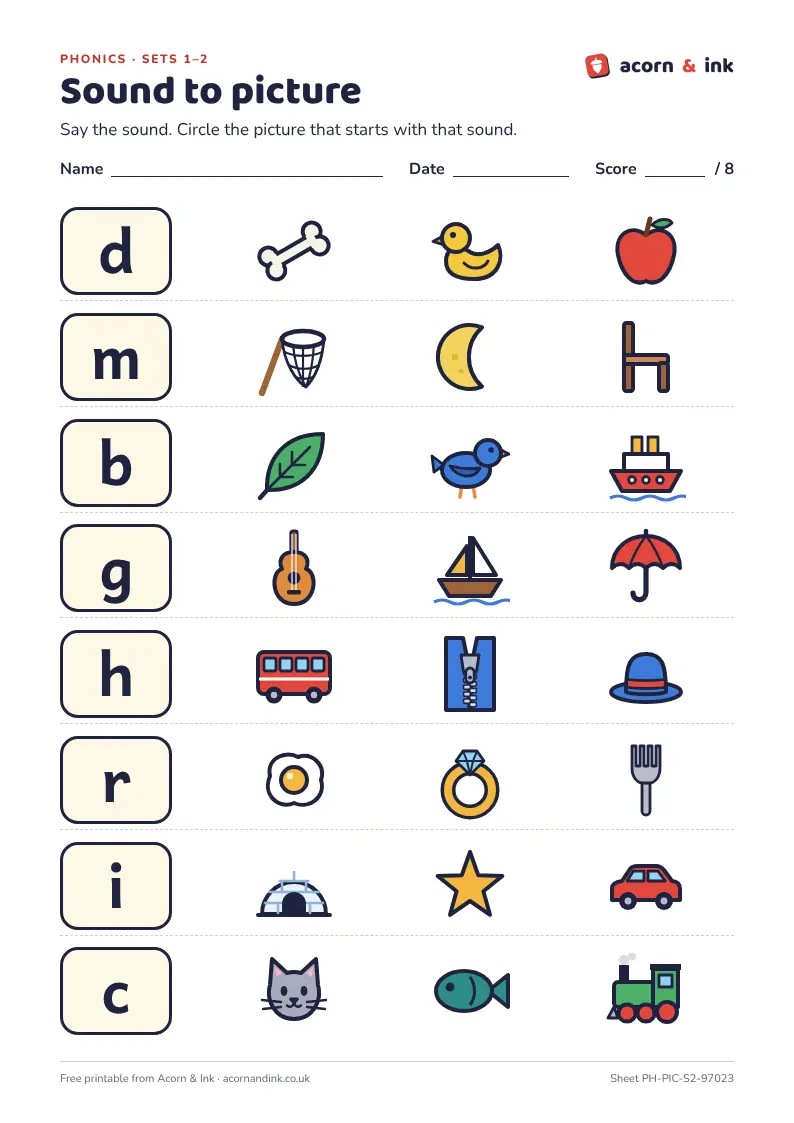
Sound to picture
The sets of sounds
The sheets group the sounds into five sets, taught in this order. Each set adds new sounds, and the sheets use every set up to the one you choose. Schools follow their own phonics programme, so the order your child meets the sounds in may be different. If so, choose the set that covers the sounds your child already knows.
Make a sheet
Choose the kind of sheet and the sets of sounds, then roll for a fresh one.
Tips for parents
- Short and often. Five or ten minutes a day works better than a long session once a week. Stop while it’s still fun.
- Go on a sound walk. Pick a sound and look for things that start with it, around the house, in the park or at the shops.
- Use magnetic letters. Build words on the fridge or a baking tray. Swap one letter to make a new word: cat, hat, hot, hop.
- Read together every day. Let your child read the words they can sound out and read the rest yourself. Share stories just for fun, too.
- Model the sounds. Sound out words slowly in front of your child, so they can hear the pure sounds and the blending.
What the curriculum says. In the early years foundation stage (Reception), the early learning goal for word reading expects children to say a sound for each letter of the alphabet and for at least 10 digraphs. They read words that match their phonic knowledge by blending sounds. They read aloud simple sentences and books that match their phonic knowledge, including some common exception words.
In Year 1, the National Curriculum for England expects children to use phonics as the route to working out words. They respond quickly with the right sound for the graphemes of all 40 or more phonemes, including other sounds a grapheme can make where it has more than one. They read unfamiliar words accurately by blending sounds they have been taught. They read common exception words, noticing where spelling and sound don’t match in the usual way. In Year 2, they keep using phonics to work out words until decoding is automatic and reading is fluent. They read accurately by blending the sounds in words with the graphemes taught so far, and especially learn to recognise the other sounds a grapheme can make.
Schools in England give Year 1 children a phonics screening check in June. It uses real words and pseudo-words (made-up words). Home-educated children don’t have to take it.
Sources: Early years foundation stage statutory framework and National Curriculum in England: English programmes of study (Department for Education). © Crown copyright, Open Government Licence v3.0. Summarised in our own words. The tricky words sheet uses the Year 1 common exception words from English Appendix 1. The sets of sounds, word lists, phrases and pictures are our own.
Questions parents ask
- What age are these phonics worksheets for?
- They suit children aged about 4 to 7, in Reception, Year 1 and Year 2. Start with Set 1 and add a set at a time once the sounds feel easy. The other spellings in Set 5, like ay, ir and a‑e, are mostly for Years 1 and 2.
- Why is the order of sounds different from my child’s school?
- Schools follow their own phonics programme, and each one teaches the sounds in its own order. The five sets on this page are our own order. Choose the set that covers the sounds your child already knows. Every word on a sheet uses only the sounds in the sets you pick.
- What are sound buttons?
- Marks under a word, one for each sound: a dot under a sound made by one letter, a line under a sound made by two or three letters, and a curved line joining a split digraph like a‑e. Children touch each button as they say its sound, then blend the sounds to read the word.
- Why are there made-up alien words?
- A child can only read a made-up word by sounding it out, so alien words show whether they can really blend, rather than remember words they have seen before. The Year 1 phonics screening check in schools in England uses made-up words too. Home-educated children don’t have to take the check.
- Do the sheets come with answers?
- The sound to picture, sound buttons and real or alien sheets can print with an answer page, with the answers in red. Read and draw and tricky words don’t need one, so they print as a single sheet.