English › Grammar and punctuation
Grammar and punctuation: fix the sentence
Free printable grammar and punctuation worksheets for Years 1 to 6. Capital letters and full stops, conjunctions, apostrophes, word classes, speech marks, relative clauses and more, step by step through the National Curriculum. Every sheet comes with an answer page.
Grammar words, explained simply
Children meet a lot of new words for talking about sentences. Here is what each one means, in plain words, with an example like the ones on the sheets. The year shows when the National Curriculum brings the word in.
- Noun Year 2
- A naming word for a person, place, animal or thing.The dog ran into the park.
- Verb Year 2
- A doing or being word. It tells you what happens or what is.Mia jumped in the puddle.
- Adjective Year 2
- A describing word. It tells you more about a noun.a fluffy rabbit
- Adverb Year 2
- Tells you more about a verb: how, when or where something happens. Many end in -ly.The owl hooted softly.
- Conjunction Year 3
- A joining word that links words or parts of a sentence, such as and, but, or, because, when and if.I wore my coat because it was cold.
- Preposition Year 3
- Shows where or when something is, compared with something else.The cat slept under the table.
- Pronoun Year 4
- A word used instead of a noun, so you don’t keep repeating it: I, you, he, she, it, we, they, him, her, them.Ava lost her hat. She looked everywhere.
- Sentence types Year 2
- A statement tells you something. A question asks and ends with ?. A command tells someone what to do. An exclamation starts with What or How and ends with !.What a big dog that is!
- Apostrophes Years 2–4
- Two jobs. They show where letters are missing, and they show who something belongs to. With more than one owner ending in s, the apostrophe goes after the s.do not → don’tthe girl’s coat · the girls’ coats
- Inverted commas Years 3–4
- Also called speech marks. They go around the words someone says. The punctuation at the end of the spoken words goes inside them.“Can we go to the park?” asked Leo.
- Fronted adverbial Year 4
- Words at the start of a sentence that say when, where or how something happened. Put a comma after them.After lunch, we played football.
- Relative clause Year 5
- Adds information about a noun. It starts with who, which, where, when, whose or that.The girl who won the race is my sister.
- Active and passive Year 6
- In an active sentence, the one doing the action comes first. In a passive sentence, the thing the action happens to comes first.Ella kicked the ball. (active)The ball was kicked by Ella. (passive)
Make a sheet
Choose a year band, then the skill to practise, or Mixed for a bit of everything from that band. Roll for a fresh set of sentences.
Tips for parents
- Spot punctuation in the books you read together. Stop at a question mark and ask why it’s there. Point out the inverted commas when a character speaks, and the capital letter on a name.
- Read writing aloud. Ask your child to read their own writing out loud. Where they pause or take a breath is often where a full stop or comma belongs.
- Correct gently. Pick one thing to fix at a time, and say what’s right first. Marking the sheet together with the answer page turns mistakes into a chat rather than a red pen.
- Say it before you write it. For joining words, tenses and Standard English, say the sentence out loud first. Most children can hear when “we was” sounds wrong in a sentence they read carefully.
- Little and often. One sheet on one skill is plenty for a session. Use Mixed now and then to look back over earlier skills.
- The bands are a guide. If a skill is new, start with an earlier band, even if your child is older.
What the National Curriculum says, year by year
English Appendix 2 of the National Curriculum for England sets out the vocabulary, grammar and punctuation for each year. Here are the main points, in our own words, with the ones these sheets practise.
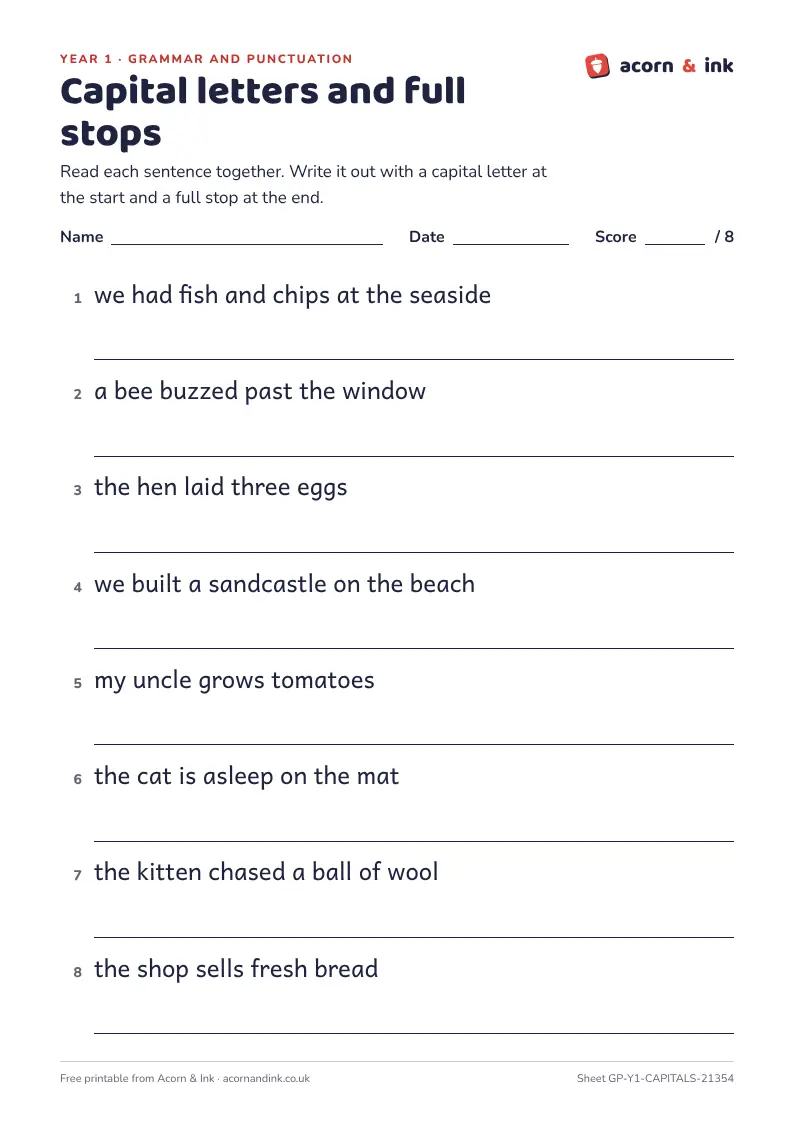
- Year 1. Leaving spaces between words; joining words and ideas with and; starting to use capital letters, full stops, question marks and exclamation marks to show where sentences begin and end; capital letters for names and for I.
- Year 2. Joining ideas with and, but and or, and with when, if, that and because; knowing whether a sentence is a statement, question, exclamation or command; using the present and past tense correctly and consistently; commas in lists; apostrophes for missing letters and for one owner. Children also learn the words noun, verb, adjective and adverb.
- Year 3. Choosing a or an; using conjunctions, adverbs and prepositions to say when, where and why; starting to use inverted commas for direct speech.
- Year 4. Telling plural and possessive -s apart, and apostrophes for plural owners; Standard English verb forms, such as we were rather than we was, and I did rather than I done; fronted adverbials, with a comma after them; choosing a pronoun or a noun to avoid repetition; full punctuation for direct speech.
- Year 5. Relative clauses starting with who, which, where, when, whose or that; using modal verbs and adverbs to show how likely something is; brackets, dashes or commas for parenthesis; commas to make the meaning clear.
- Year 6. Using the passive; the difference between informal speech and formal writing, including subjunctive forms such as If I were; semicolons, colons and dashes between main clauses; a colon to introduce a list; hyphens to avoid ambiguity, such as man-eating shark.
Source: National Curriculum in England: English programmes of study, English Appendix 2: Vocabulary, grammar and punctuation (Department for Education). © Crown copyright 2013, Open Government Licence v3.0. Summarised in our own words. All the sentences on the sheets are written by us.
Questions parents ask
- What grammar and punctuation should my child know in each year?
- In Year 1, children learn capital letters, full stops, question marks and exclamation marks, and join ideas with and. Year 2 adds commas in lists, apostrophes, more joining words, sentence types and the past and present tense. Years 3 and 4 bring in inverted commas for speech, fronted adverbials, prepositions and plural apostrophes. Years 5 and 6 cover relative clauses, parenthesis, modal verbs, the passive, semicolons, colons and hyphens. The year-by-year list on this page has the details.
- What is a fronted adverbial?
- It’s a word or group of words at the start of a sentence that tells you when, where or how something happened, such as “After lunch” or “Quietly”. In writing, it is followed by a comma: “After lunch, we played football.”
- Is it the girl’s coat or the girls’ coats?
- Both are right, but they mean different things. The girl’s coat belongs to one girl, so the apostrophe goes before the s. The girls’ coats belong to more than one girl, so the apostrophe goes after the s of girls. Plurals that don’t end in s, such as children and men, take ’s: the children’s toys.
- Why do the Year 5–6 sheets say “If I were” and not “If I was”?
- “If I were you” uses the subjunctive, a form the National Curriculum asks Year 6 children to know for formal writing. Lots of people say “If I was” when they talk, and that is fine in everyday speech. The sheets ask children to pick the formal form.
- Are the answers included?
- Yes. Every sheet has an answer page, with the answers in red. Where more than one answer is right, such as brackets, dashes or commas around extra information, the answer page says so. Choose Sheet only or Answers only to print just one of them.