Topics › Fossils
Fossils for kids: life turned to stone
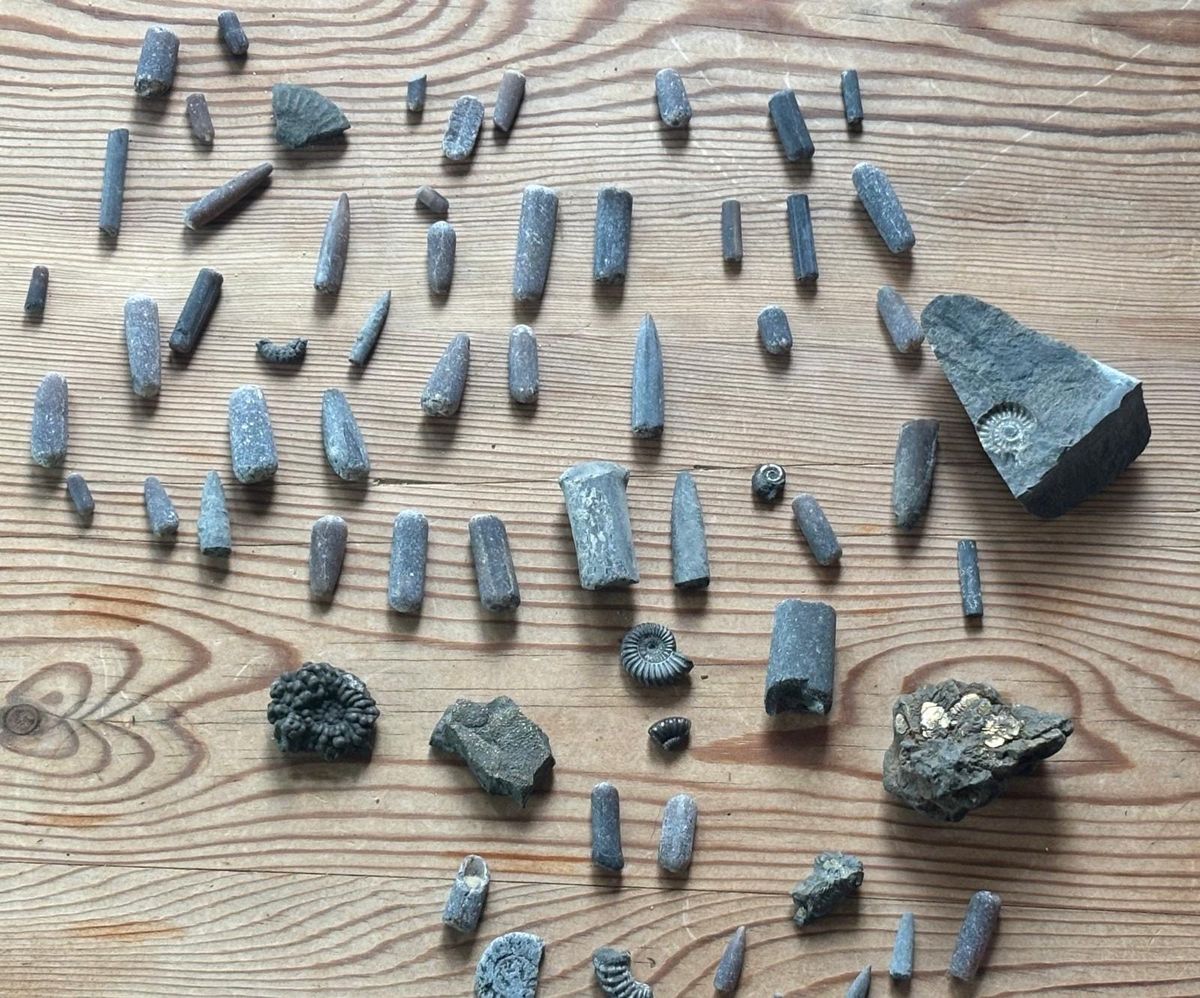
Find out what fossils are, how they form and who Mary Anning was, then get ready for a fossil hunt on the Jurassic Coast. Print a fact sheet for your child’s age, then make free quizzes and worksheets for ages 5 to 14: missing words, true or false, put the steps in order, name the fossil, and a fossil-hunt checklist and finds log.
Print a fact sheetMake quizzes and worksheetsGo fossil hunting
What is a fossil?
A fossil is what is left of a plant or animal that lived a very long time ago, kept in rock. It can be part of the body, such as a bone, a shell or a tooth, or a trace the animal left behind, such as a footprint. Most fossils are more than 10,000 years old.
The word fossil comes from the Latin word fossilis, which means “dug up”. Scientists who study fossils are called palaeontologists.
- AmmoniteA sea animal with a coiled, ribbed shell. Small ones turn up on some beaches.
- BelemniteThe hard, bullet-shaped part from inside a squid-like sea animal.
- TrilobiteA sea animal with a hard outer skeleton. Trilobites lived for more than 250 million years.
- FootprintA trace fossil: it shows where an animal walked.
How a fossil forms
It dies and sinks to the sea floor. It is buried quickly in mud and sand. Minerals slowly replace the shell. The sea wears the rock away and the fossil is found.
Fossils form when a plant or animal dies and is buried quickly by mud, sand or silt, often at the bottom of a sea, lake or river. Being buried keeps the remains away from things that would break them up or make them rot. The soft parts rot away, but hard parts such as bones, shells and teeth can slowly be replaced by minerals until they turn to stone.
This can be quick or very slow. A small soft-bodied animal can start to become a fossil within months or even days, but big dinosaur bones can take thousands of years.
Fossils form more often in the sea, where mud and sand settle quickly, than on a rocky mountaintop, where bodies rot before anything covers them.
Body fossils and trace fossils
Body fossils are the remains of the plant or animal itself: bones, teeth, claws, shells, tree trunks and leaves.
Trace fossils are signs it left behind, such as footprints, trackways, burrows and fossil poo, which is called a coprolite. Trace fossils can show how an animal behaved, like where it walked or what it ate.
Where are fossils found?
Most fossils are found in sedimentary rock. It forms when sand, silt, mud or the shells of sea creatures settle in layers, which are pressed together over a very long time.
Which fossils you find depends on the type and age of the rock. Palaeontologists use geological maps, which show the rock layers in an area, to work out where to look. The first geological map of Britain was made by William Smith in 1815.
In Britain, one of the best places to look is the Jurassic Coast in Dorset, a World Heritage Site. Its crumbly cliffs keep releasing ammonites, belemnites and other fossils onto the beach.
Mary Anning, the fossil hunter
Mary Anning was born in Lyme Regis in Dorset in 1799 and became one of the most important fossil hunters of her time. As a child she went fossil hunting with her father and her brother Joseph, and the family sold what they found to visitors.
- 1799Mary is born in Lyme Regis, Dorset.
- 1811–12Joseph finds the skull of an ichthyosaur, a sea reptile. Mary, aged about 12, finds the rest of the skeleton.
- 1823She finds a nearly complete plesiosaur, a sea reptile with a very long neck. Hers were the first nearly complete plesiosaur skeletons.
- 1824She suggests that odd stones called “bezoar stones” are really fossil poo. They are later named coprolites.
- 1826She finds a belemnite fossil with an ink sac inside, like a squid’s.
- 1828She finds a pterosaur, a flying reptile: the first pterosaur skeleton found in Britain.
- 2021The Royal Mint makes 50p coins showing her finds.
In Mary’s time, women were not allowed to join the Geological Society of London, an important society for scientists who studied rocks. She read and hand-copied scientific papers, and knew more about fossils than many of the wealthy collectors who bought them.
Fun facts
- Snake stonesPeople once thought ammonites were snakes turned to stone, and in Lyme Regis they were sold as “snake-stones”.
- Devil’s fingersBelemnites had a spooky local name too: “devil’s fingers”.
- Fossil pooCoprolites can be a few millimetres long or more than 60 centimetres!
- Tongue stonesFossil shark teeth were once called “tongue stones” because people thought they looked like tongues.
- Toothy recordShark teeth are the most common fossils of animals with backbones.
- Butterflies?Some trilobite fossils were once mistaken for butterflies.
- Super survivorsTrilobites lived for more than 250 million years, and more than 20,000 kinds evolved.
- Ink from the pastMary Anning found belemnite fossils with ink sacs, just like squid have today.
Key words
- fossil
- the remains or trace of a living thing from long ago, usually more than 10,000 years old
- sediment
- sand, silt and mud that settle in layers
- sedimentary rock
- rock made from layers of sediment pressed together
- minerals
- natural materials that can slowly fill and replace bone or shell
- body fossil
- part of the living thing itself, such as a bone, tooth or shell
- trace fossil
- a sign an animal left, such as a footprint, burrow or poo
- coprolite
- fossil poo
- palaeontologist
- a scientist who studies fossils
For older children and teens
Four ways fossils are preserved
- PetrificationA tree stump turned to stone.
- CompressionA fern pressed into a dark imprint.
- Mould and castA snail shell’s shape left in rock.
- Preserved remainsA fly trapped in amber.
- Petrification is the most common. Water full of minerals such as calcium carbonate or silica soaks through the rock around a buried shell, bone or tooth. This is called permineralisation. Slowly the minerals replace the original material, turning it to stone (petra was the Latin word for rock).
- Compression happens when the weight of the layers above squashes remains flat, leaving a dark imprint. Fern leaves are often preserved like this.
- Moulds and casts form when a shell or bone dissolves away, leaving a shell-shaped space called a mould. If sediment later fills the space, it makes a cast. Snail shells, which dissolve easily, are often found this way.
- Preserved remains are the rarest: the original skeleton or even soft parts survive, such as insects trapped in amber, which is fossilised tree resin.
Dating rocks with fossils
- Rock usually forms in flat layers, each younger than the one below it. Reading these layers is called stratigraphy.
- Index fossils are used to work out the age of sedimentary rocks. The best ones are common, easy to recognise, found over a wide area and lived for only a short span of time.
- Ammonites make great index fossils because they evolved quickly and spread widely; trilobites do too. Finding the same index fossil in rocks far apart tells geologists the rocks formed at about the same time.
- Radioactive dating can give an age in years, but it usually only works on volcanic ash layers. That is why palaeontologists rely so much on rock layers and fossils.
What the fossil record leaves out
- The fossil record is all the fossils we know. Because hard parts such as bones and shells fossilise far more easily than soft bodies, it gives a biased picture of past life.
- The number of species known from fossils is less than 5% of the number of known living species. That suggests far fewer than 1 in 100 of all the species that ever lived are known from fossils.
- Transitional fossils have features of both an ancestor group and the group that came after it. Archaeopteryx, from the Late Jurassic, had feathered wings like a bird but also sharp teeth and a long, bony tail like a dinosaur.
- Microfossils are less than about 1 mm across, such as tiny shells and pollen grains. Scientists study them under microscopes to learn about past climates.
Mary Anning and the missing credit
- The gentlemen geologists who wrote up Anning’s finds often left out her name. The scientific papers about her first ichthyosaur never said who had collected it.
- When the plesiosaur she found in 1823 was presented to the Geological Society, she was again not named, even though she had probably drawn the sketch that was used.
- Some scientists did credit her: William Buckland named her when he wrote about her pterosaur and about coprolites.
- The Geological Society did not admit women until 1904. In 2010 the Royal Society named Anning as one of the ten British women who most influenced the history of science.
Going fossil hunting
Charmouth beach, on the Jurassic Coast in Dorset, is one of the best places in Britain to hunt for fossils with children. The cliffs here keep slipping and crumbling, so fresh fossils wash out onto the beach, and plenty can be found lying loose among the pebbles.
When the Travels with Five family went fossil hunting at Charmouth, friends who knew the beach well gave them three tips:
- Walk up the beach as far as you can.
- Head towards the water’s edge as the tide goes out, because that is when “new” fossils wash up.
- Get comfy: sit or crouch, take your time, and lift and rummage through the stones.
They had packed a hammer and safety goggles, but didn’t need them. What they did wish they had brought was a bucket or tub for their finds: lots of tiny ammonites, belemnites and some fool’s gold (you can see them in the photo at the top of this page). To finish the day, the Charmouth Heritage Coast Centre is free to visit and full of fossils, including some spectacular recent finds.
Stay safe on a fossil hunt
- Check the tide times before you go. Hunt as the tide goes out, and leave plenty of time to get back.
- Keep well away from the cliffs and from fresh rock falls. They can fall without warning.
- Only pick up loose fossils from the beach. Never dig into the cliffs.
- Follow the West Dorset Fossil Collecting Code.
- Found something special? Take it to the Charmouth Heritage Coast Centre, who can help work out what it is, and remember where you found it.
Looking after your finds
- Wrap delicate finds in tissue or newspaper for the trip home.
- Fool’s gold is a mineral called pyrite. Air and damp can make it slowly crumble, so keep those finds dry, ideally in an airtight box.
- Brush off loose mud gently with a dry brush. Ask an expert before washing fossils with fool’s gold in them.
Print the fact sheet
All the facts above on one A4 page, written for each age. Read it together, stick it on the wall, then try the quizzes below.
Choose a sheet to see it below, then print it.
Quiz time
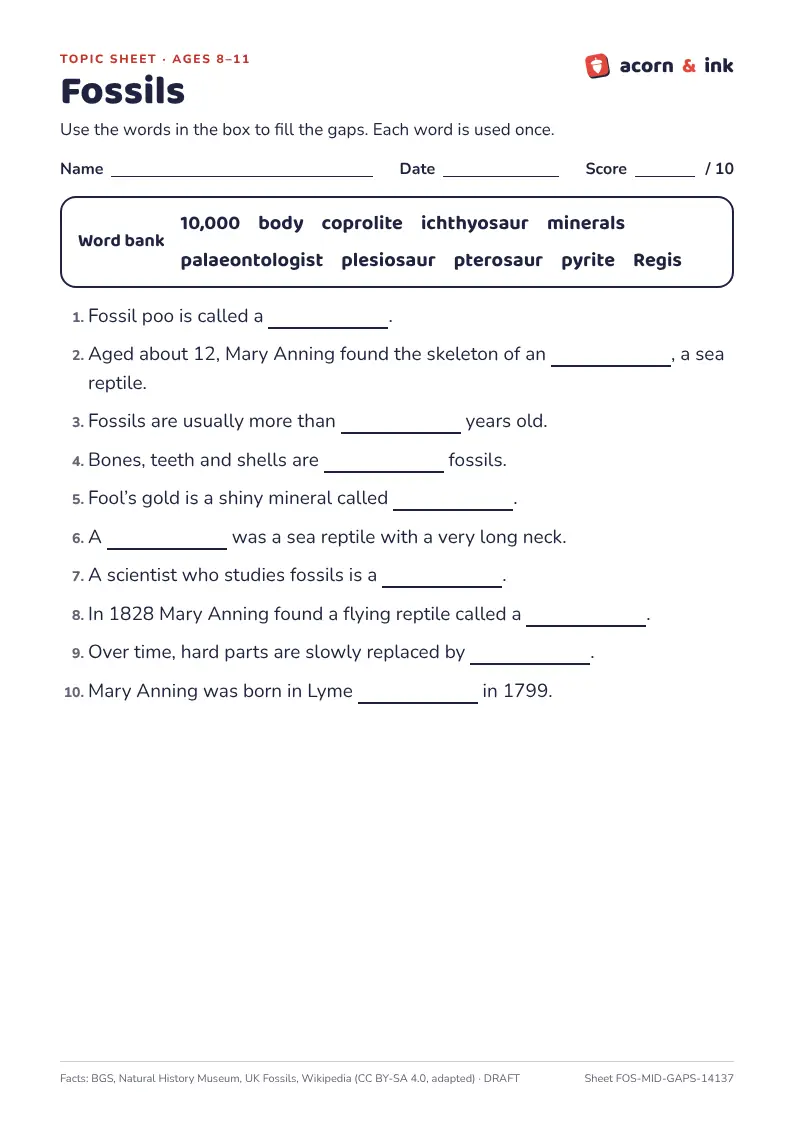
Now check what they remember. Choose the age and the kind of sheet, roll for a fresh one, and print it with or without answers. The fossil-hunt log prints as two pages: a checklist and a finds log with a ruler.
More fossil activities
Questions parents ask
- What is a fossil, in simple words?
- A fossil is what is left of a plant or animal that lived long ago, usually more than 10,000 years ago, kept in rock. It might be part of its body, such as a bone, shell or tooth, or a trace it left behind, such as a footprint or a burrow.
- How long does it take for a fossil to form?
- It depends. A small soft-bodied animal can start to fossilise within days or months, while big dinosaur bones can take thousands of years. The ammonites and belemnites on the beach at Charmouth come from rocks laid down in the Jurassic period.
- What is the difference between a body fossil and a trace fossil?
- A body fossil is part of the living thing itself, such as a bone, tooth, shell or leaf. A trace fossil is a sign it left behind, such as a footprint, a burrow or fossil poo, which is called a coprolite.
- Where can children find fossils in the UK?
- The Jurassic Coast in Dorset is a favourite. At Charmouth, ammonites, belemnites and other fossils wash out of the cliffs and can be picked up loose on the beach, so it suits families. Check the tide times, keep away from the cliffs and follow the West Dorset Fossil Collecting Code.
- Do we need a hammer to go fossil hunting?
- Not on Charmouth beach. Travels with Five took a hammer and goggles and didn’t need them; a bucket or tub for the finds was far more useful. If you do use a hammer, only use it on loose rocks on the open beach, away from the cliffs, and always wear safety goggles.
- Can we keep the fossils we find?
- On the West Dorset coast, collecting loose fossils from the beach is supported under the West Dorset Fossil Collecting Code, but digging into the cliffs needs permission first. If you think you have found something important, report it to the Charmouth Heritage Coast Centre and note where you found it.
- Who was Mary Anning?
- Mary Anning (1799–1847) was a fossil hunter from Lyme Regis in Dorset. With her brother Joseph she found an ichthyosaur skeleton when she was about 12, and she later found the first nearly complete plesiosaur skeletons and the first pterosaur skeleton found in Britain. She also worked out that “bezoar stones” were fossil poo.
- What ages are these fossil worksheets for?
- There are three levels: ages 5–7 (Years 1 and 2), ages 8–11 (Years 3 to 6) and ages 12+ (Key Stage 3). Harder ideas, such as the four kinds of preservation, index fossils and transitional fossils, are only in the 12+ sheets.