Topics › France
France for kids: our neighbour across the Channel
Find out where France is, what makes Paris famous, and about France’s mountains, rivers, food, wildlife and famous people, with a short history of France for older children. Print a fact sheet for your child’s age, then make free quizzes and worksheets for ages 5 to 14: missing words, true or false, match the words, label the map, colour the flag and a “My France trip” page.
Print a fact sheetMake quizzes and worksheetsVisiting France with children
Where is France?
France is a country in Western Europe, and one of our nearest neighbours: across the narrow Strait of Dover, the north of France faces south-east England. It is the largest country in Western Europe, and its outline is roughly six-sided.
France has coasts on the English Channel, the North Sea, the Atlantic Ocean (including the Bay of Biscay) and the Mediterranean Sea. On land it borders eight countries: Belgium, Luxembourg, Germany, Switzerland, Italy, Monaco, Andorra and Spain.
The part of France in Europe is called metropolitan France. France also has overseas regions and territories far away, such as French Guiana in South America and islands in the Caribbean, the Indian Ocean and the Pacific.
France at a glance
The capital of France is Paris. People in France speak French and pay with the euro.
- The flagThree upright stripes: blue, white and red.
- Eiffel TowerOne of the most famous sights in Paris. About 6 million people visit it each year.
- Cheese and breadFrance is famous for its cheeses: there are hundreds of kinds. On their trip, Travels with Five bought long loaves called baguettes.
- Mont BlancThe highest mountain in the Alps, about 4,810 metres high.
- TGVA high-speed train that travels at 320 km/h.
- Tour de FranceThe world’s most famous bike race, held since 1903.
Paris and other big cities
Paris is the capital of France and by far its largest city, with more than 13 million people living in and around it. It lies in the north-central part of the country and has long been nicknamed the “city of light”. Paris is known around the world for its food, fashion, painting and books.
Famous sights include the Eiffel Tower, the Arc de Triomphe and the Louvre, the most visited art museum in the world. Gustave Eiffel designed many bridges, but he is best remembered for the Eiffel Tower.
Other big cities include Lyon, on an old trade route along the Rhône valley; Marseille, France’s biggest port, which Greek traders founded on the Mediterranean about 2,600 years ago; Lille; Toulouse; Bordeaux, on the Garonne; Nantes, a port near the Atlantic coast; and Strasbourg, where the European Parliament meets.
Mountains, rivers and islands
Much of France is fairly low: plains, plateaus and old, worn-down blocks of mountains. The high, younger mountains are the Alps in the south-east and the Pyrenees in the south-west, along the border with Spain. In the south of central France is the Massif Central, a plateau of ancient mountains and volcanoes that no longer erupt.
Mont Blanc in the Alps, on the border with Italy, is about 4,810 metres high. It is the highest point in Western Europe.
France has four great rivers: the Seine, the Loire, the Garonne and the Rhône. With the smaller rivers that flow into them, they drain more than three-fifths of mainland France. The Rhône flows into the Mediterranean Sea at the Camargue, and the Garonne flows past Bordeaux to the Atlantic Ocean. The Loire valley is famous for its castles, called châteaux. The Rhine forms part of France’s eastern border.
The largest island near the mainland is Corsica, in the Mediterranean Sea.
Animals and nature
Forests cover more than a quarter of France, and about half is countryside or farmland. Deer and wild boar live in the lowland forests. High in the Alps and the Pyrenees live rare animals such as the chamois (a kind of mountain antelope), the ibex, brown bears and alpine hares.
Every year millions of birds stop on the Mediterranean coast as they migrate from Africa, including flamingos, vultures, egrets and bee-eaters. About a tenth of France is set aside as parks and nature reserves, including nine national parks.
Language, money and symbols
The official language is French, which grew from Latin. Some people also speak regional languages such as Breton, Basque, Occitan, Catalan, Alsatian and Corsican.
France uses the euro (€). Its motto is Liberté, égalité, fraternité, meaning “Liberty, equality, fraternity”, and its national anthem is La Marseillaise.
The name France comes from the Latin Francia, “the land of the Franks”. The Franks were a people who formed a kingdom here about 1,500 years ago. Their name is linked to the English word frank, which once meant “free”.
About 67 million people live in mainland France, or about 69 million counting overseas France.
Food
French cooking is famous around the world. In 2010, French gastronomy (the art of good food) was added to a UNESCO list of the world’s most important traditions.
France is known for its cheeses, many of them named after the place where they are made. Each region has its own dishes, such as quiche from Lorraine, cassoulet from the south-west, beef bourguignon from Burgundy and choucroute from Alsace. Other famous dishes include steak frites and bouillabaisse. Cooks in the north use more butter and cream; in the south, more olive oil.
A French meal often has three courses: a starter (entrée), a main course (plat principal), then cheese or a pudding.
Getting around and sport
Eurostar trains and LeShuttle link France with the UK through the Channel Tunnel. France’s high-speed trains, the TGV, travel at 320 km/h, and the Millau Viaduct in France is the tallest bridge in the world.
The Tour de France, first held in 1903, is the world’s most famous cycle race. Football is the most popular sport, and the national team is nicknamed “Les Bleus”. Rugby, tennis, judo and pétanque are popular too, and the French Open tennis championship is played in Paris.
It was a Frenchman, Pierre de Coubertin, who suggested bringing back the Olympic Games at the end of the 1800s. Paris has hosted the Summer Olympics three times: in 1900, 1924 and 2024.
Famous French people
- Claude Monet
- A painter who founded Impressionism. His eight huge Water Lily paintings hang in a museum in Paris.
- Victor Hugo
- A writer whose novels include Les Misérables and The Hunchback of Notre-Dame.
- The Lumière brothers
- Auguste and Louis Lumière are credited with creating cinema in 1895.
- Alice Guy-Blaché
- The world’s first female filmmaker.
- Pierre de Coubertin
- Suggested bringing back the Olympic Games.
- Charles Perrault
- Wrote fairy tales including Cinderella, Puss in Boots and Sleeping Beauty.
- Jules Verne
- Wrote Twenty Thousand Leagues Under the Seas.
- Antoine de Saint-Exupéry
- Wrote The Little Prince, one of the best-selling books ever.
Fun facts
- Top spot for visitorsMore foreign visitors go to France than to any other country: 102 million in 2025.
- City of lightParis has long been nicknamed the “city of light”.
- Tallest bridgeThe Millau Viaduct is the tallest bridge in the world.
- Cave artThe cave paintings at Lascaux are about 20,000 years old.
- Fairy talesCinderella and Puss in Boots were written by the French writer Charles Perrault.
- Theme parkDisneyland Paris is the most popular theme park in Europe.
- Water liliesClaude Monet’s eight huge Water Lily paintings hang in a Paris museum.
- Free and frankThe Franks, who gave France its name, are linked to the old word frank, meaning “free”.
Key words
- Paris
- the capital and largest city of France
- Alps
- high mountains in the south-east, with Mont Blanc
- Pyrenees
- mountains along the border with Spain
- Corsica
- the largest island near mainland France
- Channel Tunnel
- the tunnel trains use between France and the UK
- TGV
- France’s high-speed train
- Tour de France
- a famous cycle race, first held in 1903
- Louvre
- the most visited art museum in the world
For older children and teens
A short history of France
- c. 18,000 BCPeople make cave paintings at Lascaux.
- Iron AgeCeltic tribes known as the Gauls settle the land.
- 52–51 BCJulius Caesar completes the Roman conquest of Gaul. A mixed Gallo-Roman way of life grows, and Lugdunum (now Lyon) becomes the capital of the Gauls.
- Late 400sClovis unites the Franks and makes Paris his capital.
- 843Charlemagne had reunited the Frankish kingdoms into an empire across Western and Central Europe. His grandsons split it in three, and the western part, West Francia, grows into France.
- 1337–1453The Hundred Years’ War between England and France. Joan of Arc leads French armies to important victories, and France wins back most of the land English kings held there.
- 1500sThe French Renaissance: art flourishes and French becomes the country’s official language.
- 1600sLouis XIV, the “Sun King”, keeps his court at the Palace of Versailles. France becomes the leading power in Europe, and art and science flourish.
- 1789The French Revolution begins. On 14 July crowds storm the Bastille in Paris, and the Declaration of the Rights of Man sets out ideals France still holds today.
- 1792The rule of kings is ended and France becomes a republic.
- 1799–1815Napoleon Bonaparte takes power, becomes Emperor of the French and builds an empire across much of Europe, until his final defeat at Waterloo in 1815.
- 1800s–1900sFrance builds a large overseas empire, the second-largest after the British Empire. Most of its colonies become independent in the 1960s.
- 1914–1945France fights in both world wars. It is occupied by Germany from 1940 until it is freed in 1944.
- 1958Charles de Gaulle sets up the Fifth Republic, the system France still has today.
- 1992–1999France signs the Maastricht Treaty and helps set up the eurozone.
Regions, departments and government
- Since 2016, France has been divided into 18 regions: 13 in metropolitan France (including Corsica) and 5 overseas.
- The regions are split into 101 departments, numbered mainly in alphabetical order. A department’s number is used in postcodes and was once used on car number plates.
- Five overseas departments, French Guiana, Guadeloupe, Martinique, Mayotte and Réunion, have the same status as departments in mainland France, so they are part of the European Union too.
- The departments are split again into smaller areas, down to more than 36,000 communes, each with its own elected council.
- France is a republic with two leaders: a president, elected by the people for five years (Emmanuel Macron since 2017), and a prime minister chosen by the president. Parliament has two houses, the National Assembly and the Senate.
Landscapes: massifs, basins and estuaries
- France has three main kinds of landscape: old, worn-down mountain blocks called massifs, such as the Armorican Massif, the Massif Central and the Vosges; low plains and basins, such as the Paris Basin and the Aquitaine Basin; and young, high fold mountains, the Alps, the Pyrenees and the Jura.
- The massifs formed long ago, in the Paleozoic era. The Alps, the Pyrenees and the Jura are much younger, so they are higher and less worn down.
- An estuary is where a river widens as it meets the sea. The Garonne meets the Dordogne just after Bordeaux to form the Gironde estuary, which runs for about 100 km to the Atlantic. It is the largest estuary in Western Europe.
- The Rhône valley is a natural route between the north and the south. The Rhône separates the Massif Central from the Alps.
- Mainland France stretches about 1,000 km from north to south and from east to west.
Energy: nuclear power and hydropower
- After the oil crisis of 1973, France invested heavily in nuclear power so that it could make its own electricity.
- Today about 70 to 75 per cent of France’s electricity comes from nuclear power stations, the highest share of any country. It has 56 working reactors, the second-highest number in the world.
- This is one reason France ranks only 19th in the world for carbon dioxide emissions.
- Hydropower, electricity from flowing water, is the biggest renewable source, making about 13 per cent of France’s electricity.
- In 2021, France was the world’s largest net exporter of electricity (it sold far more than it bought), mostly to the UK and Italy.
Art and buildings: Gothic cathedrals and Impressionism
- Gothic architecture began in the Paris region (Île-de-France) in the 12th century. At first it was called Opus Francigenum, “French work”, and it spread across Europe.
- The Basilica of Saint-Denis was the first great Gothic church. Others include the cathedrals of Chartres, Amiens and Reims, where French kings were crowned.
- In the Renaissance, grand homes were built in the Loire valley, such as the Château de Chambord and the Château de Chenonceau.
- In the second half of the 1800s, Impressionism grew up in France. Its best-known painters include Claude Monet, Auguste Renoir, Edgar Degas, Édouard Manet and Camille Pissarro. The Musée d’Orsay in Paris is mostly given over to Impressionism.
- The composers Claude Debussy and Maurice Ravel are the names most linked with Impressionist music.
France, Europe and the world
- France was a founding member of the European Union. It signed the Maastricht Treaty in 1992 and helped set up the eurozone in 1999.
- Since the Élysée Treaty of 1963, France and Germany have worked closely together, and they are often called the driving force of the EU.
- France and the UK have had a friendly agreement, the Entente Cordiale, since 1904.
- France is one of the five permanent members of the United Nations Security Council.
- The five overseas regions use the euro, but French Polynesia, New Caledonia and Wallis and Futuna, in the Pacific, use the CFP franc, which is tied to the euro.
Visiting France with children
The Travels with Five family have been to France several times, and they love going by ferry with their car. They have crossed from Dover to Calais twice and from Newhaven to Dieppe. After their first crossing to Calais, they spent three weeks driving around France on a road trip. One day they would like to take the overnight ferry to St Malo, but a family of five would need two cabins.
Why they choose the ferry
- The car comes too. There is no car hire to pay for, and packing is easier: water bottles, a book and a pencil case by every seat, and blankets.
- You queue at the port in your own car, so children can carry on drawing, playing or eating.
- On board you can walk around: to the shop, the café or out on deck.
- On the Newhaven to Dieppe crossing they paid for a cabin, with two sets of bunk beds, a table and a toilet. They played cards, read and ate there.
- There is no waiting for suitcases at the end: you just drive off.
Read why Travels with Five would rather sail than fly
A week at Center Parcs in France
On their latest trip the family drove for about three hours from Dieppe to Center Parcs Le Lac d’Ailette, in the Aisne, for six days in the summer holidays. Their children were 5, 8 and 11. The highlights were cycling everywhere on hired bikes (with a tag-along bike for their youngest), the Aqua Mundo water park, a pedalo on the lake, archery, a pony ride and sweet crêpes. From the shop they picked up baguettes, fruit, milk and cheese.
Taking the ferry to France? Don’t miss the boat
Tips from the Travels with Five family, who sail to France with their three children:
- Arrive in good time. Check-in can close 30 minutes before the ferry leaves. The family arrived 20 minutes before and found the gates already locked.
- If you do miss it, ask about the next sailing. They got places on the next ferry for an extra £50, and spent five hours exploring the market and shops in Dieppe while they waited.
- Check what food you can take. The family found that you can’t bring dairy or meat into France, so look up the rules before you pack.
Read Travels with Five’s guide to travelling by ferry with kids
Printables for the journey
- Ferry activity pack: ferry I-spy, sea bingo, design a ship and a journey diary.
- Holiday and road-trip journal: a trip diary, packing list, car bingo and a postcard home.
- My France trip: tick off what you spot, mark where you went and draw the best bit.
Print the fact sheet
The main facts above on one A4 page, written for each age. Read it together, stick it on the wall, then try the quizzes below.
Choose a sheet to see it below, then print it.
Quiz time
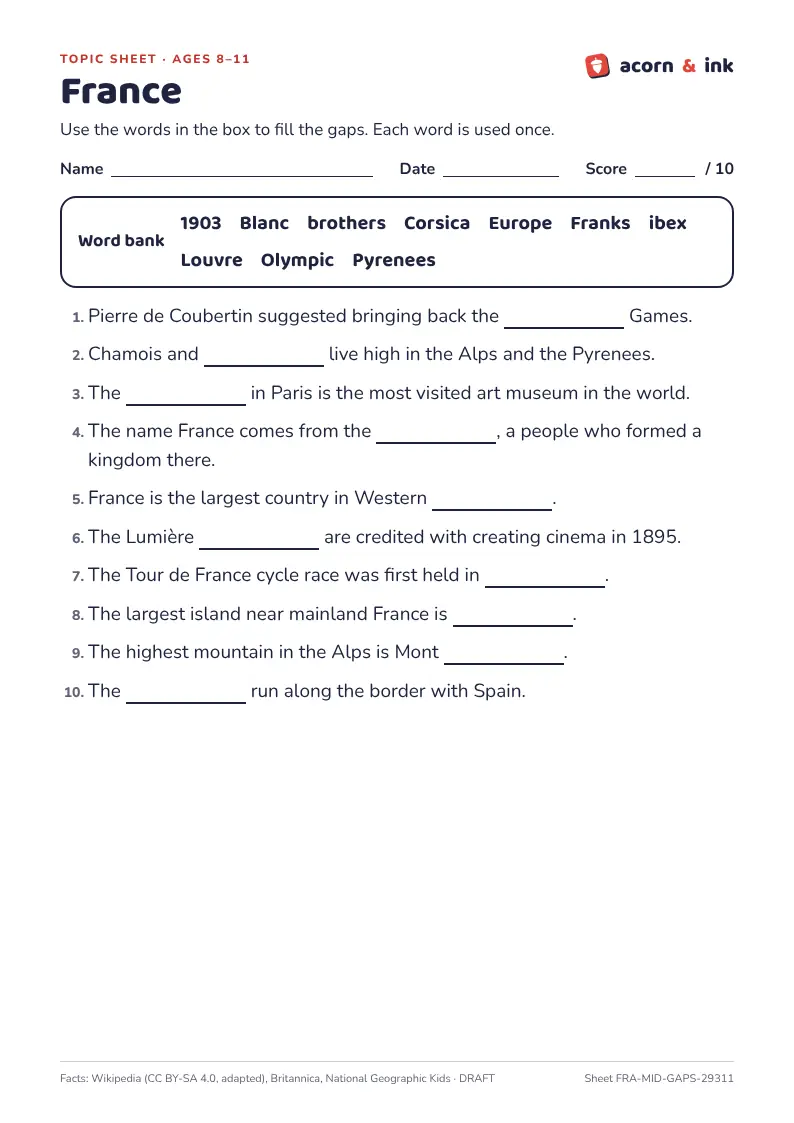
Now check what they remember. Choose the age and the kind of sheet, roll for a fresh one, and print it with or without answers. Label the map comes with an answer page; Colour the flag and My France trip are one page to colour and fill in.
More France activities
More topics
Questions parents ask
- What is France famous for?
- France is famous for Paris and the Eiffel Tower, for its food and its hundreds of cheeses, for art such as Monet’s paintings, and for the Tour de France cycle race. More foreign visitors go to France than to any other country.
- What is the capital of France?
- Paris is the capital and by far the largest city, with more than 13 million people living in and around it. It is nicknamed the “city of light”, and its sights include the Eiffel Tower, the Arc de Triomphe and the Louvre.
- What language do people speak in France, and what money do they use?
- The official language is French, and the money is the euro. Some people also speak regional languages such as Breton, Basque, Occitan, Catalan, Alsatian and Corsican.
- What are the main rivers and mountains in France?
- The four great rivers are the Seine, the Loire, the Garonne and the Rhône. The main mountains are the Alps, the Pyrenees and the Massif Central. Mont Blanc in the Alps, about 4,810 metres high, is the highest point in Western Europe.
- How many people live in France?
- About 67 million people live in mainland France, or about 69 million counting overseas France. The sources give slightly different numbers depending on the year and on whether they count overseas France, so we round them.
- How can you get to France from the UK?
- Through the Channel Tunnel on Eurostar or LeShuttle, or by ferry. The Travels with Five family have taken the ferry from Dover to Calais and from Newhaven to Dieppe, with their car on board.
- Who are some famous French people children might know?
- Claude Monet, who painted the Water Lilies; Victor Hugo, who wrote Les Misérables; the Lumière brothers, who are credited with creating cinema; Charles Perrault, who wrote Cinderella; and Pierre de Coubertin, who suggested bringing back the Olympic Games.
- What ages are these France worksheets for?
- There are three levels: ages 5–7 (Years 1 and 2), ages 8–11 (Years 3 to 6) and ages 12+ (Key Stage 3). Harder subjects, such as the history timeline, regions and departments, massifs and estuaries, and nuclear power, are only in the 12+ sheets.