English › Story writing
Story writing: plan it, then write it
Free printable story writing sheets for ages 5 to 11. There’s a story planner, a story mountain, a character profile, a setting sheet, story paper with a big picture box, and a story starter with a fresh idea every time you roll. Pick the younger or older version and a theme, add a name and a title if you like, and print one sheet or the whole pack.
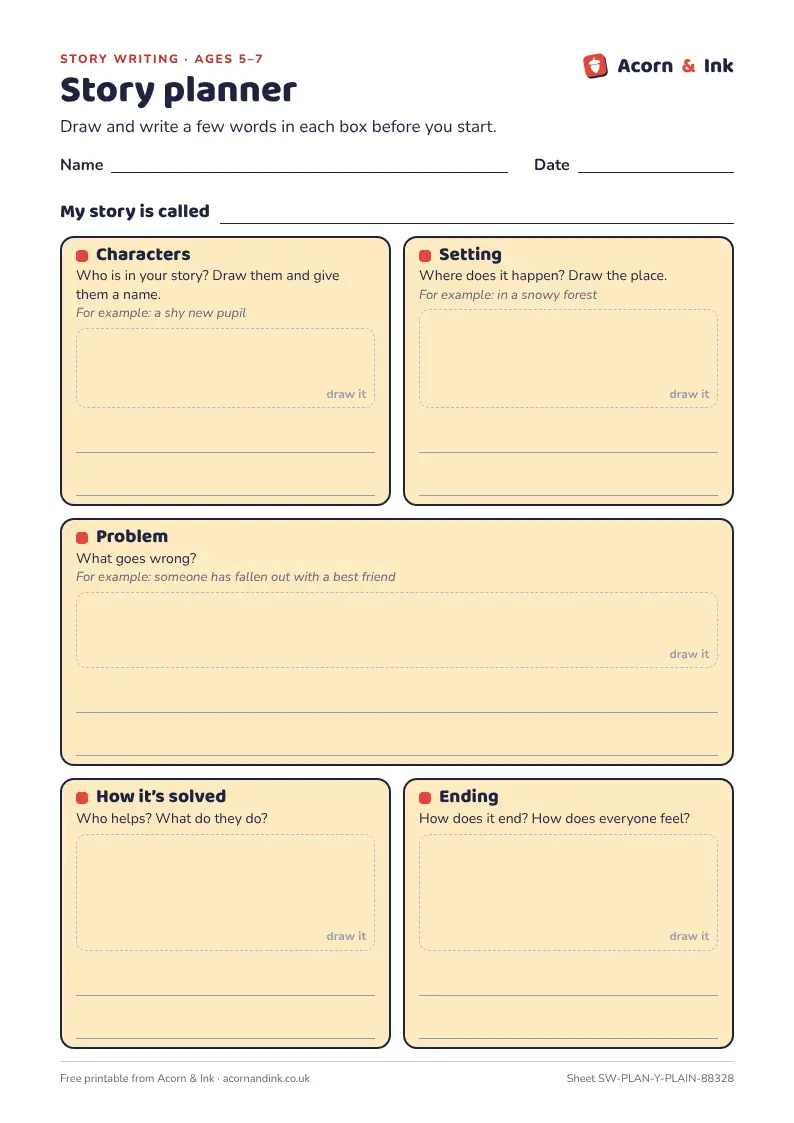
How to plan a story
A plan doesn’t need full sentences. A few words or a quick drawing for each of these is enough to get started.
- 1Who is it about?Choose a main character. Give them a name and think about what they’re like.
- 2Where does it happen?Pick a place, and maybe a time: a sunny morning, a stormy night.
- 3What goes wrong?Every story needs a problem. Something is lost, broken, stuck or in the way.
- 4How does it get fixed?The character, or a friend, does something to sort the problem out.
- 5How does it end?Finish the story. How does everyone feel, and what has changed?
The story mountain
A story mountain is a drawing that shows the shape of a story. It climbs up to the problem at the top, then comes back down as the problem is sorted out. Older children can use it to plan a story in five parts.
- Opening. Meet the character and the setting.
- Build-up. Something starts to happen, and the story heads towards trouble.
- Problem. The top of the mountain: the big thing that goes wrong.
- Resolution. The problem is sorted out.
- Ending. The story finishes, and things settle down again.
Stuck for a character name?
Try the kid-friendly name generators from our sister site, The Name Generators. Press a button and get a name for a fairy, a dragon, a pirate and plenty more.
Make a sheet
Pick a sheet or the whole pack, the younger or older version and a theme. Add a name and a story title if you like, then print.
Tips for parents
- Talk the story through first. Tell the story out loud together before anyone writes. Once the ideas are sorted, the writing is much easier.
- Let younger children draw and dictate. They draw the pictures and tell you the story, and you write their words on the lines. The ideas are still all theirs.
- Use the story dice for ideas. If nobody knows where to start, roll the story dice for a character, a setting and a problem, or roll a new story starter here.
- Don’t correct spelling on the first draft. Let the story flow first. Afterwards, pick one or two things to fix together, and leave the rest.
- Read it back together. When the story is finished, read it aloud and talk about the best bit.
In the National Curriculum for England, story writing comes under writing composition. In Year 1, pupils say out loud what they are going to write about, compose each sentence out loud before writing it, put sentences in order to make short narratives, and re-read what they have written. In Year 2, they write narratives about their own experiences and those of others, real and fictional, and plan or say out loud what they are going to write about. In Years 3 and 4, they plan by discussing writing that is similar to what they are planning to write, and in narratives they create settings, characters and plot. In Years 5 and 6, they plan by identifying the audience and purpose of their writing, and in narratives they describe settings, characters and atmosphere. Source: National Curriculum in England: English programmes of study (Department for Education), summarised in our own words. Crown copyright, Open Government Licence v3.0.
Questions parents ask
- What ages are the story writing sheets for?
- Children aged 5 to 11, from Year 1 to Year 6. The younger version (ages 5 to 7) has big boxes to draw in and fewer, wider lines. The older version (ages 7 to 11) has more lines, more prompts in each box, and a page of extra lines for longer stories.
- What is a story mountain?
- It’s a way to plan a story in five parts: the opening, the build-up, the problem, the resolution and the ending. The story climbs up to the problem at the top of the mountain, then comes back down as the problem gets sorted out.
- Which sheet should we start with?
- Start with the story planner or the story mountain, then write the story on the story paper. If your child can’t think of an idea, print the story starter: it gives a character, a place and a problem to write about. The character profile and setting sheet help when they want to think about one part in more detail.
- What do the themes change?
- The fairy, dragon and pirate themes add small drawings in the corners of each sheet and change the example ideas and the story starter to match. The boxes and lines stay the same. Choose Plain for no drawings and everyday ideas.
- How many pages is the whole pack?
- Six A4 pages: the planner, the story mountain, the character profile, the setting sheet, the story paper and the story starter. If you choose the older version with a second page of lines, it’s seven.