Halloween for kids: turnip lanterns, soul cakes and apple bobbing
Find out where Halloween came from: the name All Hallows’ Eve, the old festival of Samhain, why people in Ireland and Scotland once carved turnips, and how souling and guising grew into trick-or-treating. Print a fact sheet for your child’s age, then make free quizzes and worksheets for ages 5 to 14: missing words, true or false, match the words, a mini quiz, a reading comprehension and design your own turnip lantern.
- Printable worksheetsNo sign-up needed
- Answers includedPrint or save as PDF
- Made for home learningAges 5–14
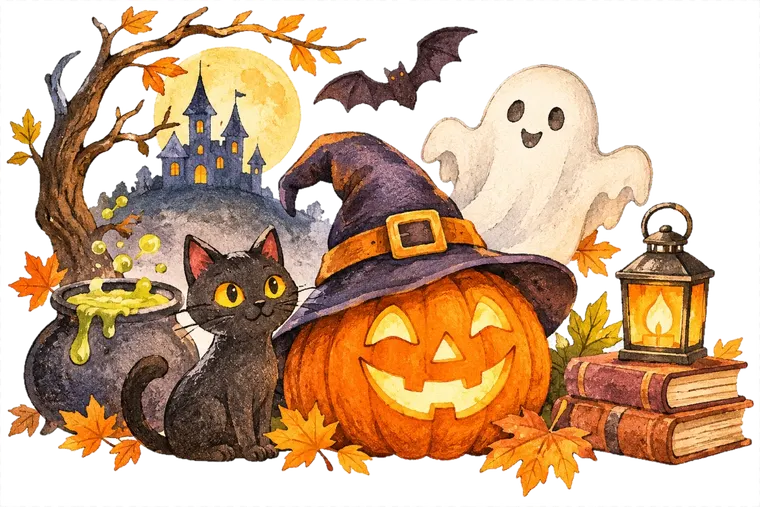
What is Halloween?
Halloween is on 31 October. Today, in most of Europe and North America, it is mainly a time for fun rather than religion: people dress up, carve jack-o’-lanterns, go trick-or-treating and have parties.
Its name is short for All Hallows’ Eve, the evening before All Hallows’ Day. “Hallow” is an old English word that means holy, and it was also used to mean a saint, so All Hallows’ Day is another name for All Saints’ Day.
The spelling Hallowe’en comes from Scotland. In the Lowland Scots language, “even” means evening, and it was shortened to “e’en”. So “All Hallows’ Even” became Hallowe’en, and then Halloween: “the saints’ evening”.
Halloween is the first of three days that Christians call Allhallowtide, a time for remembering the saints and everyone who has died:
- 31 OctoberAll Hallows’ EveHalloween
- 1 NovemberAll Saints’ Dayremembering all the saints
- 2 NovemberAll Souls’ Daypraying for everyone who has died
Samhain: the end of summer
Long before Halloween had its name, people in Ireland, Scotland and the Isle of Man kept a festival called Samhain (say “sow-in”) on 31 October and 1 November. It marked the end of the harvest and the start of winter, the darker half of the year, when farm animals were brought in from the fields.
For the Celtic peoples, a new day began at sunset, so Samhain began on the evening of 31 October. In Wales, a festival like it was called Calan Gaeaf, which means “the first day of winter”.
People believed that at Samhain the boundary between our world and the world of spirits grew thin, so spirits and fairies could cross over more easily. They left out food and drink for them, lit bonfires on the hills, and sometimes wore masks or disguises so that any spirits would not recognise them.
Many books say Halloween grew out of Samhain. Other historians think it grew mainly from the Christian days of All Saints and All Souls. There is more about this for older children below.
All Saints and All Souls
On All Saints’ Day, 1 November, Christians remember all the saints, both famous ones and those nobody has heard of. By about the year 800, churches in Ireland and in Northumbria, in the north of England, were keeping a feast for all the saints on 1 November.
All Souls’ Day, on 2 November, became widespread about 900 years ago, in the 12th century. On this day people prayed for everyone who had died, and church bells were rung.
In some places people lit candles or lanterns on graves, or in their windows, on All Hallows’ Eve. They believed the lights would help to guide the souls of people who had died. On the evening before a big feast day, the Church also held a vigil, with prayers and fasting, and some Christians did not eat meat that day. That is one reason why apples, potato pancakes and soul cakes became Halloween foods.
Turnips before pumpkins
The first Halloween lanterns were not pumpkins. In parts of Ireland, the Scottish Highlands and Somerset, people hollowed out turnips (or other big root vegetables), carved faces in them and put a light inside. In Somerset the custom goes with Punkie Night, and in Scotland the lanterns are called neep or tumshie lanterns.
People carried them from door to door at Halloween. Some said the glowing faces would scare away spirits; others said they stood for the spirits themselves.
A folk tale from Ireland tells of a trickster called Stingy Jack, who tricked the Devil. He ended up wandering in the dark with only a glowing coal to light his way, which he carried in a hollowed-out turnip. That is where the name “Jack-o’-lantern” is said to come from.
In the 1800s, many Irish and Scottish people moved to North America. There they used pumpkins, which grew there and are much bigger and softer than turnips, so they are far easier to carve. Pumpkin carving in America is written about by 1837.
All about pumpkins
Is a pumpkin a fruit or a vegetable? Scientists call it a pepo, a kind of “false berry”. It grows from the flower, has a hard outer skin called a rind and is full of seeds, just like a cucumber or a watermelon, which are pepos too. In the kitchen, though, we cook it like a vegetable, in soups and stews or roasted.
An uncarved pumpkin kept somewhere cool, dry and airy can last for up to about 12 weeks. Once it is carved it only lasts a few days before it goes soft.
Don’t waste it! If your pumpkin is in good condition and hasn’t been sprayed or nibbled, the flesh inside can be roasted or made into soup or pie, and the seeds can be roasted too. What is left can be recycled in ways that are good for the garden.
Souling, guising and trick-or-treating
Children going from door to door at Halloween is not new. In souling, which goes back at least 600 years, poor people, often children, went from house to house around All Saints’ and All Souls’ Days. They offered to pray for the family’s loved ones who had died, and were given a soul cake: a small cake, often marked with a cross. Souling was found in parts of England and Wales, and elsewhere in Europe.
Mumming was another old custom: people in disguise went from house to house and performed for food and drink, sometimes with a blessing for the household.
In Scotland and Ireland, children go guising: they dress up and go from door to door, and perform a song, a joke or a poem in return for a treat, such as food or a coin. Their masks used to be called false faces. Until the 2000s, the usual thing for children in Ireland to call out at the door was “Help the Halloween Party!”
Irish and Scottish people took guising to North America. The words “trick or treat” were first printed in a Canadian newspaper in 1917, and by the middle of the 1900s trick-or-treating was common across the USA. From there it spread around the world again.
- 1400sSouling, for soul cakes, is already a custom.
- 1500sGuising and mumming at Halloween in Ireland, Scotland, the Isle of Man and Wales.
- 1800sIrish and Scottish people take Halloween to North America.
- 1911A newspaper in Ontario, Canada, reports children out “guising”.
- 1917The first known printing of the words “trick or treat”, also in Ontario.
- Mid-1900sTrick-or-treating is common across the USA.
Halloween games
Halloween comes just after the apple harvest, so apples and nuts have long been part of the fun.
In apple bobbing, apples float in a tub of water and you try to pick one up using only your teeth: no hands allowed! In Scotland it is called dooking. Another old game is to hang treacle scones on strings and try to eat one without using your hands, which always ends in a very sticky face.
In Ireland, many families still have a barmbrack at Halloween: a light fruit loaf with a ring, a coin and other small charms baked inside. Finding one in your slice is meant to be lucky. Toffee apples are a Halloween treat too.
Black cats and bats
In the Middle Ages, some people in Europe believed that witches kept black cats as helpers, or could even turn into cats themselves. That is how the idea began that a black cat crossing your path brings bad luck. Old European stories also linked bats with witches, and seeing a bat at Halloween was once thought to be a bad sign.
These are only superstitions. Cats can’t bring bad luck, whatever colour they are. In Scotland and Japan, a black cat can even be a sign of good luck, and in ancient Egypt cats were special to the goddess Bastet.
Halloween’s colours are black and orange, and sometimes purple. The orange comes from pumpkins. Scarecrows are a Halloween decoration too: they stand for Halloween’s old links with farming and the harvest.
Halloween around the world
- IrelandBonfires are still lit in some places, with fireworks, guising, games and barmbrack. Schools close for a Halloween break.
- ScotlandChildren go guising and tell a joke or sing for their treats, and families go dooking for apples.
- WalesThe Welsh name for Halloween is Nos Galan Gaeaf, sometimes called “Winter’s Eve” in English.
- AustriaAll Souls Week runs from 30 October to 8 November. Families leave out bread and lamps for loved ones who have died, and church bells ring on 1 November.
- The PhilippinesIn Pangangaluluwa, children in the countryside drape themselves in white cloth and go from house to house, singing, in return for prayers and sweets.
- JapanHalloween is a big party, with parades, street parties and amazing costumes.
Not Halloween: the Day of the Dead
Día de los Muertos, the Day of the Dead, is a different festival with different roots. It comes from Mexico, from the beliefs of Indigenous peoples such as the Aztecs and the Maya, and is held on 1 and 2 November.
It is a joyful time for families to remember and celebrate loved ones who have died. They build ofrendas, home altars with photos, candles, bright orange marigolds and the person’s favourite foods, and visit and decorate their graves. People in Mexico often say it is not “Mexican Halloween”.
A greener Halloween
In 2019, two UK charities, Hubbub and the Fairyland Trust, worked out that Halloween costumes and decorations in the UK make about 2,000 tonnes of plastic waste every year. That is about as much plastic as 83 million plastic bottles.
Some ideas for a greener Halloween:
- Swap costumes with friends, look in charity shops, or make one from old clothes and cardboard.
- Keep your costume for next year, or give it to someone else.
- Make paper decorations instead of buying plastic ones.
- Eat your pumpkin (see above), so none of it goes to waste.
Fun facts
- Turnips firstBefore pumpkins, people in Ireland and Scotland carved lanterns out of turnips.
- A false berryA pumpkin is a pepo, a kind of “false berry”, like a cucumber or a watermelon.
- Sticky facesOne old game: eat a treacle scone hanging on a string, with no hands.
- DookingIn Scotland, apple bobbing is called “dooking”.
- Help the Halloween PartyUntil the 2000s, children in Ireland usually called out “Help the Halloween Party” at the door.
- First in printThe words “trick or treat” were first printed in a Canadian newspaper in 1917.
- Lucky catsIn Scotland, a black cat can be a sign of good luck.
- No pumpkinPumpkin spice usually has no pumpkin in it: it is cinnamon, nutmeg, cloves and ginger.
- False facesIn Scotland and Ireland, Halloween masks used to be called “false faces”.
- 12 weeksAn uncarved pumpkin kept cool and dry can last up to about 12 weeks.
Key words
- hallow
- an old word meaning holy, or a saint
- Allhallowtide
- the three days from 31 October to 2 November
- Samhain
- a Celtic festival at the end of the harvest and the start of winter
- jack-o’-lantern
- a hollowed-out turnip or pumpkin with a face, lit from inside
- souling
- going door to door for soul cakes, in return for prayers
- guising
- dressing up and performing a song, joke or poem for a treat
- pepo
- a “false berry”, such as a pumpkin, cucumber or watermelon
- superstition
- a belief that something brings good or bad luck, with no proof
For older children and teens
Where did Halloween come from? The debate
- One theory says many Halloween customs came from Samhain, and some writers go further, saying the Church turned Samhain into All Hallows’ Day and its eve. Other scholars argue that Halloween began on its own, as a Christian holiday: the vigil (eve) of All Hallows’ Day.
- The historian Ronald Hutton says there is no evidence that Samhain was first a festival of the dead, though it was certainly a time to guard against supernatural forces. Nicholas Rogers argues that Samhain gave Halloween little except its fire rites, and that most Halloween customs grew up alongside All Saints’ and All Souls’ Days.
- The popular idea that Samhain was the “Celtic New Year” was first suggested by the scholar John Rhys in 1901, based on folk customs he saw in Wales and the Isle of Man. Critics say his evidence was flimsy, yet the idea is still repeated in many books and websites today.
- Souling, recorded from at least the 15th century, may have replaced an older custom of leaving food out for the dead. Some of Halloween’s customs, then, may be very old, even if the festival as a whole is not simply Samhain renamed.
The Reformation and Guy Fawkes Night
- During the Reformation in the 1500s, Protestants in Britain rejected the idea of Purgatory, so ceremonies of prayer for the souls of the dead were stopped. All Hallows’ Day stayed in the Church of England’s calendar, as a day to remember the saints.
- Even so, Halloween carried on in Britain as a festival that was not religious. In parts of England some people kept up souling, candlelit processions or ringing bells for the dead.
- In 18th- and 19th-century rural Lancashire, Catholic families gathered on hills on All Hallows’ Eve. One person held a bunch of burning straw on a pitchfork while the others knelt round and prayed for relatives and friends until the flames went out. This was called teen’lay.
- After 1605, Allhallowtide in England was overshadowed by Guy Fawkes Night (5 November), which took over some of its customs. In Scotland, Halloween customs survived, because the Church of Scotland saw that they mattered to local communities and would be hard to stamp out.
- Wearing costumes and playing pranks at Halloween were customs of Ireland and the Scottish Highlands; they did not spread to England until the 20th century.
Across the Atlantic and back
- In New England, the Puritans strongly opposed Halloween, along with other church festivals such as Christmas. Almanacs from around 1800 give no sign that Halloween was widely kept in North America.
- That changed after large numbers of Irish and Scottish people moved to North America in the 1800s. At first Halloween was kept mainly in their communities, but by the early 20th century it was celebrated across the country by people of all backgrounds.
- The first known printing of the words “trick or treat” was in The Sault Daily Star, a newspaper in Sault Ste. Marie, Ontario, in 1917. Sources differ on when trick-or-treating became widespread in the USA (one says the 1930s, another the 1950s), so we say “by the middle of the 1900s”.
- Then, through American influence, Halloween customs spread to many other countries in the late 20th and early 21st centuries, including mainland Europe, Australia and parts of East Asia, and back to Britain and Ireland in their American form.
Think and discuss
- Many books say Halloween comes from Samhain, but some historians say the evidence is thin. Why might a story about where a festival came from stay popular even if the evidence is weak?
- Irish and Scottish emigrants swapped turnips for pumpkins in North America. What does this tell us about how traditions change when people move?
- American-style Halloween has spread around the world. What might be gained, and what might be lost, when a festival spreads to new places?
- The Day of the Dead is often mistaken for “Mexican Halloween”. Why does it matter to get this right?
- After 1605, Guy Fawkes Night took over some Halloween customs in England. Why might one festival take over the customs of another?
Print the fact sheet
All the facts above on one A4 page, written for each age. Read it together, stick it on the wall, then try the quizzes below.
Choose a sheet to see it below, then print it.
Quiz time
Now check what they remember. Choose the age and the kind of sheet, roll for a fresh one, and print it with or without answers. Design a turnip lantern and Did you know? are one page to fill in, with no answers; for ages 11–14, Did you know? becomes Think and discuss.
More Halloween activities
Halloween crossword
Make the sheet →Halloween flashcards
Make the cards →Write a Halloween story
Make the sheets →A certificate
Make a certificate →More topics

Octopus
Explore octopuses →
Marrakech
Explore Marrakech →
Fossils
Explore fossils →
France
Explore France →
Dinosaurs
Explore dinosaurs →Questions parents ask
- Why is Halloween on 31 October?
- Because it is All Hallows’ Eve, the evening before All Saints’ Day on 1 November. The old Gaelic festival of Samhain was kept at the same time: it marked the start of winter, and because Celtic days began at sunset, it began on the evening of 31 October.
- Why did people carve turnips before pumpkins?
- In Ireland, Scotland and parts of England, people carved lanterns from turnips and other root vegetables. Irish and Scottish people who moved to North America in the 1800s used pumpkins instead, which are bigger and softer and much easier to carve.
- Where did trick-or-treating come from?
- From older door-to-door customs: souling in England, when people prayed for the dead in return for soul cakes, and mumming and guising in Ireland and Scotland, when people in disguise performed a song, joke or poem for a treat. Irish and Scottish emigrants took guising to North America; the words “trick or treat” were first printed in Canada in 1917, and by the middle of the 1900s trick-or-treating was common across the USA.
- Is the Day of the Dead the same as Halloween?
- No. Día de los Muertos is a Mexican festival, held on 1 and 2 November, with roots in the beliefs of Indigenous peoples such as the Aztecs and the Maya. Families remember and celebrate loved ones who have died, with home altars, marigolds and favourite foods. It is a different festival from Halloween, with a different meaning.
- What ages are these Halloween worksheets for?
- There are three levels: ages 5–7 (Years 1 and 2), ages 7–11 (Years 3 to 6) and ages 11–14 (Key Stage 3). Harder ideas, such as the debate about where Halloween came from, the Reformation and Guy Fawkes Night, and how Halloween crossed the Atlantic and came back, are only in the 11–14 sheets.
Sources
Written in our own words. Facts from:- Britannica, “Halloween” by Tamanna Nangia and the Britannica Editors, and “Day of the Dead”
- National Geographic Kids UK, “10 hair-raising Halloween facts”
- V&A Mused, “7 Halloween traditions around the world”
- History.com, “Halloween” (the topic page’s summaries)
- University of Kentucky College of Arts and Sciences, “Fun facts you probably didn’t know about Halloween from a UK folklorist” by Tatum Armstrong and Lindsey Piercy, with Jeanmarie Rouhier-Willoughby (here “UK” means the University of Kentucky)
- BBC Bitesize, “Is pumpkin a fruit or a vegetable?”
- Wikipedia, “Halloween”, CC BY-SA 4.0; text adapted
- Where the sources disagree, we word around it: on when trick-or-treating became widespread in the USA (the 1930s or the 1950s), whether souling was on 1 or 2 November, how old the Stingy Jack tale is, how old Samhain is, and how to say Samhain (“sow-in” or “sow-wen”).
- Drawings: our own.