Home › Topics › Renewable and non-renewable energy
Renewable and non-renewable energy for kids: sun, wind and water, coal, oil and gas
Find out what energy is, how coal, oil and gas formed from plants and tiny sea creatures that lived long ago, and how sunshine, wind, moving water, the Earth’s heat and plants can make electricity, with the good and bad points of each and the UK picture. Print a fact sheet for your child’s age, then make free quizzes and worksheets for ages 5 to 14: missing words, true or false, match the words, a mini quiz, read and answer, renewable or not, an energy hunt at home and design a home powered by renewables.
- Printable worksheetsNo sign-up needed
- Answers includedPrint or save as PDF
- Made for home learningAges 5–14
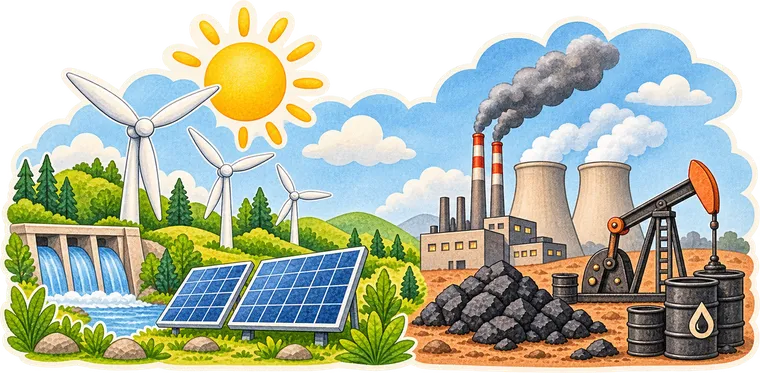
What is energy?
Energy is what makes things work and move. Your body gets its energy from the food you eat, and that lets you run, jump and think. Machines need energy too. Lights, televisions and phones need electricity. Many homes burn gas for heating and cooking, and most cars, trains and planes run on fuel made from oil.
At home we use energy to cook, to keep warm, to heat water, and to power lights and machines. All that energy has to come from somewhere. There are two kinds of energy source:
RenewableWill never run out: the sun, the wind, moving water, heat from inside the Earth, and plants, which grow again.
Non-renewableWill run out one day, and can’t be replaced: coal, oil and gas (and the fuel used in nuclear power).
Think of a rain barrel in the garden. You use some water, and the next shower of rain fills it up again: that is like renewable energy. Non-renewable energy is more like a tube of toothpaste. Once you have squeezed it all out, there is no more.
What are fossil fuels?
Coal, oil and natural gas are called fossil fuels. Like the fossils you can find in rocks, they are made from the remains of things that lived a very long time ago. A fuel is something we burn to get energy.
The energy in fossil fuels first came from the Sun. Long ago, plants used sunlight to grow, and tiny sea creatures fed on them. When we burn coal, oil and gas, we let out energy that has been stored underground for millions of years.
Fossil fuels are non-renewable. New ones would take millions of years to form, so once we use them up, they are gone. Even so, most of the energy the world uses still comes from them: about 87 in every 100 units of energy in 2024, according to Stanford University.
How did coal, oil and gas form?
Coal formed from plants that grew in ancient swamps. Oil and gas formed mainly from plankton: tiny living things, too small to see, that lived in the sea.
- LivingPlants grew in swamps, and plankton lived in the sea.
- BuriedWhen they died, they sank into mud and were covered by more and more layers.
- SqueezedDeep underground, they were heated and squeezed by the rock above them.
- ChangedOver millions of years, plants became coal, and plankton became oil and gas.
Much of the coal we use today began to form in a time called the Carboniferous Period, millions of years before the first dinosaurs. Its name means “coal-bearing”. And no, fossil fuels are not made from dinosaurs. A lot of our oil did form while dinosaurs were alive, but it came from tiny sea plankton and algae, not from dinosaur bones.
How we get them, and what we use them for
Coal is a solid fuel. It has to be dug out of the ground in mines. Some coal is close to the surface, and some lies deep underground.
Oil and gas are found deep below the surface. To get them out, people drill wells, on land and out at sea, where oil rigs stand in the water. Gas and crude oil travel through pipelines, and coal goes by train, boat or lorry.
Before oil can be used, it is refined: split up into different fuels such as petrol, diesel and jet fuel for planes. Oil is also used to make plastics, and in things like cosmetics and medicines.
We use fossil fuels for:
- Electricity: power stations burn them to make heat, which is used to make electricity.
- Heating and cooking: many homes burn gas to keep warm and to cook.
- Transport: most cars, trains and planes use fuels made from oil.
- Making things: plastics and many other materials.
Why are fossil fuels a problem?
They will run out. There is only so much coal, oil and gas in the ground, and it does not renew itself in a human lifetime.
They warm the Earth. Burning coal, oil and gas makes a gas called carbon dioxide. It traps heat around the Earth, like a blanket, and makes the Earth warmer than it should be. This is what scientists call climate change.
They make the air dirty. Burning fossil fuels also gives off other harmful gases and tiny particles that pollute the air, water and land.
Getting them out can harm the land and sea. Coal mines can strip away large areas of land, and oil can spill into the sea from drilling or from ships, which harms sea life.
So why do we still use them?
Fossil fuels have some real advantages, which is one reason why changing away from them takes time. Stanford University lists reasons such as these:
- There is still a lot of them, in many places.
- They pack a lot of energy into a small space, which makes them hard to replace in transport and in industries that need great heat.
- They are easy to store and to move, by pipeline, ship, train or lorry.
- A power station that burns them can be turned up or down to make more or less electricity, whatever the weather.
- Countries already have the power stations, pipelines and vehicles that use them, and many people work in these industries.
Renewable energy: power that won’t run out
Renewable energy comes from natural sources that refill themselves faster than we use them: sunlight, wind, moving water, heat from inside the Earth and plants. These are found in every country, and they give off little or no greenhouse gas while they make electricity.
Most of them use a turbine: a machine with blades that spins when wind, moving water or steam pushes on it. The spinning turbine is used to make electricity. Solar panels are different: they turn sunlight straight into electricity, with nothing moving at all.
-
Solar power
Solar panels turn sunlight straight into electricity. They can sit on a house roof or fill a whole field. Other solar systems use the sun’s heat to warm water. Solar panels even power the International Space Station.
Works anywhere the sun shines, and panels can power a single home.
Makes no electricity at night and less on cloudy days. Big solar farms can take up farmland.
-
Wind power
The wind pushes on the blades of a wind turbine and spins them, and the turbine makes electricity. The stronger the wind, the more it makes. Groups of turbines, called wind farms, are built on high ground or out at sea, where the wind is strongest. One turbine can make enough electricity for up to 1,500 homes.
Needs no fuel once it is built, and it is already the UK’s biggest renewable source.
No wind, no power. Some people dislike how wind farms on land look or sound, and birds and bats can fly into the blades.
-
Hydropower
Hydro means water. Moving water, from a river or let out from behind a dam, rushes through turbines and spins them. The biggest hydropower dam in the world is the Three Gorges Dam in China.
Can be turned up or down, so it can fill the gaps when the wind drops or the sun goes in.
A dam and its lake take up a lot of space, which can affect people and wildlife nearby. New dams cost a lot and take a long time to be approved.
-
Tidal and wave power
The sea is always moving. The flow of the tides and the movement of waves can drive turbines too. These ideas are still quite new: tidal power is the most developed, and the biggest tidal power station is at Sihwa Lake in South Korea.
The UK is surrounded by sea: one estimate says tides and waves could one day cover around 20% of the electricity it needs.
Most of the machines are still being tested and are not yet used on a big scale.
-
Geothermal power
Geothermal means heat from the Earth. Deep underground, the rocks are hot. Where they are near the surface, as in places with volcanoes, they heat water, and the steam can drive a turbine to make electricity. In Iceland, this heat also warms people’s homes directly.
Unlike wind and solar, it doesn’t depend on the weather.
Works best only in some places, where hot rock is close to the surface.
-
Biomass
Biomass is wood, plant waste, animal dung and other things that are, or once were, alive. Burning it makes heat and electricity. Some plants, such as sugar cane and maize, are made into fuels for vehicles. Biomass counts as renewable because new plants grow, and growing plants take carbon dioxide out of the air.
Can be burned whenever it is needed.
It is only renewable if new plants are grown to replace what is burned.
What about nuclear power?
Nuclear power stations give off very little carbon dioxide, so nuclear power is called low-carbon. But it is not renewable, because it uses up its fuel, a radioactive material, which can’t be replaced.
Energy in the UK
Wind is the UK’s biggest source of renewable energy. By summer 2026, the UK had over 32 GW of wind farms (GW, or gigawatts, measure how much electricity they can make at once), about half on land and half out at sea. In 2025, wind power made enough electricity for over 26 million homes, according to RenewableUK, which speaks for the wind industry.
The sea could help too: one estimate says tidal stream and wave energy together could one day cover around 20% of the electricity the UK uses now.
The UK still uses a lot of gas, for heating homes and for making electricity. It is one of the countries that are stopping using coal.
The government publishes official figures for the UK’s renewable energy, from wind and solar to wood and the fuels used in transport, in its renewables statistics.
Look north: Iceland
Iceland gets more than 75% of its energy from low-carbon sources. Most of it comes from hydropower, and most of the rest from geothermal energy: Iceland’s glaciers and volcanoes give it plenty of both.
A short history of energy
Before coal came into wide use in the 1800s, almost all the energy people used was renewable: their own muscles and animals’ muscles, wood fires, water and wind.
- Over 1 million years agoPeople burn wood and plants for fire: the oldest known use of renewable energy.
- About 7,000 years agoPeople use the wind to sail boats.
- Ancient timesWater mills in ancient China and Persia use moving water to do work.
- About 700–900The earliest known windmills, in Iran.
- Late 1700sPeople start using fossil fuels faster than ever before. Fossil fuels power the Industrial Revolution.
- 1883Charles Fritts makes the first solar panel.
- 1982The first large solar power plant is built, in California.
- 2024Renewables make over 30% of the world’s electricity.
Fun facts
- Sunshine insideThe energy in coal, oil and gas first came from the Sun, captured by plants millions of years ago.
- Older than dinosaursMuch of our coal began to form in the Carboniferous Period, millions of years before the first dinosaurs.
- 1,500 homesOne wind turbine can make enough electricity for up to 1,500 homes.
- Solar in spaceSolar panels help power the International Space Station.
- First solar panelCharles Fritts made the first solar panel in 1883.
- Windy UKWind is the UK’s biggest source of renewable energy.
- Ancient windmillsThe earliest known windmills were built in Iran, about 1,100 to 1,300 years ago.
- Hot homesIn Iceland, heat from inside the Earth warms people’s homes.
- Tiny but mightyOil and gas formed mainly from plankton, sea life too small to see.
- Oil on topOil is still the world’s biggest single source of energy.
Key words
- energy
- what makes things work or move
- renewable
- from a natural source that will not run out
- non-renewable
- will run out one day and can’t be replaced
- fossil fuel
- coal, oil or gas, formed from things that lived long ago
- plankton
- tiny sea life; most oil and gas formed from it
- turbine
- a machine with blades that wind, water or steam spins to make electricity
- solar panel
- turns sunlight straight into electricity
- hydropower
- electricity made from moving water
- geothermal
- using heat from inside the Earth
- biomass
- wood, plant waste or dung burned for energy
- carbon dioxide
- a gas made when fuels burn; it traps heat around the Earth
- low-carbon
- giving off little carbon dioxide, like nuclear, wind or solar power
For older children and teens
Earth’s kitchen: how fossil fuels are “cooked”
- Fossil fuels are hydrocarbons: chains of hydrogen and carbon atoms. The energy in them first came from sunlight, captured by ancient plants, algae and plankton through photosynthesis, so they are sometimes called “fossil solar energy”.
- The key is low oxygen. When remains sink to the bottom of a swamp or sea and are buried quickly where there is little oxygen, they don’t rot away. Instead, heat and pressure slowly change them.
- Woody plants change step by step into peat, then brown lignite, then coal, then hard anthracite. Most of our coal was laid down in the Carboniferous Period, when swamps, bogs and marshes were common.
- Plankton becomes oil only within a certain range of temperature and pressure, called the oil window. With more heat and pressure, the same material breaks down further into natural gas.
- Much oil formed in the Mesozoic Era, the age of the dinosaurs, when the climate was warm, there were no polar ice caps and much of the deep ocean floor was low in oxygen: a “plankton paradise”.
- Burning fossil fuels reverses that slow process, sending carbon that was stored in the Earth’s crust for hundreds of millions of years back into the air.
The greenhouse effect and carbon dioxide
- Carbon dioxide (CO₂) and other greenhouse gases trap heat in the atmosphere. They occur naturally, and without them the Earth would be much colder. Burning fossil fuels releases carbon that was locked away hundreds of millions of years ago, adding extra CO₂, so more heat is trapped and the planet warms.
- Most human-caused greenhouse gas emissions come from burning fossil fuels. The estimates vary a little: about 77% (Stanford, for 2023), “nearly three-fourths” over the past 20 years (US Department of Energy), and roughly 80% (Eurostat).
- Coal and oil are among the biggest contributors. Gas is often described as cleaner than coal and oil, but burning it still releases CO₂. Stanford also counts methane that leaks from oil and gas wells, coal mines and gas pipelines as part of fossil fuels’ effect on the climate.
- The UN says the power sector, making electricity and heat, was the largest single source of greenhouse gas emissions in 2023.
Acid rain and air pollution
- Burning coal and oil releases sulphur dioxide (SO₂) and nitrogen oxides (NOₓ). High in the air these dissolve in water vapour and fall as acid rain. Nitrogen oxides also help to cause smog.
- Acid rain can make lakes and rivers harmful to some plants and animals, damage forests by washing nutrients out of the soil, and eat away at buildings.
- Burning fuels also releases tiny particles, called particulates, and toxins such as mercury. Some pollutants can be removed in a power station’s chimney before they escape, and leftovers such as coal ash have to be dealt with safely.
When the wind drops: variable power and storage
- Wind and solar are variable (or intermittent): solar makes nothing at night, and wind power rises and falls with the wind speed. Hydropower, geothermal and bioenergy can be controlled more easily, and fossil fuel power stations can be turned up and down to match demand.
- So the electricity supply has to be balanced. One answer is energy storage: saving energy when lots is being made and little is needed, and sending it back to the grid later. Pumped-storage hydroelectricity is the most common way to store electricity for the grid; batteries are being used more and more in homes and on the grid; and hydrogen made with renewable electricity may store energy for longer.
- Other answers include using a mix of different renewables, “smart” grids, charging electric cars when there is plenty of power, and building more wind and solar than is needed on an average day.
Renewable is not the same as low-carbon
- Nuclear power gives off almost no CO₂ while it runs, so it is low-carbon. But it uses up a radioactive fuel that can’t be replaced, so it is not renewable.
- Biomass is renewable, because plants regrow and take in CO₂ as they grow. But burning it still gives off carbon, though less than fossil fuels, and it can release a lot if new plants are not grown to replace what is burned.
- Biomass can also harm forests if it isn’t managed well. Growing palm oil for biodiesel, for example, has led to rainforests being cut down, and some biomass is not sustainable if it is used up too quickly.
Renewables have trade-offs too
- Metals and mining. Wind turbines need a lot of copper and zinc; solar panels need aluminium; batteries use copper, nickel, aluminium and graphite. Demand for lithium for batteries is expected to grow about 42 times between 2020 and 2040. Mining can harm the environment: lithium mining, for example, uses a lot of water in some deserts. Recycling metals from old batteries could reduce the need for new mining.
- Land and nature. Wind, solar and hydro plants can need up to 10 times more land than fossil fuel plants for the same energy, and over 2,000 have been built, or are being built, in important areas for nature. The researchers who found this support renewables, but say the key is to build them in places where they don’t harm wildlife.
- Living nearby. Some people object to wind farms near their homes because of how they look or sound, while surveys usually show strong support for wind and solar power overall. Wind farms owned by local communities can help win local support.
Oil spills
- Oil drilled from under the sea bed, or carried in ships, can spill into the sea through accidents. Spilled oil harms ocean life, and refineries can pollute the air and water.
- In 2010, the Deepwater Horizon spill in the Gulf of Mexico was the largest marine oil spill in US history. Scientists have studied it for years, to learn where the oil went and how it affected the coast and sea life.
- Old oil and gas wells and coal mines that are no longer used can keep polluting the environment if they are not properly cleaned up and sealed.
The numbers, and why they differ
- Different sources give different figures for how much of the world’s energy comes from fossil fuels: about 90% (Britannica Kids), up to 78% (BBC Bitesize) and 87% in 2024 (Stanford). They may measure different things, or different years. For electricity alone, Stanford and the UN both say nearly 60%.
- Stanford’s figures for 2024 show China and the USA as the biggest users of fossil fuels, and China, the USA and Russia as the biggest producers in 2023.
- How much oil is left? BBC Bitesize says around 1.6 trillion barrels (2023); Stanford gives 1.7 trillion barrels of “proved reserves” (2024). Estimates change as new oil is found and technology changes.
- Renewables are growing fast: by 2024 they made over 30% of the world’s electricity, up from about 20% in 2011 (Kiddle).
How fast should we change? Different views
- The United Nations says that, to avoid the worst effects of climate change, the world needs to cut greenhouse gas emissions by almost half by 2030 and reach “net zero” by 2050. It points out that renewable power is now often cheaper than coal, oil or gas.
- Others stress how hard the change is. Stanford’s list of reasons why fossil fuels are still so widely used shows some of them: fossil fuels are plentiful, easy to store and move, can be turned up or down when needed, are hard to replace in transport and in industries that need great heat, and support many jobs. Renewables, for their part, need new mining, land and ways to store energy.
- People disagree about how fast to change, how to pay for it, and how to protect jobs, nature and energy bills along the way. Thinking these questions through, with the evidence, is part of studying energy.
Think and discuss
- Fossil fuels are reliable and easy to store, but they warm the Earth and will run out. How would you weigh up these points?
- Wind and solar power vary with the weather. What could a country do to keep the lights on when it is calm and dark?
- Nuclear power is low-carbon but not renewable. Should it count as “clean” energy? Give reasons for and against.
- A wind farm is planned near a village. Who might be for it, who might be against it, and why?
- Batteries for renewable energy need metals that have to be mined. How can we compare the harm from mining with the harm from burning fossil fuels?
- Some people want to change to renewables as fast as possible; others want to go more slowly. What are the strongest arguments on each side?
Print the fact sheet
All the facts above on one A4 page, written for each age. Read it together, stick it on the wall, then try the quizzes below.
Choose a sheet to see it below, then print it.
Quiz time
Now check what they remember. Choose the age and the kind of sheet, roll for a fresh one, and print it with or without answers. Renewable or not? has an answer sheet too. The energy hunt, Design a renewable home and Did you know? are one page to fill in, with no answers; for ages 11–14, Did you know? becomes Think and discuss.
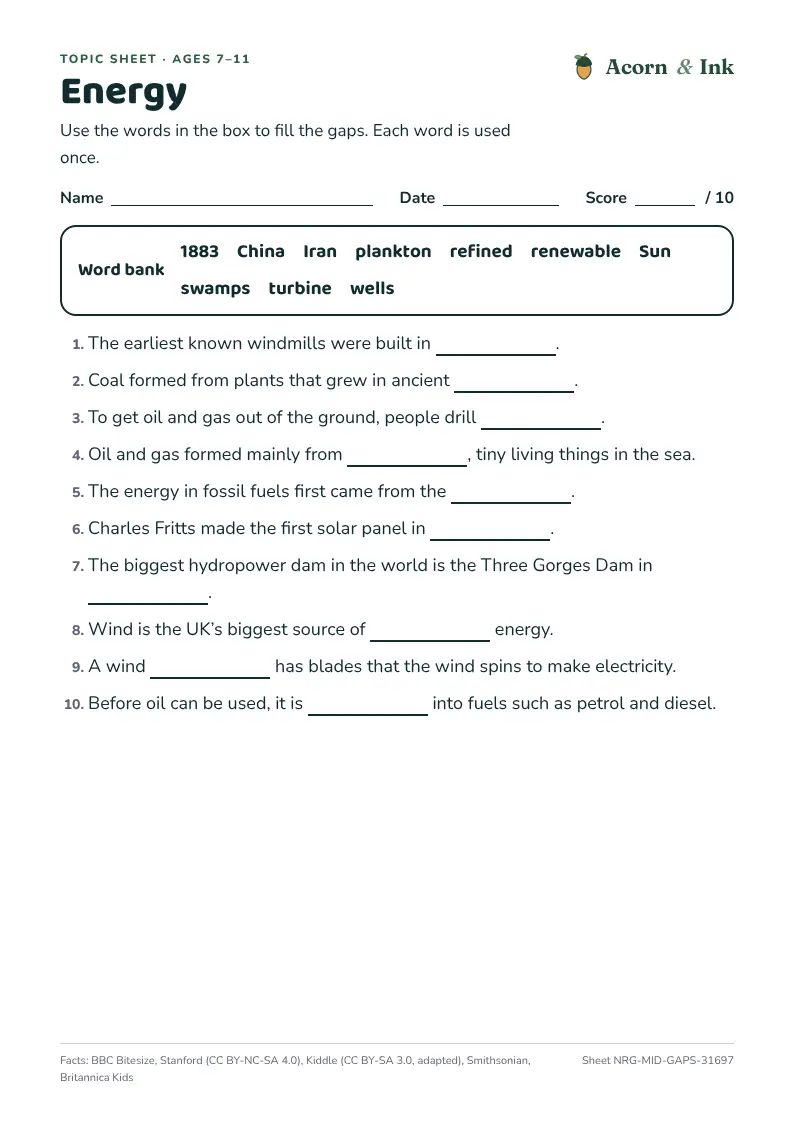
More energy activities
Energy crossword
Make the sheet →Energy flashcards
Make the cards →Energy bingo
Make the cards →A certificate
Make a certificate →More topics
Octopus
Explore octopuses →
Marrakech
Explore Marrakech →
Fossils
Explore fossils →
France
Explore France →
Dinosaurs
Explore dinosaurs →
Halloween
Explore Halloween →Questions parents ask
- What is the difference between renewable and non-renewable energy?
- Renewable energy comes from natural sources that refill themselves and won’t run out: sunlight, wind, moving water, heat from inside the Earth and plants, which grow again. Non-renewable energy comes from sources that will run out one day and can’t be replaced in a human lifetime: coal, oil and gas (the fossil fuels), and the fuel used in nuclear power stations.
- Is nuclear power renewable?
- No. Nuclear power is low-carbon, because it gives off very little carbon dioxide, but it is not renewable, because it uses up a radioactive fuel that can’t be replaced. That is why “renewable” and “low-carbon” don’t always mean the same thing.
- Why do we still use fossil fuels?
- They still supply most of the world’s energy, and they have real advantages: there is still a lot of them, they pack a lot of energy into a small space, they are easy to store and move, power stations that burn them can be turned up or down whenever more or less electricity is needed, and countries already have the power stations, pipelines, vehicles and workers that use them. Against that, they will run out, they warm the Earth and they pollute the air. People disagree about how fast to change, and our 11–14 sheets look at the different views.
- Where does the UK get its renewable energy?
- Mostly from wind, which is the UK’s biggest renewable source: in 2025, wind farms on land and at sea made enough electricity for over 26 million homes. The UK also uses solar power, and wood and other biomass, and one estimate says tides and waves could one day cover around 20% of its electricity.
- What ages are these energy worksheets for?
- There are three levels: ages 5–7 (Years 1 and 2), ages 7–11 (Years 3 to 6) and ages 11–14 (Key Stage 3). Harder ideas, such as the greenhouse effect, acid rain, storing energy, the trade-offs of renewables and the debate about how fast to change, are only in the 11–14 sheets.
Sources
Written in our own words. Facts from:- BBC Bitesize, “What is renewable and non-renewable energy?” (KS2 Science) and “Explore fossil fuels and renewable energy” (KS2 Geography)
- Stanford University Understand Energy Learning Hub, “Introduction to Fossil Fuels” (updated December 2025), CC BY-NC-SA 4.0; facts adapted
- Kiddle, “Renewable energy facts for kids”, CC BY-SA 3.0; text adapted
- Smithsonian Ocean, “What are fossil fuels?”
- BBC Science Focus, “The biggest myth about fossil fuels and dinosaurs, debunked by science”
- Jeff Simpson and Carolina Londoño Michel, “Fossil Fuels – An Overview”, in Dynamic Planet: Exploring Geological Disasters and Environmental Change, CC BY-NC-SA 4.0; text adapted
- Britannica Kids, “fossil fuel”
- US Department of Energy, “Fossil”
- Eurostat, Statistics Explained, “Glossary: Fossil fuel”
- Greenpeace UK, “Fossil fuels” (used for plain facts only)
- United Nations, “Renewable energy – powering a safer and prosperous future” (used for plain facts only)
- RenewableUK, “Facts and figures” (last updated 30 July 2026)
- GOV.UK, Department for Energy Security and Net Zero, “Renewables statistics”. Crown copyright, Open Government Licence v3.0
- A “Fossil Fuel Facts” sheet supplied to us, used only where another source agrees
- The curriculum note is a short paraphrase of the National Curriculum in England science and geography programmes of study (Department for Education). Crown copyright, Open Government Licence v3.0
- Where the sources disagree, we say so or word around it: on how much of the world’s energy comes from fossil fuels (about 90%, up to 78% or 87%), which country uses the most fossil fuels (we follow Stanford’s 2024 figures), how much oil is left (1.6 or 1.7 trillion barrels), and how old solar power is (BBC Bitesize says almost 200 years, but dates the first solar panel to 1883, so we give the date).
- Drawings: our own.