Christmas for kids: the nativity story, Victorian Christmas and traditions around the world
Find out what Christmas celebrates and the story of the first Christmas, what Advent and the Twelve Days are, where Christmas trees, cards and crackers came from, who Saint Nicholas was, and how Christmas is kept around the world. Print a fact sheet for your child’s age, then make free quizzes and worksheets for ages 5 to 14: missing words, true or false, match the words, a mini quiz, read and answer, Christmas around the world, design a Christmas card and a thank-you letter.
- Printable worksheetsNo sign-up needed
- Answers includedPrint or save as PDF
- Made for home learningAges 5–14
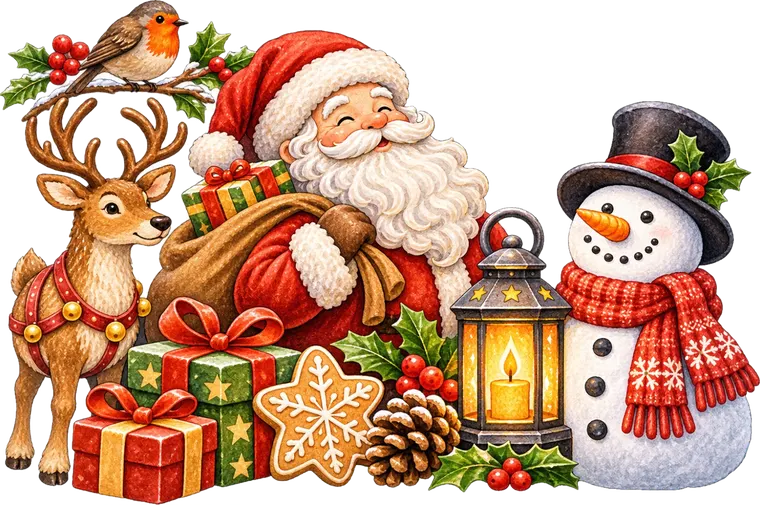
What is Christmas?
Christmas is a Christian festival. It celebrates the birth of Jesus, who Christians believe was the son of God. For most people it is on 25 December.
No one knows the exact date when Jesus was born. Most Orthodox Christians, for example in Russia, keep Christmas on 7 January, because they follow an older calendar (there is more about this below).
Christmas is also enjoyed as a holiday by many people who aren’t Christian. Christmas Day is a public holiday in many countries, including some where most people aren’t Christian. In Japan, for example, few people are Christians, but Christmas trees, decorations and presents are popular.
The story of the first Christmas
Christians believe that Jesus was born in Bethlehem, a town that today is in an area of the Middle East called the West Bank. The story of his birth is called the nativity. It comes from two books of the Bible, the Gospels of Matthew and Luke, and the two tell it a little differently.
Luke’s Gospel
- The angel Gabriel visits Mary to tell her she will have a baby.
- Mary and Joseph travel from Nazareth to Bethlehem, to be counted in a census.
- There is no room at the inn, so Jesus is born in a stable and laid in a manger.
- Angels tell the shepherds the news. The shepherds come to see the baby, then spread the word.
Matthew’s Gospel
- An angel visits Joseph.
- Wise men, called the Magi, follow a star to Bethlehem.
- They bring gifts of gold, frankincense and myrrh.
Many Christmas customs remember this story. A star on top of a Christmas tree stands for the star the wise men followed, and an angel on top stands for the angels in the story. Nativity plays grew from the tradition of nativity scenes (see Christmas trees and decorations).
Where does the name come from?
The word Christmas comes from the Old English Cristes mæsse, which means “Christ’s Mass”.
In Xmas, the X is not a letter X at all: it is the Greek letter chi (Χ), the first letter of Christos (Χριστός), the Greek word for Christ. People have used this short form for hundreds of years.
Christmas has other names too. Noël, as in the carol “The First Nowell”, comes from the Latin word for “birth” or “birthday”. Yule was the Anglo-Saxon name for the midwinter season. In Scotland, Yule was the main name for Christmastime until modern times.
Advent and the Twelve Days of Christmas
Advent is the time of getting ready for Christmas. It starts on the fourth Sunday before Christmas. The word comes from the Latin adventus, which means “arrival” or “coming”. Many families mark Advent with an Advent calendar or an Advent wreath.
Christmas doesn’t stop on Christmas Day. The Twelve Days of Christmas run from 25 December to 5 January, and the last of them is called Twelfth Night. In some countries, Twelfth Night is the traditional time to take the decorations down.
The next day, 6 January, is Epiphany, which marks the wise men’s visit to the baby Jesus. The word comes from the Greek for “show” or “reveal”.
- Advent SundayThe fourth Sunday before ChristmasAdvent begins
- 6 DecemberSaint Nicholas’s Dayhis feast day
- 25 DecemberChristmas Daythe first of the Twelve Days
- 5 JanuaryTwelfth Nightthe last of the Twelve Days
- 6 JanuaryEpiphanythe wise men’s visit
- 7 JanuaryOrthodox Christmasfor most Orthodox Christians
Father Christmas and Saint Nicholas
Father Christmas is also called Santa Claus. It’s said that he delivers presents on Christmas Eve, on a sleigh pulled by flying reindeer.
The name Santa Claus comes from Sinterklaas, the Dutch name for Saint Nicholas. Saint Nicholas was a Christian bishop who lived in the 4th century, at a place called Myra. He was known for being kind and generous and for giving gifts, and he became the patron saint of children. His feast day is 6 December.
In Germany, St Nikolaus brings small gifts, such as sweets, nuts and fruit, on 6 December, and in some places children put out their shoes for them. Around the world, there are other gift-bringers too:
- The ChristkindIn parts of Austria, Switzerland, southern Germany, the Czech Republic, Slovakia and Hungary, the Christkind (the Christ Child) brings the presents.
- La BefanaIn Italy, it’s said that a kind witch called La Befana flies on a broomstick, delivering toys.
- The Yule LadsIn Iceland, children leave a shoe on the windowsill for the 13 Yule Lads. Good children find sweets in it; naughty ones find a rotten potato!
- Saint BasilIn Greece, children get presents from Saint Basil, on New Year’s Eve.
- The StarmanIn Poland, different regions have different gift-bringers, such as the Starman and the Little Angel. Saint Nicholas brings gifts everywhere on 6 December.
Christmas trees and decorations
Long before Christmas trees, people used evergreens, plants that stay green all winter, as symbols of life that lasts. Historians think this may go back to the Romans and the Ancient Egyptians.
In Germany in the 1500s, people decorated fir trees at Christmas. The first decorations were fruit, such as apples, and nuts; later came sweets, paper shapes and candles, the very first Christmas tree lights. One early record of a Christmas tree comes from Strasbourg Cathedral, in 1539. Tinsel was first made in Nuremberg, Germany, in 1610, and it was once made of silver. Germany also made the earliest artificial Christmas trees, out of dyed goose feathers.
In Britain, the German-born Queen Charlotte first brought in the Christmas tree in the early 1800s. Trees became popular after Queen Victoria married the German Prince Albert: in 1848 a picture of the royal family’s tree at Windsor Castle caused a sensation.
Every year, Norway sends a Christmas tree to London. It stands in Trafalgar Square and is about 20 metres tall. It is a thank-you for Britain’s help to Norway in the Second World War. A Christmas tree grown in the ground can take up to 15 years to grow about 2 metres tall.
Nativity scenes
In 1223, Saint Francis of Assisi made a famous nativity scene, showing the birth of Jesus, at Greccio in Italy. This helped nativity scenes spread across Europe, and nativity plays grew from this tradition.
Christmas colours and plants
The traditional Christmas colours are green, for the evergreen trees that stay green all winter, gold, for the wise men’s gift of gold, and red. Holly, ivy and mistletoe are traditional Christmas plants. Poinsettias come from Mexico, where the plant is called the Flower of the Holy Night.
A story says that in 1670 a German choirmaster asked a sweet-maker to shape sweets like a shepherd’s crook, to remind people of the shepherds in the nativity story. That is said to be how candy canes got their shape.
Christmas in history
Christmas has been a big day in Britain for a very long time. William the Conqueror was crowned King of England on Christmas Day 1066.
In the Middle Ages, Christmas was a big public festival. People decorated with holly, ivy and other evergreens, and held great feasts. At one feast given by King Richard II in 1377, the guests ate 28 oxen and 300 sheep! In those days, gifts in England were given at New Year.
In the 1640s, the Puritans who ran Parliament banned Christmas. They thought it had become too much about partying, and that people had forgotten what it meant to Christians. Many people carried on celebrating in secret, and sang carols in secret too. Christmas was allowed again in 1660, when King Charles II came back to the throne.
- 1066William the Conqueror is crowned on Christmas Day.
- 1377Richard II’s Christmas feast: 28 oxen and 300 sheep.
- 1640sThe Puritans in Parliament ban Christmas.
- 1660Christmas is allowed again when Charles II returns.
- Early 1800sQueen Charlotte brings in the Christmas tree.
- 1843The first Christmas card, and A Christmas Carol.
- 1848A picture of the royal tree at Windsor causes a sensation.
- 1871Christmas Day becomes a bank holiday in Scotland.
- 1879The first Christmas grotto opens, in Liverpool.
A Victorian Christmas
Many of the Christmas traditions we have in the UK today grew popular in Victorian times, the years when Queen Victoria was on the throne. Queen Victoria and Prince Albert loved Christmas. Christmas cards, giving presents, crackers, mince pies and roast turkey all became popular then.
The first Christmas card was made in 1843. Sir Henry Cole had it made, and an artist called John Callcott Horsley designed it. It said “A Merry Christmas and a Happy New Year to You”, and about 1,000 were printed.
Also in 1843, Charles Dickens wrote A Christmas Carol, which helped make Christmas a time for family, kindness and generosity, it made the words “Merry Christmas” popular, and the name of one of its characters, Scrooge, came to mean a mean person.
Early in Victorian times, mince pies still had meat in them, a habit that went back to Tudor times. Over the 1800s, the recipe changed to the fruit and spices we know today. And in 1879 the first Christmas grotto opened, in Lewis’s department store in Liverpool.
Christmas food
In the UK, a typical Christmas dinner is turkey or another big bird, with roast potatoes, vegetables and gravy. In recent years many people have a nut roast too. For pudding there might be Christmas pudding, mince pies, Christmas cake or a Yule log.
Oranges have been part of Christmas for a long time, because they were one of the few fruits found in northern countries in winter. Other countries have their own Christmas foods:
- ItalyPanettone, a sweet fruit bread from Milan.
- FranceBûche de Noël, a cake shaped like a log.
- GermanyStollen.
- SwedenA Christmas smörgåsbord, with ham, meatballs and herring.
- Poland and ScandinaviaFish is often the main course. In Sicily, 12 kinds of fish are eaten on Christmas Eve.
- JapanMany families eat fried chicken at Christmas, a habit that began with an advert in 1974.
Carols and Christmas songs
Carols began as folk songs, sung at celebrations such as harvest as well as at Christmas, and only later were they sung in church. Some carols we still sing, such as “Good King Wenceslas” and “In dulci jubilo”, go back to the Middle Ages. Charles Wesley wrote the words of “Hark! The Herald Angels Sing”, and the tune of “Deck the Halls” is a Welsh tune from 1794.
“Jingle Bells” doesn’t mention Christmas, Jesus or Santa, because it was first written for Thanksgiving, an American holiday. And “White Christmas”, sung by Bing Crosby, is the best-selling Christmas song of all time.
Christmas around the world
Christmas is kept in many different ways. Here are some traditions from around the world:
- The PhilippinesThe longest Christmas season of all, with decorations from September to January, and star-shaped lanterns called parols.
- SwedenStraw Yule goats tied with red ribbon are a traditional decoration. The town of Gävle builds a giant straw goat every year; at its tallest it was about 15 metres high.
- RomaniaOn Christmas Eve, people dressed as goats (capra), in bright costumes, go through the streets with singers.
- FinlandMany families take a Christmas sauna on Christmas Eve, and leave treats for the sauna elf, Saunatonttu, to thank him for keeping the sauna warm.
- LatviaIn the twelve days of Christmas, mummers in masks, often dressed as animals, go from house to house, and are given treats in return for a dance.
- UkraineA folk tale tells of a poor woman who had no decorations for her tree. Overnight, spiders spun webs all over it. Finding a spider’s web on the tree is thought to be lucky.
- EthiopiaChristmas, called Genna or Ledet, is on 7 January.
- ArmeniaThe Armenian church celebrates the birth of Jesus on 6 January.
- Christmas IslandThere are two of them: one in the Pacific Ocean and one in the Indian Ocean.
Fun facts
- Christ’s MassThe word Christmas comes from the Old English for “Christ’s Mass”.
- X marks the chiThe X in Xmas is the Greek letter chi, the first letter of the Greek word for Christ.
- Silver tinselTinsel was first made in Nuremberg, Germany, in 1610, and was once made of silver.
- Feather treesThe earliest artificial Christmas trees were made in Germany from dyed goose feathers.
- Meaty mince piesEarly in Victorian times, mince pies still had meat in them.
- Not for Christmas“Jingle Bells” was first written for Thanksgiving, an American holiday.
- A thank-you treeNorway sends London a Christmas tree every year, to thank Britain for its help in the Second World War.
- Two islandsThere are two Christmas Islands: one in the Pacific Ocean and one in the Indian Ocean.
- A royal feastAt Richard II’s Christmas feast in 1377, the guests ate 28 oxen and 300 sheep.
- Slow growersA Christmas tree can take up to 15 years to grow about 2 metres tall.
Key words
- Advent
- the time of getting ready for Christmas; from the Latin for “coming”
- nativity
- the birth of Jesus, and the story of it
- manger
- where the baby Jesus was laid after he was born
- Magi
- another name for the wise men who followed the star
- Epiphany
- 6 January, which marks the wise men’s visit; from the Greek for “show”
- carol
- a Christmas song; carols began as folk songs
- evergreen
- a plant that stays green all winter
- Yule
- the Anglo-Saxon name for the midwinter season
For older children and teens
Why 25 December? Two ideas
- The Gospels don’t say what day Jesus was born, and no one knows the exact date. Some historians think it may have been in spring, because the shepherds were out in the fields with their flocks, as they would be at lambing time.
- In the 4th century, the Church in Rome chose 25 December. The oldest record that gives 25 December as Jesus’s birthday is a Roman calendar from AD 336.
- One idea: in the Roman calendar, 25 December was the winter solstice, when the days begin to get longer, and a Roman sun festival was held on that day.
- Another idea: early Christians worked the date out for themselves, by counting nine months on from 25 March.
- Historians still disagree, and the question hasn’t been settled.
Where did Christmas customs come from? The debate
- Some writers say many Christmas customs came from older winter festivals, such as the Germanic Yule. Other scholars argue that most of them grew up among Christians.
- Evergreens were used as symbols of life that lasts long before Christmas trees; historians think this may go back to the Romans and the Ancient Egyptians. Fir trees decorated at Christmas are recorded in Germany in the 1500s, with an early record from Strasbourg Cathedral in 1539. Riga, in Latvia, says it had the first decorated Christmas tree, in 1510.
- Some customs began with a single person or event. Saint Francis of Assisi’s nativity scene at Greccio in 1223 helped nativity scenes spread across Europe, and a story says the candy cane’s crook shape began with a German choirmaster in 1670.
- Customs also move between countries. The Christmas tree came to Britain from Germany with Queen Charlotte in the early 1800s, and spread after Queen Victoria married the German Prince Albert.
The Puritan ban
- In the 1640s, during the time when the Puritans ran Parliament, Christmas was banned. The Puritans thought it had become too much about partying, and that its religious meaning had been forgotten.
- Many people carried on regardless. They celebrated in secret, held secret services, and sang carols in secret.
- Christmas was allowed again in 1660, when King Charles II came back.
- In Scotland, Christmas Day only became a bank holiday in 1871.
Dickens and the “Victorian Christmas”
- People sometimes say the Victorians “invented” the family Christmas. Many traditions did grow popular in Victorian times: Christmas cards, giving presents, crackers, mince pies and roast turkey. Queen Victoria and Prince Albert loved Christmas, and a picture of their tree at Windsor in 1848 caused a sensation.
- Charles Dickens’s A Christmas Carol (1843) helped make Christmas a time for family, kindness and generosity. It made the phrase “Merry Christmas” popular, and the name Scrooge came to mean a mean person.
- But many customs are much older: feasts and evergreen decorations in the Middle Ages, carols such as “Good King Wenceslas”, nativity scenes from the 1200s and decorated trees in Germany from the 1500s. Even Victorian customs changed: early in the period mince pies still had meat in them, a habit from Tudor times.
The Christmas truce of 1914
- During the First World War, at Christmas 1914, soldiers on opposing sides held informal truces, agreeing among themselves to stop fighting.
- Some sang, some swapped small gifts, and some even played football together.
Two calendars, and Christmas as a cultural mix
- Most Orthodox Christians, for example in Russia, celebrate Christmas on 7 January. They use an older calendar, the Julian calendar, which is 13 days behind the Gregorian calendar that most of us use.
- In Ethiopia, Christmas (Genna or Ledet) is on 7 January, and the Armenian church celebrates the birth of Jesus on 6 January.
- Christmas is a Christian festival, but it is also enjoyed as a cultural holiday by many people who aren’t Christian. It is a public holiday in many countries, including some where most people aren’t Christian. In Japan, few people are Christians, but Christmas trees, decorations and gifts are popular, and many families eat fried chicken at Christmas.
- Each country mixes in its own customs: parols in the Philippines, straw goats in Sweden, the sauna elf in Finland, mummers in Latvia and the Yule Lads in Iceland.
Think and discuss
- Christmas was banned in the 1640s, yet many people kept celebrating in secret. Why might people keep a tradition going even when it is banned?
- In Japan, few people are Christians, but Christmas trees, decorations and gifts are popular. Why do you think so many countries where most people aren’t Christian enjoy Christmas?
- Cards, crackers, mince pies and roast turkey all grew popular in Victorian times. Which of your family’s Christmas traditions are really Victorian, and which might be older?
- Historians have two main ideas about why 25 December was chosen. What kind of evidence would help you decide between them?
- In 1914, soldiers on opposing sides sang and swapped small gifts at Christmas. What does this tell us about what Christmas meant to them?
- Some scholars say Christmas customs came from older winter festivals; others say most grew up among Christians. Why might it be hard to know where a custom began?
Print the fact sheet
All the facts above on one A4 page, written for each age. Read it together, stick it on the wall, then try the quizzes below.
Choose a sheet to see it below, then print it.
Quiz time
Now check what they remember. Choose the age and the kind of sheet, roll for a fresh one, and print it with or without answers. Christmas around the world has an answer sheet too. Design a Christmas card, the thank-you letter and Did you know? are one page to fill in, with no answers; for ages 11–14, Did you know? becomes Think and discuss.
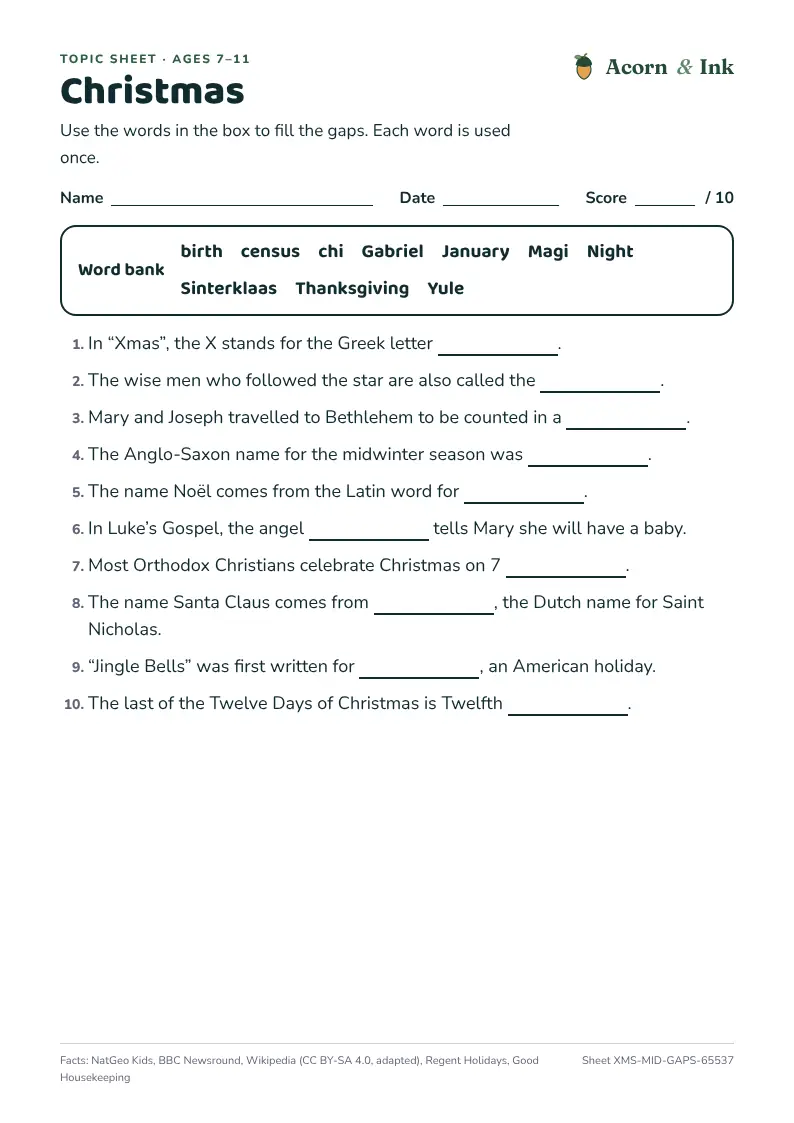
More Christmas activities
Christmas crossword
Make the sheet →Christmas flashcards
Make the cards →Christmas bingo
Make the cards →Write a Christmas story
Make the sheets →More topics
Octopus
Explore octopuses →
Marrakech
Explore Marrakech →
Fossils
Explore fossils →
France
Explore France →
Dinosaurs
Explore dinosaurs →
Halloween
Explore Halloween →
Renewable energy
Explore renewable energy →Questions parents ask
- Why is Christmas on 25 December?
- No one knows the exact date Jesus was born, and the Gospels don’t say. The Church in Rome chose 25 December in the 4th century, and the oldest record of that date is a Roman calendar from AD 336. Historians have two main ideas about why: one is that 25 December was the winter solstice in the Roman calendar, when a Roman sun festival was held; the other is that early Christians worked it out by counting nine months on from 25 March. The question hasn’t been settled.
- Why do some people celebrate Christmas on 7 January?
- Most Orthodox Christians, for example in Russia, follow an older calendar, the Julian calendar, which is 13 days behind the Gregorian calendar most of us use. So their 25 December falls on our 7 January. Christmas in Ethiopia is on 7 January too, and the Armenian church celebrates the birth of Jesus on 6 January.
- Where did Christmas trees come from?
- People used evergreens as symbols of life that lasts long before Christmas. In Germany in the 1500s, people decorated fir trees at Christmas with fruit and nuts, and later with sweets, paper shapes and candles. In Britain, the German-born Queen Charlotte first brought in the Christmas tree in the early 1800s, and trees became popular after Queen Victoria married the German Prince Albert.
- Who was Saint Nicholas?
- Saint Nicholas was a Christian bishop who lived in the 4th century at Myra. He was known for being kind and generous and for giving gifts, and he became the patron saint of children. His feast day is 6 December, when in Germany St Nikolaus brings small gifts such as sweets, nuts and fruit. In Dutch his name is Sinterklaas, and that is where the name Santa Claus comes from.
- What ages are these Christmas worksheets for?
- There are three levels: ages 5–7 (Years 1 and 2), ages 7–11 (Years 3 to 6) and ages 11–14 (Key Stage 3). The 5–7 sheets keep to the nativity story, Advent, trees, Christmas dinner and carols. Harder ideas, such as why 25 December was chosen, where Christmas customs came from, the Puritan ban and the 1914 truce, are only in the 11–14 sheets.
Sources
Written in our own words. Facts from:- National Geographic Kids UK, “10 facts about Christmas!”
- BBC Newsround, “Ten festive facts to impress your family this Christmas” (2022)
- Wikipedia, “Christmas”, CC BY-SA 4.0; text adapted
- Regent Holidays, “The strangest Christmas traditions from around the world” (used only for traditions around the world)
- Good Housekeeping, “Interesting Christmas facts” (used for a few facts only)
- UK Christmas World, “20 fun facts about Christmas” (used only where another source agrees, or as a claim)
- The curriculum note is a short paraphrase of the National Curriculum in England history and English programmes of study (Department for Education). Crown copyright, Open Government Licence v3.0
- Where the sources disagree, we word around it: on when Christmas was banned (NatGeo Kids says 1644, Wikipedia 1647, so we say “in the 1640s”), when Queen Charlotte brought in the tree (“around 1800” or “the early 1800s”), and when “Jingle Bells” was written (1850 or 1857, so we leave the date out). Riga’s claim to the first decorated tree, in 1510, is given as a claim. Heights in metres are our own conversions from feet.
- Drawings: our own.