Maths › Times tables › 7 times table
7 times table worksheets: with answers
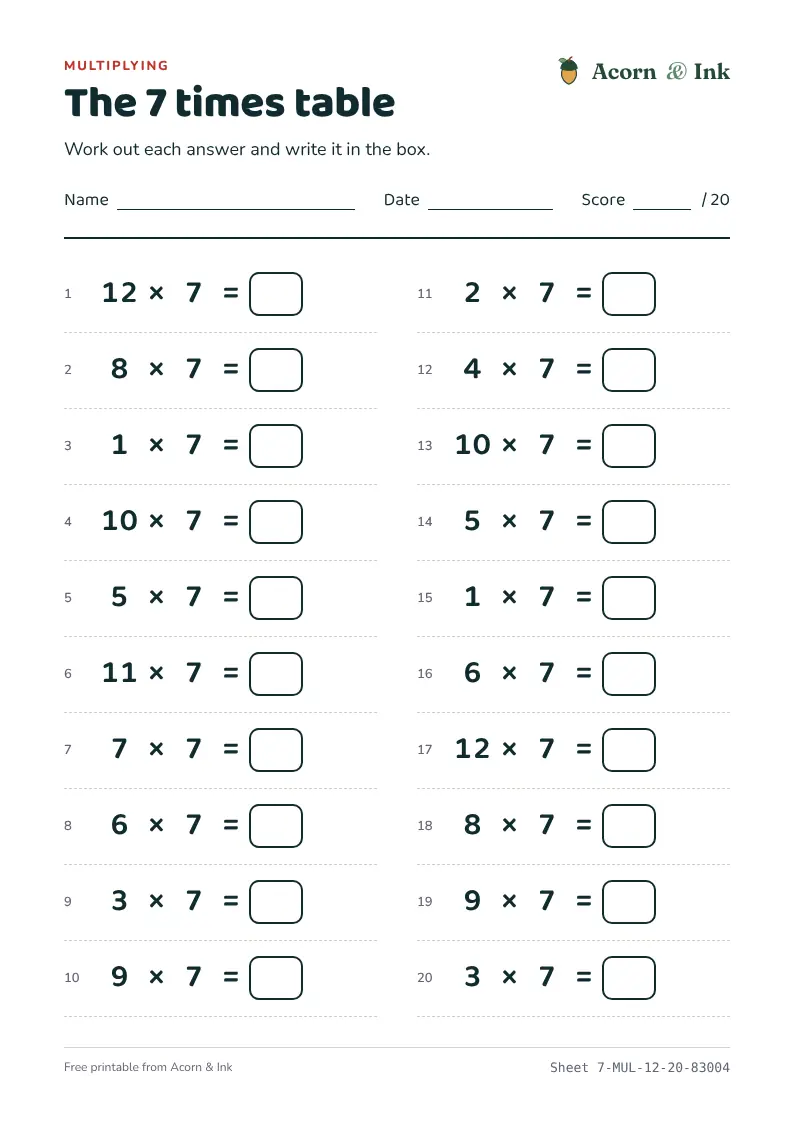
Free printable 7 times table worksheets, with a fresh set of questions every time and an answer sheet after each one. Practise 7 × 6 = ?, 42 ÷ 7 = ? or ? × 7 = 42, in order or shuffled, or try a 60-second challenge. For children aged 8 to 11 (Year 4 to Year 6), free to print or save as a PDF, with no sign-up.
The 7 times table
- 1 × 7 = 7
- 2 × 7 = 14
- 3 × 7 = 21
- 4 × 7 = 28
- 5 × 7 = 35
- 6 × 7 = 42
- 7 × 7 = 49
- 8 × 7 = 56
- 9 × 7 = 63
- 10 × 7 = 70
- 11 × 7 = 77
- 12 × 7 = 84
Patterns to look for
- Odd, even, odd, even. The answers take turns: 7, 14, 21, 28… Seven is odd, so adding it flips an odd answer to even and back again.
- Every last digit, once each. Look at the last digit of the first ten answers:
- 7
- 4
- 1
- 8
- 5
- 2
- 9
- 6
- 3
- 0
Each digit from 0 to 9 comes up exactly once.
Make a 7 times table sheet
The 7 times table is already picked. Choose the kind of question and how many, then roll for a fresh one. You can switch to any other table from here too.
Tips for learning the 7 times table
- Most of it is already known. 7 × 8 is the same as 8 × 7, so a child who knows the 2, 3, 4, 5, 8 and 10 times tables already knows those six facts in the 7s. That leaves 7 × 6, 7 × 7, 7 × 9, 7 × 11 and 7 × 12 to learn, and 7 × 1 is just 7.
- Seven is five and two. To work out 7 × 6, do 5 × 6 = 30 and 2 × 6 = 12, then add them: 42. This works for any fact in the table while it is still being learnt.
- Count in sevens. Say 7, 14, 21, 28… out loud, on a walk or on the stairs, before trying shuffled questions.
- Use the facts both ways. When 7 × 9 = 63 is known, ask what 63 ÷ 7 is. The division and missing number sheets practise exactly this.
- Little and often. A short sheet of 12 questions a few times a week does more than one long sheet now and then.
In the National Curriculum for England, children learn the 3, 4 and 8 times tables in Year 3, then in Year 4 they learn to recall the multiplication and division facts for all the times tables up to 12 × 12, which is where the 7s come in. Source: National Curriculum in England: mathematics programmes of study (Department for Education). Crown copyright, Open Government Licence v3.0. Home educators don’t have to follow the National Curriculum: it’s here as a guide.
Questions parents ask
- When do children learn the 7 times table?
- In the National Curriculum for England, the 7 times table is part of Year 4, when children learn all the times tables up to 12 × 12. Many children keep practising it in Years 5 and 6.
- Are the answers included?
- Yes. Each sheet can print with an answer sheet after it, with the answers in red. Untick Include an answer sheet if you only want the questions.
- Can I practise dividing by 7?
- Yes. Choose division questions such as 42 ÷ 7, missing number questions such as ? × 7 = 42, or a mix of all three.
- What is a quick way to work out the 7 times table?
- Split the 7 into 5 and 2. For 7 × 8, work out 5 × 8 = 40 and 2 × 8 = 16, then add them to get 56.
- Are the worksheets free?
- Yes. Every sheet is free to make, print or save as a PDF, and there is no sign-up.