What the National Curriculum says that fits an ocean topic, then an activity for each age, with what you’ll need, how long it takes, step-by-step instructions and useful links. The curriculum links are our summary of the Department for Education’s programmes of study. The ideas are our suggestions.
In the National Curriculum: the seven continents and five oceans, the seas around the UK and words like beach, cliff and coast (ages 5–7). Latitude, longitude, the Equator, the Tropics and the polar circles, UK coasts, the water cycle, trade, grid references and fieldwork (ages 7–11). [TODO] Ages 11–14 geography links: that programme hasn’t been supplied yet.
Ages 5–7About 45 minutes
Label the continents and oceans on a world map. Find the UK and its seas on a globe. Draw a seaside picture map with a key.
You’ll need
How to do it
- Spin the globe together. Is there more land or more sea?
- Find each ocean in the atlas, say its name, and stick a labelled sticky note on it.
- Find the UK, then the sea on each side of it.
- Draw a seaside picture map: beach, sea, cliffs and a harbour. Add a key with a little symbol for each.
Ages 7–9About 1 hour
Mark the Equator, the Tropics and the Poles, and colour the oceans. Find beaches, cliffs and harbours on an OS map with four-figure grid references.
You’ll need
- a children’s atlas
- an OS map of a stretch of coast (library), or the OS Maps app (free to view)
- coloured pencils and a ruler
How to do it
- In the atlas, find the Equator, the two Tropics and the Poles. Trace them onto a world map in different colours.
- Colour the oceans blue and label them.
- On the OS map, use the key to find the symbols for beaches, cliffs and harbours.
- Take turns giving each other four-figure grid references to find: along the corridor first, then up the stairs.
Ages 9–11About 1 hour
Plot an ocean voyage with latitude, longitude and eight compass points. Trace a sea trade route. Sketch a map of a stretch of coast if you visit one.
You’ll need
- an atlas with lines of latitude and longitude
- wool or string
- squared paper
How to do it
- Choose a home port and a faraway port in the atlas.
- Plan three stops. Write down the latitude and longitude of each, with north or south and east or west.
- Describe each part of the voyage with eight compass points, such as “sail south-west”.
- Lay wool along the route. Does it cross the Equator?
- Bonus: find something in your kitchen that came by sea, and trace its journey.
Ages 11–141–2 hours, plus a trip
Compare two coastlines using maps and photos. Plan a fieldwork question, such as “What litter is on our beach, and where does it come from?”
You’ll need
How to do it
- Choose two contrasting UK coasts, such as one with high cliffs and one with long sandy beaches.
- List what is the same and what is different: landforms, towns, harbours, how the land is used.
- Write one question you could test on a real visit.
- Plan how you will collect data (tallies, photos, a sketch map), then try it on your next trip.
In the National Curriculum: animal groups and what they eat (Year 1). Habitats, with the seashore and ocean as examples, and food chains (Year 2). Classification keys, harm to habitats, evaporation and the water cycle (Year 4). Dissolving, evaporating, water resistance and life cycles (Year 5). Adaptation (Year 6). Food webs and toxins, floating and upthrust, waves, and climate (ages 11–14).
Ages 5–7About 45 minutes
Sort sea-animal pictures by animal group, then by what they eat. Build a three-link sea food chain. Make a rock-pool picture.
You’ll need
- 10–12 pictures of sea animals (from magazines, books, or drawn)
- paper, glue stick and scissors
- three paper plates for the food chain
How to do it
- Lay out the pictures. Sort them into groups: fish, mammals, birds and others. Ask “how did you decide?”
- Sort them again by what they eat: plants, animals, or both.
- Make a food chain on three plates: the food at the bottom, what eats it, then what eats that. Draw arrows meaning “is eaten by”.
- Draw or collage a rock pool full of creatures.
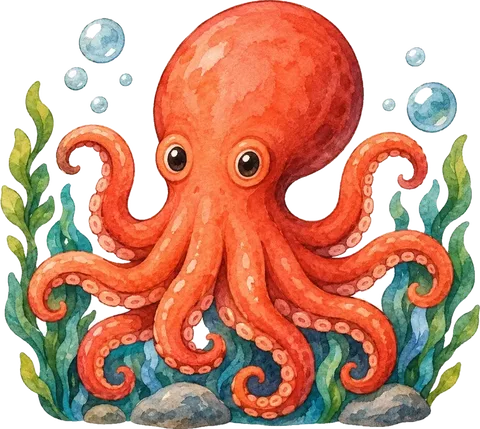
Links: our octopus fact sheet
Ages 7–9About 1 hour, then a few days of watching
Make a classification key for sea creatures, including invertebrates like the octopus. Watch a saucer of salty water evaporate. Do a beach-litter survey.
You’ll need
- a saucer, salt, warm water and a teaspoon
- gardening gloves and a bag (for the survey)
- squared paper
How to do it
- Choose eight sea creatures. Split them with yes-or-no questions, such as “Does it have a backbone?”, until each one is on its own. That’s your key.
- Stir two teaspoons of salt into a cup of warm water. Pour a little onto a saucer and leave it on a sunny windowsill.
- Look each day. Where is the water going? What is left behind?
- At the beach, tally the litter you find in ten minutes. Wear gloves, and leave anything sharp for a grown-up.
Links: Great British Beach Clean · tide times · our tides and currents page
Ages 9–11About 1 hour
Dissolve salt in water, then get it back by evaporating (a grown-up does the heating). Test boat shapes for water resistance. How are sea animals adapted?
You’ll need
- salt, a jug of warm water and a teaspoon
- a small pan and a hob (grown-up only), or a dish for a sunny windowsill
- modelling clay
- string and a phone stopwatch
- a full bath
How to do it
- Stir salt into warm water until no more will dissolve. Where has the salt gone?
- A grown-up gently heats a little of it in a pan until the water has gone (or leave a dish in the sun for a few days). What is left?
- Shape the same lump of clay into three different boats. Pull each one along the bath on a string and time it. Which shape is fastest, and why?
- Pick a sea animal. List three of its features and how each helps it live where it does.
Ages 11–141–2 hours
Fair test: does salt water change what floats? Draw an ocean food web and show how a toxin builds up along it. Make waves in a tray and watch them reflect.
You’ll need
How to do it
- Put each object in fresh water, then in very salty water. Keep the amount and temperature of the water the same. What changes? Explain it using upthrust.
- Draw a food web for one ocean with at least eight living things.
- A toxin enters at the bottom of the web. Use numbers to show how much builds up in each animal further up.
- Make waves in a tray of water. Hold a ruler across it as a sea wall, and watch what the waves do.
In the National Curriculum: the lives of significant people, with explorers given as examples (ages 5–7). Viking raids, and a local history study (ages 7–11). Britain’s first colonies, and the transatlantic slave trade and its abolition (ages 11–14).
Ages 5–7About 45 minutes
Compare two explorers from different times. The curriculum suggests Christopher Columbus and Neil Armstrong.
You’ll need
How to do it
- Read about each explorer together.
- Fold a sheet of paper in half. Draw one explorer on each side, with the ship or spacecraft they travelled in.
- Talk: what was the same? What was different? How long ago did each one live?
- Make a simple timeline: Columbus, Armstrong, and you today.
Ages 7–9About 1 hour
Viking longships: how did the sea make the Viking raids possible?
You’ll need
- a library book about the Vikings
- card, lolly sticks, scissors and glue
- a washing-up bowl of water
How to do it
- Look at pictures of a longship. What shape is it? How was it moved along?
- Talk: how would a ship like this help raiders arrive quickly, and get away again?
- Make a model longship from card and lolly sticks, and test that it floats.
- Write three sentences to answer the big question.
Ages 9–111–2 hours, plus a visit
Local sea history: a port, lifeboat station or shipwreck near you. Or trace how ships changed, from sail to steam to today.
You’ll need
How to do it
- Choose your nearest port, lifeboat station or a local shipwreck.
- Find three sources about it: a photo, a map and a story or record.
- Make a timeline of how it changed.
- Visit if you can, then write it up with the trip log.
Links: RNLI (each lifeboat station has its own page) · National Maritime Museum (free entry)
Ages 11–14Several sessions
Sea trade and empire, including Britain’s transatlantic slave trade and its abolition. For this age only: take it carefully and talk it through.
You’ll need
- library books on sea trade and the slave trade
- a museum visit, such as the National Maritime Museum (free entry)
- a notebook
How to do it
- Map a trade route: what was carried, where to, and why?
- Study the transatlantic slave trade using a trusted source, such as a museum. Stop and talk it through together.
- Look at abolition: who campaigned against the slave trade, and how?
- Write an answer to “How did the sea shape Britain’s history?”, using evidence.
In the National Curriculum: poems learnt by heart, non-fiction, and writing about real events (ages 5–7). Myths and legends, finding facts in non-fiction, persuasive writing and debate (ages 7–11). Poetry from different times, arguments and speeches (ages 11–14).
Ages 5–715–20 minutes a day
Learn a verse of “The Owl and the Pussy-cat” by heart. Write labels for your rock pool. Write a “day at the seaside” recount.
You’ll need
How to do it
- Read the poem together every day, and act it out with toys.
- Learn one verse by heart, a line or two a day.
- Write labels for your rock-pool picture.
- Write a seaside recount using “first, next, then, finally”.
Ages 7–9Two sessions of about 45 minutes
Read and retell a sea myth. Make a fact file on one sea creature, with headings and sub-headings.
You’ll need
How to do it
- Read a sea myth or legend together.
- Retell it in order with five quick drawings, then out loud.
- Choose one sea creature and find facts in a book, or use our octopus fact sheet.
- Make a fact file with a title, headings and sub-headings.
Links: story dice
Ages 9–11About 20 minutes a day, plus a writing session
Learn “Sea-Fever” by heart. Write a persuasive letter about beach litter. Hold a family debate about it.
You’ll need
- “Sea-Fever” by John Masefield (in an anthology from your library)
- lined paper
- an envelope and stamp, if you want to send the letter
How to do it
- Read “Sea-Fever” aloud. What does the sailor long for?
- Learn it a few lines a day, then perform it.
- Write a persuasive letter about beach litter to your local council: the problem, your evidence, and what you want done.
- Hold a family debate: one side for, one side against, then swap.
Links: Great British Beach Clean
Ages 11–14Two or three sessions
Compare “Sea-Fever” with Grace Nichols’s “To My Coral Bones”. Write a speech about protecting the oceans, then give it.
You’ll need
- “Sea-Fever” (in an anthology)
- a notebook, and a phone to film the speech
How to do it
- Read both poems, and listen to Grace Nichols reading hers.
- Compare them: the speaker, their feelings about the sea, the language and the form.
- Write a two-to-three-minute speech about protecting the oceans, using persuasive techniques.
- Give the speech to the family, and film it to keep.
Links: “To My Coral Bones” on the Children’s Poetry Archive
In the National Curriculum: measuring length and capacity, tally charts and pictograms (ages 5–7). Counting back through zero to negative numbers, and coordinates (Year 4). Negative numbers in context and line graphs (Year 5). Coordinates in four quadrants, miles and kilometres, and the mean (Year 6). Scale, speed and standard form (ages 11–14).
Ages 5–7About 45 minutes
Tally beach finds (or picture cards) and turn them into a pictogram. Fill and compare containers of water.
You’ll need
- 10 or more beach finds or picture cards
- four different-shaped containers, a jug and a cup
- squared paper
How to do it
- Sort the finds into types: shells, stones, seaweed and so on.
- Make a tally: one line for each find, with every fifth line going across.
- Turn the tally into a pictogram, with one picture for each find. Which type do you have most of? How many more?
- Guess which container holds the most water, then fill each one with cupfuls to check.
Ages 7–9About 45 minutes
Draw a treasure map on a coordinate grid. Count down a depth line through zero.
You’ll need
How to do it
- Draw two axes on squared paper and number them 0 to 10.
- Draw an island with treasure, rocks and a shipwreck where the lines cross.
- Write the coordinates of each one: across first, then up. Swap maps and find each other’s treasure.
- Stick notes down a door as a depth line: 0 at sea level, then −1, −2, −3 going down. Make up a diver’s dive and count it.
Ages 9–11About 1 hour
Show depths below sea level as negative numbers. Convert sea distances between miles and kilometres. Work out a mean.
You’ll need
- squared paper
- a thermometer, or a weather app
- a calculator for checking
How to do it
- Write a submarine’s dive log with depths as negative numbers. How far did it go down or come up each time?
- Convert some sea journeys between miles and kilometres, using 5 miles ≈ 8 kilometres.
- Record the temperature outside at the same time each day for a week, and work out the mean.
- Plot the temperatures as a line graph.
Ages 11–14About 1 hour
Use a map scale on a ferry route. Work out speed, distance and time for a voyage. Write ocean sizes in standard form.
You’ll need
- a ferry route and timetable (from the ferry company’s website)
- an atlas with a scale bar and ocean areas
- a calculator
How to do it
- Pick a ferry route. Measure it on the map and use the scale to find the distance.
- Use the timetable to find the crossing time, then work out the average speed.
- Look up the area of each ocean in the atlas, write them in standard form, and put them in order.
Links: ferry activity pack
In the National Curriculum: colour, pattern and texture, and learning about artists (ages 5–7). Sketchbooks, painting and clay, and great artists (ages 7–11). Different media and art history (ages 11–14).
Ages 5–7About 1 hour, plus drying
Make a wave collage from torn paper in every blue you can find. Model a shell from salt dough.
You’ll need
- old magazines and paper in blues, greens and white
- card and a glue stick
- salt dough: 1 cup plain flour, ½ cup salt, about ½ cup water
- paint and a brush
How to do it
- Tear blue, green and white paper into strips.
- Glue the strips onto card in layers to build waves, with white on top for the foam.
- Mix the salt dough. Shape a shell, or press a real shell into a flat piece.
- Leave it to dry for a few days (or a grown-up bakes it on a low heat), then paint it.
Ages 7–9About 1 hour
Fill a sketchbook page with shells. Paint your own great wave, after Hokusai.
You’ll need
- shells, or photos of shells
- a pencil and a sketchbook or paper
- paints and brushes
How to do it
- Draw a shell slowly: the outline first, then the pattern, then the shading.
- Look closely at The Great Wave. What shapes can you see in the foam?
- Paint your own great wave, with something from your own life in the background.
Links: The Great Wave at the British Museum
Ages 9–111–2 hours
Design an underwater sculpture inspired by Jason deCaires Taylor, then model it in clay.
You’ll need
- air-drying clay and a lolly stick for shaping
- a sketchbook
How to do it
- Look at photos of his underwater sculptures. Why put art under the sea?
- Sketch three ideas of your own. Where could sea creatures live on it?
- Choose one idea and model it in air-drying clay.
Links: Jason deCaires Taylor’s website
Ages 11–14Two sessions
Compare Hokusai, deCaires Taylor and Maggi Hambling’s Scallop. What is each artist saying about the sea?
You’ll need
- a sketchbook
- materials of your choice for a response piece
How to do it
- Look closely at each work.
- For each one, note what it is, how it was made, why, and what it says about the sea.
- Make your own response piece in any medium.
Links: The Great Wave at the British Museum · Jason deCaires Taylor’s website · Scallop on Art UK
In the National Curriculum: designing to criteria and building stable structures (ages 5–7). Testing and evaluating, circuits with motors, and cooking, including where ingredients are caught (ages 7–11). Designs inspired by nature, known as biomimicry, and specifications (ages 11–14).
Ages 5–7About 45 minutes
Design a boat that floats and carries 10 coins. Test it, improve it, and test it again.
You’ll need
- recycling: foil, yoghurt pots, small boxes and bottles
- sticky tape and 10 coins
- a bath or washing-up bowl
How to do it
- Talk about what the boat must do: float, stay upright and carry 10 coins.
- Build it.
- Test it, adding the coins one at a time.
- Make it better and test it again. Draw your best boat.
Ages 7–9About 1 hour
Waterproof boat challenge: which materials work best, and why?
You’ll need
- samples of paper, foil, cling film, fabric, a plastic bag and card
- a cup of water, a teaspoon and a timer
How to do it
- Predict which materials will be waterproof.
- Over a cup, drip five drops of water onto each one and watch for a minute.
- Record what happened in a table.
- Build a boat from the winning material and test it.
Ages 9–11Two sessions of about 1 hour
Add a motor and a switch to your boat. Cook a simple fish dish and find out where the fish was caught.
You’ll need
- a small motor, propeller, switch, wires and an AA battery pack (a beginner electronics kit)
- a plastic bottle and waterproof tape
- fish fillets, a lemon, oil and foil
- an oven (grown-up)
How to do it
- Build a circuit with the battery pack, switch and motor, and test it on the table.
- Fix it into a bottle boat with the propeller at the back. Keep the batteries dry.
- Test it in the bath and improve it.
- Wrap fish with lemon and a little oil in foil, and bake until it’s cooked all the way through and flakes easily (a grown-up checks). Read the label, or ask at the fish counter, to find out where it was caught.
Ages 11–14Several sessions
Biomimicry challenge: design something inspired by a sea animal. Write a specification, make it and test it.
You’ll need
- a notebook
- recycling and craft materials
How to do it
- Pick a sea animal and one feature of it, such as the suckers on an octopus’s arms.
- Research the feature, then write a specification for a product inspired by it.
- Make a prototype.
- Test it against your specification, then evaluate and improve it.
Links: our octopus fact sheet
In the National Curriculum: simple instructions, and finding and fixing mistakes (ages 5–7). Programs with loops and choices, and judging what you read online (ages 7–11). Modelling real-world systems (ages 11–14).
Ages 5–7About 30 minutes
Program a floor robot, or a grown-up, to reach the treasure on an ocean grid.
You’ll need
- masking tape or chalk for a floor grid
- a toy “treasure”
- paper for arrow cards
- a programmable floor robot, if you have one
How to do it
- Make a 5 by 5 grid on the floor with tape. Add an island, rocks and the treasure.
- Make arrow cards: forward, back, turn left, turn right.
- Lay out the cards as a program, then run it with the robot (or a grown-up as the robot).
- If it goes wrong, find the mistake and fix it: that’s debugging.
Ages 7–9About 45 minutes
Code an animation of a fish swimming round a reef.
You’ll need
How to do it
- Open Scratch. Choose an underwater backdrop and a fish, or draw your own.
- Use a “forever” loop with “move” and “if on edge, bounce”.
- Add a second creature, and sounds.
Links: Scratch (free)
Ages 9–11About 1 hour
Code a game where a turtle dodges litter. Compare two ocean websites: which can you trust, and why?
You’ll need
How to do it
- In Scratch, make a turtle move with the arrow keys.
- Make litter fall from the top. If it touches the turtle, lose a life: that’s selection.
- Keep score with a variable.
- Check two ocean websites: who made each one? When was it updated? Can you find the same fact somewhere else?
Links: Scratch (free)
Ages 11–14About 1 hour
Build a spreadsheet model of beach litter over time, with a chart.
You’ll need
- a spreadsheet app
- your litter survey results, or made-up data
How to do it
- Enter litter counts by type and date.
- Use formulas for totals, percentages and averages.
- Make a chart.
- Model it: if litter fell by 10% a year, how many years until it halved?
In the National Curriculum: singing, untuned instruments and listening (ages 5–7). Performing, composing, great composers and notation (ages 7–11). [TODO] Ages 11–14 music links: that programme hasn’t been supplied yet.
Ages 5–7About 30 minutes
Listen to “Aquarium” by Saint-Saëns. Make wave and storm sounds with home-made instruments: loud, quiet, fast and slow.
You’ll need
- a recording of “Aquarium” (search the title on any music app)
- a tub of dried rice, paper to scrunch, a pan and a wooden spoon
How to do it
- Listen to “Aquarium” with your eyes closed. What can you imagine? Draw it.
- Make instruments: rice in a tub for waves, scrunched paper for rain, a pan for thunder.
- Play a storm: start quiet, get louder and faster, then calm down again. A grown-up conducts with their hands.
Ages 7–9About 30 minutes
Sing “Wellerman” together: one group sings the verses and everyone joins in the chorus.
You’ll need
- a recording of “Wellerman” and the words (search the title)
- a pan or box to drum on
How to do it
- Listen, then learn the chorus.
- Clap or stamp the beat while you sing.
- Split into groups: one sings the verses, then everyone joins in the chorus.
- Add a steady drum beat.
Ages 9–11About 1 hour
Compose an “ocean journey” piece and write it down with your own symbols.
You’ll need
- instruments, home-made instruments or a music app
- paper and coloured pens
How to do it
- Plan three sections: calm harbour, storm, arrival.
- Choose sounds for each, and change the pitch, tempo and dynamics.
- Invent symbols and draw a graphic score.
- Perform it and record it.
Ages 11–14About 45 minutes
Compare “Aquarium” with “How Far I’ll Go”. How does each piece make you think of water?
You’ll need
- recordings of both pieces
- a notebook
How to do it
- Listen to each piece twice.
- Note the instruments, tempo, dynamics and texture, and how each one suggests water.
- Write a short comparison: which works better for you, and why?
In the National Curriculum: schools must teach swimming before age 11. Children learn to swim at least 25 metres, use a range of strokes, and rescue themselves safely in water. Also dance, and outdoor adventure.
Ages 5–7Weekly
Swimming lessons and water confidence. Make up a sea-creature dance.
You’ll need
- swimming lessons or a family swim (book ahead)
- music to dance to, and scarves or ribbons
How to do it
- Book lessons or a family swim at your local pool.
- Practise floating and kicking with a float.
- Dance: move like a jellyfish, a crab and an octopus, slowly then quickly.
Links: find swimming lessons
Ages 7–9Weekly
Work towards swimming 25 metres. Make up a wave dance together.
You’ll need
- family swims or lessons
- music to dance to
How to do it
- Count widths at each swim, working up to 25 metres.
- Read the RNLI’s water safety advice together.
- Make a group dance where a wave passes along a line of dancers.
Links: find swimming lessons · RNLI safety advice
Ages 9–11Weekly
Practise different swimming strokes, and learn how to keep yourself safe in water.
You’ll need
- swimming lessons with a qualified teacher
How to do it
- Practise front crawl, backstroke and breaststroke.
- Learn the RNLI’s “Float to Live” advice, and practise floating with an instructor in safe, supervised water.
- Record distances and strokes in the tracker.
Links: find swimming lessons · RNLI safety advice
Ages 11–14A day or half-day
Try sailing, paddleboarding or coasteering, with qualified instructors only.
You’ll need
- a session with a watersports centre or club with qualified instructors (book ahead)
How to do it
- Find a provider with qualified instructors.
- Check what to wear and bring.
- Go over the RNLI’s safety advice before you go.
Links: RNLI safety advice
In the National Curriculum: from age 7, listening, songs, new words and describing things in another language. Before 7 it’s just for fun.
Ages 5–710 minutes a day
Learn the names of five sea creatures in French, or another language you choose.
You’ll need
How to do it
- Choose five sea creatures.
- Make picture flashcards with the word on the back.
- Play snap or pairs with them.
Links: flashcards
Ages 7–9About 20 minutes
Learn sea-creature names and colours, then play a matching game.
You’ll need
- a bilingual dictionary or app
- flashcards
- coloured pens
How to do it
- Learn the colours, then the creatures.
- Make matching pairs: a picture card and a word card.
- Play a memory game with them.
Links: flashcards · France page
Ages 9–11About 30 minutes
Write simple descriptions, such as “The fish is blue”, under your own drawings.
You’ll need
How to do it
- Draw four sea creatures.
- Write a sentence under each, such as “The fish is blue”.
- Check whether the colour word changes to match the creature.
Links: France page
Ages 11–14About 45 minutes
Describe a day at the beach in your chosen language: what you saw, did and ate.
You’ll need
- a bilingual dictionary
- a phone to record yourself
How to do it
- Write eight to ten sentences in the past tense.
- Read them aloud and record yourself.
- Listen back and correct anything that doesn’t sound right.
 Days out
 Answer the big question